

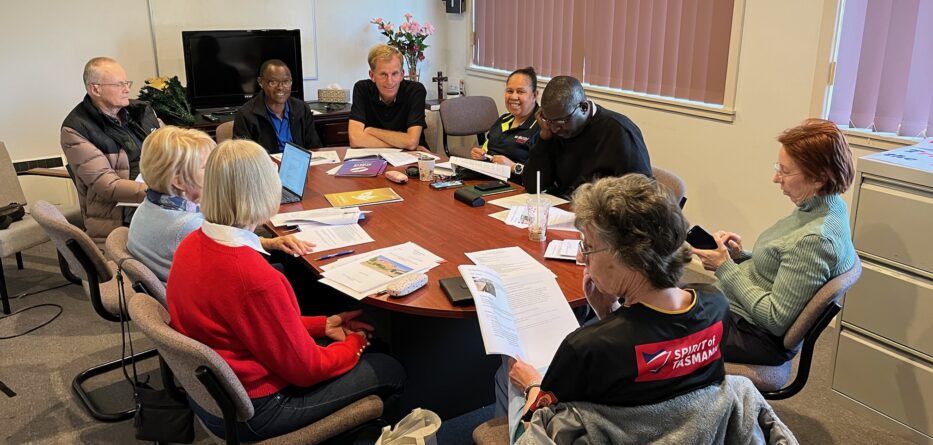
‘Called to Walk Together: Letters to a Parish on Vision, Discernment, and Renewal’ documents how the six pastoral goals for the Archdiocese of Washington were received, discussed, and prayed over at St. Mary’s Catholic Church of Piscataway. Structured as letters written to parishioners during a discernment series, author Lubomir Martin Ondrasek, the parish’s Pastoral Associate for Formation and Mission, offers a rare thing: a genuine, close, and honest record of what synodal listening actually looks like inside an ordinary parish.
What distinguishes this book from a typical planning document is its theological seriousness. Ondrasek grounds practical questions in an Augustinian conviction: renewal begins with hearts turned toward God, not with better structures alone. Vision, discernment, and renewal are treated throughout as inseparable, each correcting and deepening the others – avoiding the pitfalls of vision without discernment becoming wishful thinking or discernment without renewal becoming mere analysis.
Perhaps the book’s strongest contribution is methodological transparency: it shows, in granular detail, how a diocesan-level synodal or mission plan can be translated into parish practice. This is a useful counterpoint to synodal literature that remains only at the level of principle.
The letter form itself seems theologically deliberate rather than merely stylistic. For Ondrasek, parish renewal is relational before it is programmatic, and the letters embody that conviction. The result is a reflection on a parish genuinely engaging a diocesan pastoral vision, genuinely trying to grow in unity and synodality by listening to one another.
One thing that will resonate with anyone doing this kind of facilitation work is Ondrasek’s insistence on staying in his lane: his role is to listen, synthesise, and articulate what emerges, while pastoral decision-making authority remains with the parish priest. That boundary, named explicitly and held consistently, is one many synodal processes struggle to keep clear.
Its limitation is simply scope: the letters are addressed to a specific community and do not shy away from naming local particularities. Readers hoping for an easily portable framework for vision, mission, and strategic planning will find the raw material for one, but not a finished model. The book is honest about its own limits, presenting itself as “the beginning of a process rather than its completion,” with the work of vision, mission, and strategic planning left for a later stage. That candour is instructive for the synodal process, resisting the temptation to over-claim what a listening phase alone can deliver.
The underlying practice of synthesising in real time, writing pastorally rather than administratively, and naming the boundary between facilitation and decision-making, offers a genuinely useful model for anyone accompanying a community through its own season of discernment.
For parishes engaged in listening or assembly processes, the book’s value lies less in its conclusions, than in its demonstration of how theological reflection, pastoral analysis, and the lived experience of a parish community can be held together without one collapsing into the other.
You can purchase Called to Walk Together: Letters to a Parish on Vision, Discernment, and Renewal by Lubomir Martin Ondrasek on Amazon Australia.
Alison Ryan is a member of the Mission Enhancement Team in the Diocese of Parramatta.