

Lecture by Cardinal Blase J. Cupich, Archbishop of Chicago, on Cardinal Bernardin’s Legacy for the Church and the World
October 16, 2026
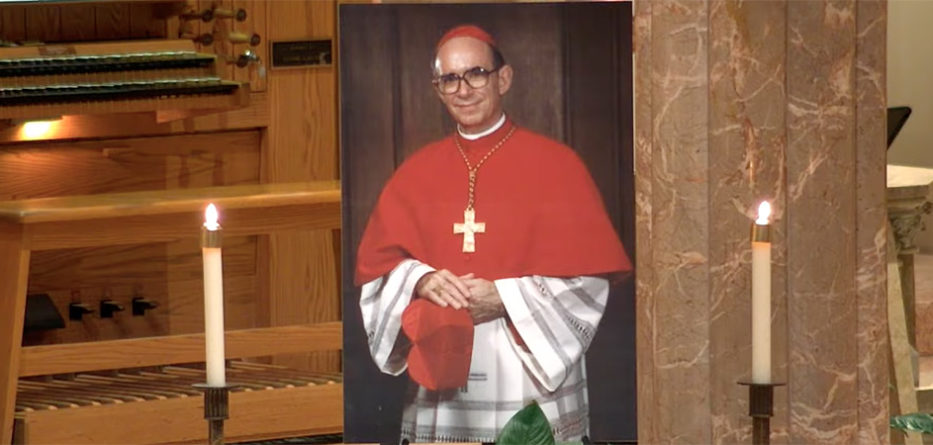
As I come from the city Cardinal Bernardin called home, I feel privileged to be here in Fiera di Primiero, where he also felt at home because of your welcome and esteem. This evening, I briefly want to share with you how Joseph Bernardin took the best of what he learned from the rich culture of Trentino and matured into a world-renowned figure, whose impact on the Church and the world continues to this day. His landmark speech at Fordham University in 1983, where he introduced his famous consistent ethic of life approach to considering critical issues of the day, and his leadership in developing the pastoral letter on peace of the American bishops, offer a window for appreciating his impact. Three convictions which were quite revolutionary guided him.
First, he was convinced of the need to heed the Second Vatican Council’s call to read the signs of the times. The cardinal understood that the Church could only be viewed as credible if it were fully engaged in the world and attentive to what was happening in the lives of real people, the forces influencing policies and public opinion. In many ways he anticipated that famous phrase of the late Pope Francis, “realities are greater that ideas.”
His reading of the signs of our times brought him to the conclusion that it was futile to treat issues like abortion, capital punishment, nuclear proliferation, the use of military force and others as discrete topics. He recognized that this was due in large part to the fact that these issues were divisive in themselves. Yet he was convinced that a comprehensive commitment to respecting life as a principle, connecting these issues, would benefit them all. As he put it: “The purpose of proposing a consistent ethic of life, is to argue that success on any one of the issues threatening life requires a concern for the broader attitude in society about respect for human life. … The viability of [this] principle depends upon the consistency of its application.”
Second, the cardinal was convinced that the integrity of Catholic social teaching meant that the Church had the unique capacity to take the lead in defining such questions in the public square. As a case in point, he asked how it was that the Catholic bishops found themselves in the unique position of witnessing ardently against both abortion and the nuclear war policies of the United States. It was the integrity of her teaching, that is, its consistency, which set the Church apart. As a result, Catholic social teaching could not be fitted into the partisan political framework that governs American public life. Yet this is why the consistent ethic of life has attracted hostility. It asserts that Catholic teaching cannot be contoured to our political divisions, nor should it be undermined by downplaying key social teachings, even to advance important political goals. Pope Leo recently observed along these same lines, that one cannot consider themselves pro-life because they oppose abortion and yet are for the death penalty or not opposed to the inhumane treatment of immigrants.
Finally, the cardinal was convinced that the Church is uniquely positioned to be a force for promoting the common good by reshaping public policy. Our worship, pastoral life, ministries of health care and education all demonstrate the integrity of Catholic social teaching. In fact, Cardinal Bernardin readily admitted that he chose a Catholic university to introduce his consistent ethic of life approach, appreciative of the fact that a Catholic university has a particular role in shaping public discourse.
The cardinal’s moral framework of a consistent ethic of life is needed in our day, given the deep divisions in society that leave people so polarized. His good counsel prompts us to reflect on the risks of living in silos of our own choosing, fearful to engage one another on a variety of issues. Many of these are indeed matters of life or death, such as the health care crisis we faced during the pandemic, the scourge of racial injustice which demeans the dignity of immigrants or the threat climate change poses to all life on earth, which is becoming more obvious every year.
The theological and moral legacy of Cardinal Joseph Bernardin remains one of the most influential frameworks in modern American Catholic social thought. As Archbishop of Chicago, Bernardin articulated a vision that linked diverse moral imperatives—from nuclear disarmament to the protection of the unborn—into a cohesive whole. His legacy is fundamentally anchored in these two defining moments: his leadership in developing the pastoral letter on peace, The Challenge of Peace: God’s Promise and Our Response (1983), and his Fordham lecture that introduced the “Consistent Ethic of Life.” While he had his critics, even among the bishops, this framework directly anticipated and mirrored the holistic moral vision later promulgated by Pope John Paul II in Evangelium Vitae. It is not too much to say that in Evangelium Vitae Pope John Paul II validated Bernardin’s broader synthesis by explicitly placing the direct attacks on innocent human life, such as abortion and euthanasia, alongside broader structural threats to human life, including war, poverty, and ecological degradation, reinforcing that a culture of life must address every threat to human dignity. And in our day, Bernardin’s words are given new life and force in the teachings of Pope Francis and now Pope Leo, both of whom call for a culture of encounter, of listening to one another, and discerning a pathway forward together.
We are the privileged beneficiaries of the kind and wise spirit that animated Cardinal Bernardin. As a successor of the good cardinal, I am delighted to be with you and celebrate his memory and the historic legacy he has left us. His words and example continue to inspire us to work for peace, for the education and formation of young people, for fostering ecumenical and interfaith understanding and collaboration, and — of course — for a respect for life in all its precious forms.
I pray that the enduring prophetic voice and legacy of our beloved Cardinal Bernardin will continue to inspire us to ever deeper solidarity with one another, as members of the same family of God. For we need it now more than ever.
Reproduced with permission by the Archdiocese of Chicago.