

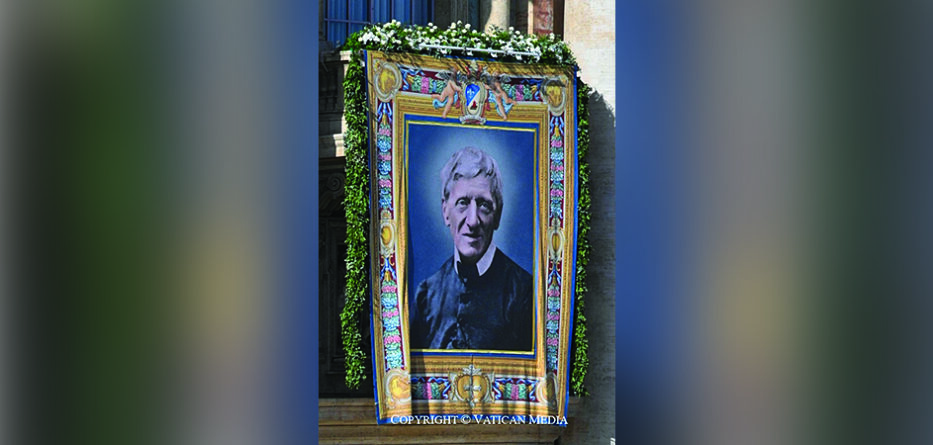
Newman is a name to reckon with. There is, of course, the wacky and weird mail carrier in the Seinfeld series; as well, we have an accomplished American actor and purveyor of salad dressings; and then there is our Newman: the onetime misunderstood and persecuted ecclesiastical misfit whom we have both raised to the altars (sainted) and added to the select galaxy we call the Doctors of the Church.
October is the month that hosts St. John Henry Newman’s feast day, so what better time to reflect on his enduring relevance than now.
Pope Leo XIV said that the author of the universally admired hymn Lead, Kindly Light provides the church and the world with a hope that refuses to be imprisoned by “the shadows of pessimism and fear.” The pope further highlighted the importance of Newman when he observed that we must not “forget that at the heart of the educational journey we do not find abstract individuals but real people … and we are called to form people, so that they may shine like stars in their full dignity.”
Our century is no slouch in providing contemporary evidence of the high costs of depersonalizing education, ripping pastoral formation and moral probity out of the curriculum, and turning education into an exercise in utility and raw pragmatism.
The twists and contortions of fact that define the daily diet of the mighty Orwellian hegemons that compete for economic and political domination remind us of what happens when language has been suborned and truth sundered.
As Alex Ross, music critic of The New Yorker, reminds us: “You wake up and brace yourself for the barrage of toxic gibberish that constitutes the modern public sphere. Your email is overrun with spam, scams, and smut … a buzz of random, fake, stupid, sinister chatter that nobody wants and nobody can stop.”
This is our reality and not Newman’s, but he provides us with a healthy diet alternative that nurtures the whole person, not atomized nor bifurcated.
He reminds us that a university is a laboratory of ideas and not a mausoleum of settled thinking, a cauldron wherein the fierce contestation of opinion generates fresh ways of seeing. Out of this cauldron of debate and competing ambitions is forged the kind of mind necessary for survival in our increasingly constrictive environment. And that kind of mind, a mind dear to Newman, is what the liberal arts or the humanities and sciences are schooled to polish and refine: a mind that knows how to read not glance, to probe and not accept, to submit to scrutiny all claims to fact and truth rather than defer out of convenience or intellectual indolence.
There is a cost to thinking clearly, but there is a greater cost in supine conformity to prevailing orthodoxies.
A university inspired by the thought and witness of John Henry Newman would be an environment where a gentle and not acrimonious pugilism is nurtured, where people are taught to engage in credible dialogue respectfully and not score nasty and brutalizing points for purposes of entertainment or propaganda. Think of those marvellous public debates in the 1920s and 30s conducted between Gilbert Keith Chesterton and George Bernard Shaw that amused and edified thousands with their vigorous disagreements on literary, cultural, political, and religious matters, disagreements seasoned in delivery, rich in irony and satire, and always leavened with affection.
Personal hostility and cancelling the other had no place in their thinking. In our media culture—soured by cynicism and prey to the political toxins flowing from seats of power—we would be well served by looking at the GKC-GBS model. Such a model embodies Newman’s conviction that truth is advanced when we have intellect in collision with intellect.
Newman was very much the Victorian genius: frightfully prolific, polymathic, undeterred by controversy, capacious in imagination and spirit. He was a figure of his time.
He was also bold in his thinking. And there were many, especially in the English establishment and in clerical Rome, who looked on him with wariness and fear. But he remained undaunted by their opposition and distrust, and we are the beneficiaries of his insights and integrity.
In our time—with questions around human definition swirling, democracies in demolition mode, and authoritarian governance on the ascendant—we yearn for clarity, a light on the horizon.
Newman is such a beacon.
Dr. Michael W. Higgins has been involved with investigating and expanding the Catholic Intellectual Tradition, particularly in Canada, for over forty years. Dr. Higgins is the Basilian Distinguished Fellow of Contemporary Catholic Thought at the University of St. Michael’s College in Toronto.
Reproduced with permission by Pontifex Minimus.