

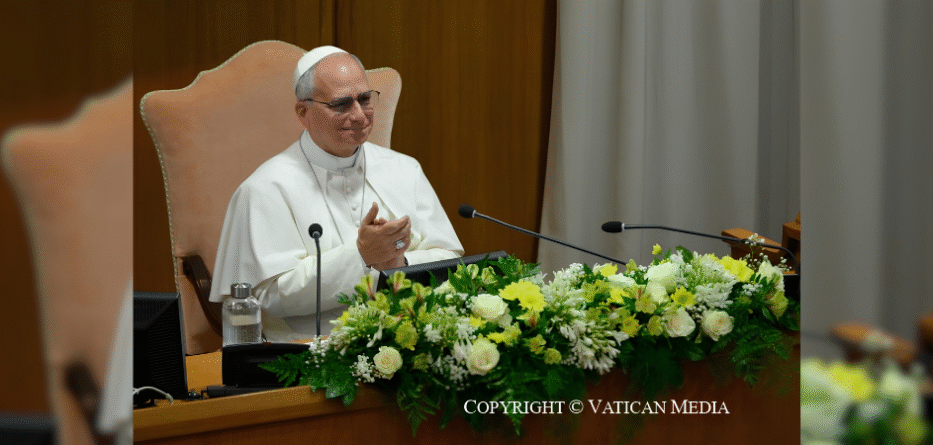
On Monday 25 May, at 8pm, I got a message from a friend. It just said “Live Now” with a link – a livestream of the Vatican launch of the encyclical, Magnifica Humanitas, from the Synod Hall in Rome. Yes. My friend and I are absolutely the coolest people we know.
Honestly, I was genuinely excited. A Pope’s first pastoral letter reveals something of who he is and wants to be as a leader: his theological and social priorities, his wisdom and the way he is calling the Church to live the Gospel. Immediately I was struck by how theologically robust it is, and how well the document has been put together. It’s a carefully ordered, well considered piece of writing that draws on the fullness of Catholic thought and applies it with real precision to the world we’re living in. I found myself stopping every few pages to sit with a new idea and caught myself smiling at Pope Leo’s masterful weaving of Catholic Social Doctrine and Magisterial Teaching.
What has struck me since its release is how widely this document has landed. I’ve been impressed by how many layers of meaning people have found in it, and by what each person has considered most important to take away from it. I watched one video where a comedian opened by making good-natured jokes about the Pope being the most unlikely voice in the A.I. conversation, and ended up quoting Pope Leo about the wonder of humanity in genuine agreement. That felt to me like something truly unprecedented.
Intentional parallels
The encyclical was signed on May 15, the 135th anniversary of Rerum Novarum, Leo XIII’s great 1891 letter on the dignity of workers at the height of the industrial revolution. That was deliberate and the parallels entirely intentional. What Leo XIII did for workers in his age, Leo XIV is trying to do for the dignity of the human person in the age of the algorithm.
We often talk about A.I. as if it’s a just new app, an inevitable addition or next step in technology. But I believe that Pope Leo is saying something more: we are in the midst of a civilisational shift on the scale of industrialisation. And the Church has something to say about it! Not from the outside, not as a reaction, but as a voice of wisdom, with a long tradition of thinking about what it means to be human.
One article I read was an interview with a priest named Fr Brendan McGuire, a former engineer with a master’s in computer science, now pastor of a parish in Los Altos California. He pointed out that conversations between the Vatican and tech companies have been happening for years now. He personally helped shape the constitution for Anthropic, a 23,000-word document that governs how the Claude A.I. system reasons through complex moral questions. As someone who has lived on both sides of this conversation Fr Brendan’s response to the encyclical is simple: that tech companies right now are searching for wisdom, and the Church has it to offer.
We’ve seen this before
Pope Leo frames the whole encyclical around two biblical images, and it’s worth taking some time with them.
The first is Tower of Babel, the story of humanity bringing together its ingenuity to build something enormous, to make a name for themselves without reference to God or for anyone outside the project. And that biblical story ends with communication breaking down, and the people scattered, the whole thing collapses under the weight of its own pride and damages the human project irrevocably.
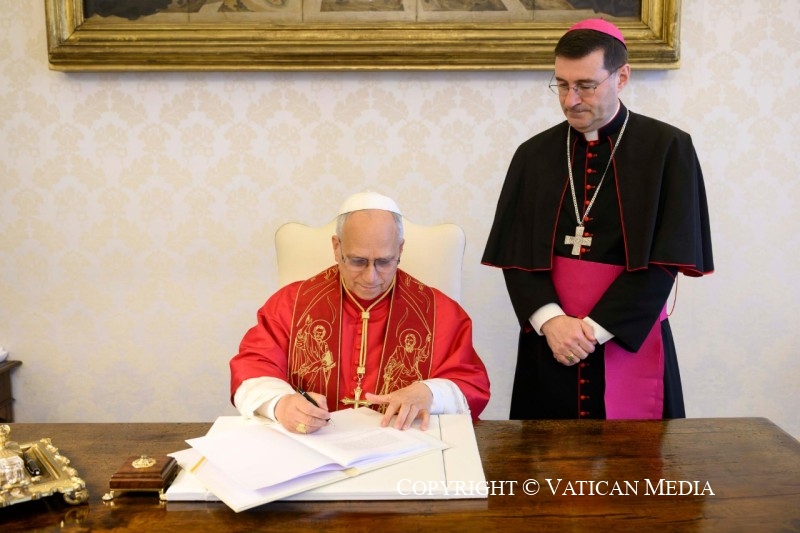
Pope Leo XIV signing ‘Magnifica Humanitas’. Image: Vatican Media
Then there is the rebuilding of Jerusalem under Nehemiah the governor of Judah, a project begun after the people return from exile, but one centred on God, moved ahead through listening, shared responsibility and genuine cooperation. Every family, every person has a role. It is the story of a project that restores and rebuilds relationships, as well as structures.
The wisdom in these ancient stories speaks directly into the modern world. They are live options for us, right now. Every time a major decision gets made about new technology and who controls what, the question underneath it is the same: who is this really for? Is it building something that serves all, for the common good, or is it building a tower for someone to make a name for themselves?
And on this question the document gets sharply practical, calling out the reality of the situation – that control over the platforms, the data, the infrastructure shaping our daily lives, most often does not sit with governments or communities. It sits with a very small number of private actors. Companies that do not have built-in safeguards or transparent processes, and in many cases their business models work by treating your human attention as a raw material to be processed for profit.
The encyclical is pointed about this: A.I. cannot be considered morally neutral. Every tool embeds choices and priorities into its processes. And when those choices concentrate power in the hands of a few, to the exclusion of the many, especially the vulnerable, and erode accountability, that is not a technical problem. It’s a moral one.
How does this all actually affect me
I want to share two recent experiences that I have had with A.I. that have stayed with me, because I think they illustrate something of what the Pope is getting at.
The first is that I’ve been dealing with some health problems, and I needed to write a letter to my doctor. Normally I’m someone who will agonise over every sentence and so I’d been putting this very important email off for days. When I finally caught myself avoiding it, I decided to use an A.I. app to draft the email. It came out clear and simple, with what needed to be said, not all the extra things that had me concerned. When it got something wrong, I could see that it was not what I wanted to express, so I edited it. And it was done. That A.I. tool took real pressure off me in an already stressful situation. Technology at its best is at the service of the human person, to help make our lives better.
The second experience is as I was writing a speech, pulling together ideas from a couple of other talks that I had previously given, and I hit a writer’s block brick wall on the closing paragraph tying it all together. I tried everything to get around it! Finally in frustration, I pasted the whole speech into an A.I. app and said, “write a final paragraph for this”.
The first attempt was terrible. Fluffy, generic, completely missed the points I had so carefully crafted. I asked again. And it was worse! Again. Somehow even worse. One more time and this time I added a note “do it better please” and it still didn’t write something I could use. But buried in that fourth attempt was a single sentence that unlocked an idea. That was enough to get me over my writer’s block that afternoon.
What I noticed in both those moments is, I think, what Pope Leo saw when he named the encyclical. A.I. technology is a tool and a useful one, sometimes even a genuinely helpful one! But it was I who knew what the letter to my doctor actually needed to say, I was the one who caught the glimmer of an idea that unlocked my writer’s block. When A.I. tools we use struggle or fail, that frustration we feel is actually a good thing, because it highlights something important: YOU are the magnificent thing here, not the software.
Near the end of Magnifica Humanitas, Pope Leo XIV invites us “to contemplate, in the face of the Son of God, the grandeur of humanity that shines a light also on the era of A.I.”. (n. 233)

The encyclical is asking us to engage with the digital world in a human way. Image: Vatican Media
Not the grandeur of our systems. Not the grandeur of our networks or our data or our productivity. The grandeur of humanity. A grandeur visible in the face of Christ and therefore in the face of every person we risk reducing to a data point. This is the encyclical’s heart. Everything else flows from this. We are magnificent. Not because of what we build, but because of who we are.
The encyclical also issues a challenge for us as we navigate our life and faith journey: paragraph 238 begins “Let us invest in education, beginning with ourselves! We all need to learn how to engage with the digital world in a human way, as an integral part of our education in the faith and in a life lived according to the Gospel.”
I recently came across some advice from Fr Mark-Mary Ames of the Franciscan Friars of the Renewal, who talked about adopting a kind of examination of conscience for our relationship with A.I. Listening to his reflection I felt the pangs of knowing discomfort, which usually mean this is something I need to work on! So, I offer you here a few self-reflection questions that I think are worth sitting with.
How am I using A.I.?
Be specific and honest.
What am I looking for when I open an A.I. app?
Quick answers… or, if you’re honest, are you also looking for affirmation? A listening ear? Some kind of connection?
Have I moved my boundaries?
Maybe a year ago you had a clear sense of what you would or wouldn’t use A.I. for
Has my use of A.I. enhanced my human experience, or has it cost me something?
Are you feeling more organised, freer, more effective? Or does getting ‘quick answers’ come at the cost of learning patience, perseverance, or the challenge of doing difficult work?
How has it affected my relationships?
With other people? … with yourself? … with God?
These aren’t supposed to be ‘gotcha’ questions, just honest ones. Questions that might test our integrity and whether what we say we believe actually aligns with what we do. The kind of questions that can lead us to the discernment that the encyclical is calling us to.
And here’s the thing about that video I mentioned – the one with the comedian who started off making jokes about the Pope and ended up quoting him: The wisdom being offered here is landing. Even in places I would least expect it. Even in some corners of our culture that would have assumed the Church had nothing useful to say about the world. Maybe that’s the sign that this document is doing the work that it set out to do. The only question left is will you let the wisdom of Magnifica Humanitas do its work in your life?
Magnifica Humanitas is Pope Leo XIV’s encyclical on safeguarding the human person in the age of artificial intelligence, released 25 May 2026.
There are a few spots left for Bishop Vincent Presents: Kim Daniels on ‘AI, Pope Leo and the future of human dignity’. Join us on 13 October to hear from one of the Church’s foremost experts on Catholic Social Thought and its importance in the age of artificial intelligence. Register here.
Alison Ryan is a member of the Mission Enhancement Team in the Diocese of Parramatta.