

Homily for the 5th Sunday of Lent
6 April 2025
Isaiah 43:16-21; Psalm 126; Philippians 3:8-14; John 8:1-11
Listen at https://soundcloud.com/frank-brennan-6/homily-6-4-25
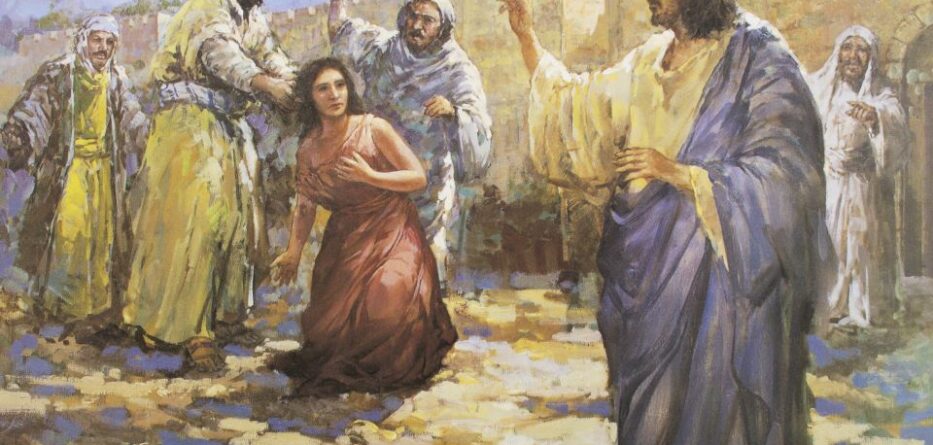
Today’s gospel tells the story of Jesus with the woman who had been caught in adultery. Scripture scholars have had a field day with this story. Most are agreed that it does not really belong in John’s gospel. It is a later interpolation. But that need not trouble us.
In Jesus’ time, the Romans forbade the Sanhedrin from imposing the death penalty. And adultery was punishable by death. The scribes and Pharisees were great moralisers about sins and crimes such as adultery. Their leaders would have been rather miffed that they did not have jurisdiction to deal with such wrongdoers. According to the law of Moses, a woman caught in adultery was to be stoned to death. According to Roman law, the local religious authorities could not authorise any such stoning. The Romans dealt with all capital cases.
The scribes and Pharisees were keen to catch Jesus out. What would be Jesus’ position when confronted by these zealots wanting to take the law into their own hands? Was Jesus going to authorise a stoning contrary to the Roman law? Or was he going to prohibit a stoning contrary to the law of Moses? The scribes and Pharisees thought they had Jesus snookered. He would be damned whichever way he went.
What does Jesus do? He deals first with the scribes and Pharisees, and then with the woman. To the scribes and Pharisees he says: ‘Let the one among you who is without sin be the first to throw a stone at her.’ Having wanted to take the law into their own hands, they now have to ‘walk away one by one, beginning with the elders.’ The experienced elders were the first ones to realise that it was now them who were snookered by their own intrigues.
After they’ve all walked away, Jesus looks at the woman and says: ‘Woman, where are they? Has no one condemned you? Neither do I condemn you. Go, and from now on do not sin anymore.’
Scripture scholar Raymond Brown says, ‘The delicate balance between the justice of Jesus in not condoning the sin and his mercy in forgiving the sinner is one of the great gospel lessons.’[1]
Does this mean that for the Christian, our courts are wrong to judge criminal offenders? Should the state informed by Christian principles forgive all offenders? Could a Christian judge ever impose punishment? Brown answers:
‘Jesus is not saying that every magistrate must be sinless to judge others, a principle that would nullify the office of judge. He is dealing here with zealots who have taken upon themselves the indignant enforcement of the Law, and he has every right to demand that their case be thoroughly lawful and their motives be honest. He recognises that, although they are zealots for the word of the Law, they are not interested in the purpose of the Law, for the spiritual state of the woman is not even in question, or whether or not she is penitent.’[2]
We can’t simply take a gospel story and apply the template to our circumstances providing a ready answer: what would Jesus do? Jesus was an itinerant preacher, not a state official. Jesus lived in an occupied country, not a democracy respectful of the human rights of all.
Today we are less than four weeks out from the federal election. In the public square, I usually go silent during the election campaign.[3] But it is a time when many church leaders and others invoking the name of Jesus proclaim all sorts of messages, some of them even implicitly urging a vote for or against a particular policy, party or candidate. The problem is that there are just so many factors at play when the Christian of good conscience is determining for whom to vote.
During the week I found myself flinching at a couple of Christian interventions in the public square. When one political leader was speaking on the hustings in Trumpian terms about education and indoctrination, the Catholic Schools NSW CEO was reported as saying: ‘Curriculum and education should be about enlightenment, not indoctrination. The national curriculum is very vague and not teacher-friendly, and is not written for practical application. Everything looks like it is drafted by the sociology department of a university.’[4] Why say these things during a federal election campaign, I wondered.
The Australian Christian Lobby inquired whether we might distribute a flyer at our church doors stating: ‘Our children’s innocence, religious freedoms, and biological truth are on the line’.[5] I read this as a coded message: Vote for X, and don’t vote for Y.
For us Christians, Y may have some repugnant policies, so too might X. For example X might be a strong advocate for ‘biological truth’ (whatever that means) but do little to address climate change; X may be hostile to asylum seekers; X might not have much interest in Indigenous affairs.
If we were to distribute anything (and I’m not a great fan of any distribution at church doors at election time), we should restrict ourselves to the sort of statement issued by our bishops which confines itself to a statement of principles which should inform the conscientious voter making a decision. The bishops state: ‘In determining our electoral choices, Australian Catholics search always to uphold the sanctity of life, protect the vulnerable, support and strengthen families, promote the common good, and foster a just society where all Australians can thrive.’[6]
At the end of the day, there are good Catholics engaged in that search who will vote Liberal; there are others who will vote Labor; there are some who will vote Green; there are others who will vote Teal, and there are others yet again who will vote for or against all manner of things.
Some voters will focus primarily on policies; others will give more attention to the competence and proven capacity of the candidate or of the party leader. Some voters will want a government with a majority in both Houses of Parliament so the government will be able to implement its mandate. Other voters will favour an evenly divided Senate where the government has to explain and negotiate their legislative outcomes. Some voters will want a government majority in the House of Representatives for the good of smooth running government; others will want a minority government so that the government of the day, whoever it may be, can be made to be more attentive to issues such as climate change and the entitlement of asylum seekers.
Reflecting on faith and politics in his encyclical Deus Caritas Est, Pope Benedict said that the aim of Catholic social doctrine was simply ‘to help purify reason and to contribute, here and now, to the acknowledgment and attainment of what is just’.[7]
There is no one way that a Catholic should vote. When voting, if only each of us, like Jesus in today’s gospel, could find that delicate balance between justice and mercy, voting for the candidate and the party most likely to act for the good of the country. Our bishops tells us: ‘Conscience is our inner guide, enabling us to discern right from wrong, and judge what is good and just, and we have a duty to follow it faithfully. This demands careful consideration of the facts and the background to our decisions, and a commitment to prayer to discern God’s will.’
Let’s pray the prayer our bishops have prepared for us as we approach the ballot box:
Grant, we pray, O Lord our God, that as the Cross shines in our southern skies, so may Christ bring light to our nation, to its peoples old and new, and by saving grace, transform our lives.
The Lord has done great things for us; we are filled with joy.
When the Lord brought back the captives of Zion,
we were like people dreaming.
Then our mouth was filled with laughter,
and our tongue with rejoicing.
The Lord has done great things for us; we are filled with joy.
Then they said among the nations,
“The Lord has done great things for them.”
The Lord has done great things for us;
we are glad indeed.
The Lord has done great things for us; we are filled with joy.
Restore our fortunes, O Lord,
like the torrents in the southern desert.
Those that sow in tears
shall reap rejoicing.
The Lord has done great things for us; we are filled with joy.
Although they go forth weeping,
carrying the seed to be sown,
They shall come back rejoicing,
carrying their sheaves.
The Lord has done great things for us; we are filled with joy.
Fr Frank Brennan SJ is serving as part of a Jesuit team of priests working within a new configuration of the Toowong, St Lucia and Indooroopilly parishes in the Archdiocese of Brisbane. Frank Brennan SJ is Adjunct Professor of the Thomas More Law School at ACU and is a former CEO of Catholic Social Services Australia (CSSA). Fr Frank’s latest book is An Indigenous Voice to Parliament: Considering a Constitutional Bridge, Garratt Publishing, 2023 and his new book is ‘Lessons from Our Failure to Build a Constitutional Bridge in the 2023 Referendum’ (Connor Court, 2024).
[1] Raymond Brown, The Gospel According to John I-XII, Volume 1, Anchor Bible Series, 1966, p. 337.
[2] Ibid, 338
[3] Outside of election campaigns, I am a strong advocate for applying Catholic social teaching in the public square to particular controversial issues. See https://catholicleader.com.au/people/fr-frank-brennans-50-years-as-a-jesuit/
[4] https://www.theaustralian.com.au/education/election-2025-catholic-schools-want-to-scrap-woke-national-curriculum/news-story/1ebd27ee64064f45db3484a45540b56e
[5] Australian Christian Lobby, Vote for Truth Flyer.
[6] See https://s3.ap-southeast-2.amazonaws.com/acbcwebsite/Articles/Documents/ACBC/ACBC%20Election%20Statement%202025%20FINAL.pdf
[7] Pope Benedict XVI, Deus Caritas Est, #28.