

Homily for Pentecost Sunday
Acts 2:1-11; Psalm 104; 1 Corinthains 12:3b-7;12-13; John 20:19-23
Listen at soundcloud.com
Scripture scholar Luke Timothy Johnson tells us that ‘the giving of the Holy Spirit at Pentecost took place in the presence of Jews from all over the world. And through Peter’s speech, the invitation to share in this gift will be made’.[1] As members of the church, we are all invited to receive the gifts of this feast.
Let’s recall that immediately after Luke’s gospel account of the gift of the Spirit being given Jesus at his baptism, Luke then traces Jesus’ Jewish heritage ‘all the way back to Abraham, and even further, to Adam’. In a similar manner, after this ‘baptism in the Spirit’ of the apostles and their company, Luke lists all the lands from which Jews have gathered. The parallelism fits the pattern of Luke’s story: ‘Jesus is the prophet who sums up all the promises and hopes of the people before him; in his apostolic successors, that promise and hope (now sealed by the Spirit) will be carried to all the nations of the earth.’[2]
I’ve spent the last couple of weeks in Poland. I gave a couple of university lectures and I witnessed the ongoing power and witness of Pope John Paul II whose life embodied the Polish challenge of faith and culture to the power of the state and foreign influences including communism and Nazism. Being sandwiched between Germany and Russia, Poland has never been far from the big conflicts of Europe. The Poles have known such suffering. Per capita, more Poles died during World War II than the people of any other nation. At the moment, about a million Ukranians are finding sanctuary in Poland.
During this month of May, Mary’s month, many Polish children make their first communion. In the days following, their parents take them in their very elaborate first communion attire to significant places such as Wadowice, the birthplace of John Paul, a small town about 50 km southwest of Kraków. At his last appearance at Wadowice, John Paul pointed across the square to the confectionary shop which had been run by Karol Hagenhuber and told the crowd about Kremówka (a Polish cream pastry) which was the favourite indulgence of the young Karol and his mates. The pastry is now a familiar reward for children once they’ve undertaken all their post-communion church activities.
Many join the throng of endless pilgrims to the shrine of the Black Madonna (Our Lady of Częstochowa) housed at the Jasna Góra Monastery in Częstochowa. At last, summer is in the air. The children’s joy is a tonic for their parents. In Krakow on the site of the Solvay Soda Factory which was where the young Karol Józef Wojtyła had worked during World War II to avoid deportation to Germany, there is the vast Sanctuary to St John Paul II. It’s a style of religion which is not all that common for us more lay back Aussies.
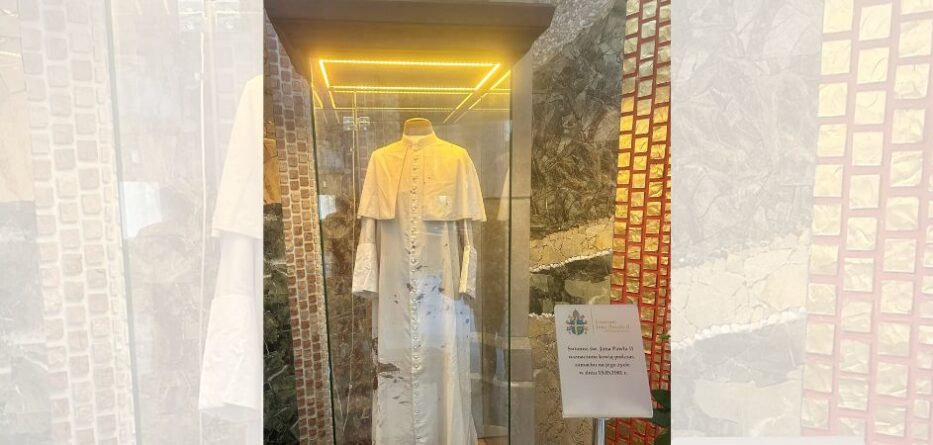
One exhibit in that vast museum and church complex caught my attention. On 13 May 1981, Mehmet Ali Agca who had connections with the Bulgarian secret service, shot Pope John Paul in St Peter’s Square. John Paul escaped death by a couple of centimetres. The blood-splattered, white papal cassock is on display at the sanctuary. The shooting took place on the anniversary of the first appearances at Fatima on 13 May 1917. Russia’s leader Leonid Brezhnev sent the pope a message: ‘I am deeply indignant at the attempt on your life. I wish you a rapid and complete recovery.’[3]
On the first anniversary of the shooting, and again on the 10th anniversary, Pope John Paul II visited Fatima. On the 19th anniversary, he wrote to the Italian president providing an ‘explanation of how [he] would feel if Italy granted a gesture of clemency.’ Agca walked free having been forgiven by the pope who over the years had not only met with him in prison but had also met with his mother at the Vatican. The fearful Turk who had probably acted with Soviet knowledge was terrified that Our Lady of Fatima would persecute him.
As Jesus said to the apostles after the resurrection: ‘Peace be with you. As the Father has sent me, so I send you.’ And when he had said this, he breathed on them and said to them, ‘Receive the Holy Spirit. Whose sins you forgive are forgiven them, and whose sins you retain are retained.’
The blood-splattered, white cassock on display in the vast pristine Krakow sanctuary stands as an icon of the message of Pentecost – accessible not just to reverent and adoring Poles, mysterious though real not just for those Catholics with a long-time dedication to Fatima. On his nine return pilgrimages to Poland as pope, John Paul provided inspiration for the whole of humanity whether he was preaching in Auschwitz or his hometown where he recalled to the hundreds of thousands gathered in the square the favourite dessert he shared with his mates as a young man. And how delightful to see young families gathered in front of the church with their children wearing their first communion apparel before being rewarded with the pope’s favourite dessert.
Returning to Australia, contemplating the many gifts of the Spirit shared with us in the Great South Land of the Holy Spirit, I recall John Paul’s classmate Jerzy ‘George’ Zubrzycki who migrated to Australia and became acknowledged in the 1970s as our father of multiculturalism. Zubrzycki and his colleagues spoke of cultural pluralism. They believed that what ‘Australia should be working towards is not a oneness, but a unity, not a similarity, but a composite, not a melting pot but a voluntary bond of dissimilar people sharing a common political and institutional structure’.[4]
Zubrzycki always emphasised the need to keep in balance: social cohesion; cultural identity; equal opportunity and access; and equal responsibility for participation in society. Gifts of the spirit for our society and for our church.
We rejoice at our differences as we recall Paul’s words to the Corinthians:
There are different kinds of spiritual gifts but the same Spirit;
there are different forms of service but the same Lord;
there are different workings but the same God
who produces all of them in everyone.
To each individual the manifestation of the Spirit
is given for some benefit.
As a body is one though it has many parts,
and all the parts of the body, though many, are one body,
so also Christ.
For in one Spirit we were all baptized into one body,
whether Jews or Greeks, slaves or free persons,
and we were all given to drink of one Spirit.
Happy Pentecost. ‘Whose sins you forgive are forgiven them, and whose sins you retain are retained.’
Fr Frank Brennan SJ AO, Adjunct Professor of Thomas More Law School at ACU and Adjunct Research Professor at the Australian Centre for Christianity and Culture, is a former Rector of Newman College, University of Melbourne, and CEO of Catholic Social Services Australia (CSSA). His latest books include Pope Francis: the Disruptive Pilgrims Guide (ATF Theology, 2025), and Gerard Brennan’s Articles and Speeches: Maintaining the Law’s Skeleton of Principle (2 volumes) (Connor Court, 2025).
[1] Luke Timothy Johnson, The Acts of the Apostles, Sacra Pagina Series (Collegeville, MN: The Liturgical Press, 1992), 47.
[2] Ibid
[3] Weigel, George. Witness to Hope: The Biography of Pope John Paul II (p. 424). (Function). Kindle Edition.
[4] Jupp, James. From White Australia to Woomera: The Story of Australian Immigration, (Function). Kindle Edition, p. 83.