

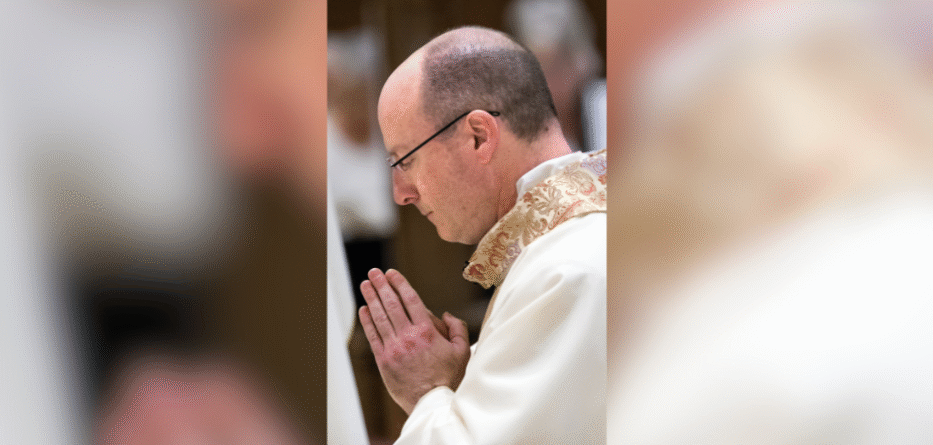
Every so often a diocesan document arrives that deserves a readership far beyond the diocese that produced it. Archbishop Shawn McKnight’s pastoral letter Renewal from the Heartland, given on 12 September 2026 to the convocation of the Archdiocese of Kansas City in Kansas, is one of them.
It is not long, about seventeen pages, and it is now appearing in installments in The Leaven. But it does something rare. It takes the Final Document of the Synod on Synodality and shows what it looks like when a local Church actually tries to live it. Nearly a thousand people took part in thirty-two listening sessions, held in parishes, high schools, community centers, two prisons, and in American Sign Language. Another 7,252 answered a survey conducted by CARA. The letter is the archbishop’s attempt to say, as a pastor, what he heard.
From the outset he insists that synodality is not a new program. Quoting the Synod’s first paragraph, he reminds his people that “every new step in the life of the Church is a return to the source.” That is the hermeneutic of reform in continuity in a single sentence, and the rest of the letter is faithful to it.
The Road to Emmaus
The letter is built on Luke 24, and the choice is more than devotional. On the road, the Risen Lord first opens the Scriptures, then takes, blesses, breaks, and gives the bread. Word, then Eucharist. It is the shape of every Mass we celebrate.
By placing synodality inside that story, the archbishop roots it in the Church’s worship rather than in management theory. Walking together, listening, and discerning are not techniques borrowed from the corporate world. They are what happens to disciples whose hearts burn within them in the breaking of the bread. Here the lex orandi forms the lex vivendi. And the disciples do not stay at table. They turn around and go back to Jerusalem. Synodality, on this reading, always ends in mission.
The Stories He Chose to Tell
What moved me most is that the archbishop let his people’s wounds into the text. A husband cared for his wife through Alzheimer’s. After he put her name on the parish prayer list, no one from the parish contacted them for six months, until ten days before she died. A public-school girl ran for her parish CYO track team, and the other parents did not cheer when she raced.
A bishop could easily have left such stories in the CARA report. McKnight puts them at the center and asks the hard question of the Good Samaritan: how many read that prayer list and simply went on with their lives? He then names those for whom parish life is hardest to enter: newcomers, converts, single adults, childless couples, divorced persons, non-Catholic spouses. His conclusion is one every pastor should post on the sacristy door. Hospitality “cannot be only a greeting at the door.” It must become accompaniment.
He also hears a call for a public Catholic witness that holds together the unborn, vulnerable families, economic justice, creation, and the rejection of racism, “not as competing concerns.” That is Cardinal Bernardin’s seamless garment, and it comes from the people of northeast Kansas themselves.
Heard, Not Studied
The heart of the letter, and its finest theological passage, concerns co-responsibility. The archbishop warns against a counterfeit synodality: comment cards collected, opinions tabulated, a report produced, all in the way “a company might survey and market to its customers.” Listening of that kind leaves the sheep studied but not heard. “A sheep that has only ever been observed,” he writes, “has not yet been known.”
This is a sound reading of Lumen Gentium. The sensus fidei is not data to be measured. It is a gift of the Spirit to the whole People of God, given so that pastors may be enlightened by those they serve. The archbishop cites Lumen Gentium 37: pastors, helped by the experience of the laity, can make “clearer and more suitable decisions.” The Council fathers, he notes, were not making a concession to modern culture. They were describing a Church that believes the Spirit has been poured out on all the baptized.
Synodality, at its heart and in the concrete reality of a local Church, shows the living interaction between an ecclesia docens and an ecclesia discens, a teaching Church and a listening Church. For too long the two were treated as separate classes, the clergy who teach and the laity who listen and learn. Archbishop McKnight’s letter shows how they belong together. The shepherd who teaches must first learn and listen to his people, and the faithful who are taught bring a sensus fidei that teaches the shepherd in return. A vibrant Church needs both, held in dynamic tension and never collapsed into one.
From there he treats pastoral and finance councils with real seriousness. “Every parish budget is a moral document,” he writes. And to the laity: you are not volunteers filling a gap in Father’s schedule. You already carry the smell of the sheep in ways your pastor cannot. He calls synodality “simply the tenth chapter of the Gospel of John, organized.” I have not read a better one-line definition. “I am the good shepherd, and I know mine and mine know me” (John 10:14).
On the Liturgy
The archbishop’s paragraphs on worship will interest readers of this Substack most. He names the unease plainly: some regard their own preference among legitimate liturgical expressions “as the only way to be truly reverent according to the mind of the Church.” He grounds the remedy in the Second Vatican Council and in Pope Leo’s recent letter to Cardinal Roche for the liturgical conference at Mount Angel Abbey. That letter calls for fidelity to the rites promulgated by Paul VI and John Paul II, and for an ars celebrandi “expressed not only by the celebrant of the liturgy, but also by the entire assembly.”
That phrase is participatio actuosa in its conciliar sense. The whole assembly celebrates, not the priest alone. Giving everyone the benefit of the doubt, McKnight then asks whether the strong opinions on every side might be read not as opposites but as “a shared desire for the proper celebration of the liturgy, just expressed differently.”
The Measure of a Parish
The letter’s conclusion gives every parish a measure it can test itself against. The question is not whether people know the Church’s name. It is “whether, in the hour they most needed mercy, they discovered the Church already knew their name.”
Having given more than fifty years to parish and cathedral life, I can say that the Church is rarely judged by its programs or its buildings. It is remembered for who noticed, who listened, and who came. Archbishop McKnight has written a letter that is faithful to the Council, cum Petro et sub Petro, and attentive to the people entrusted to him. I hope brother priests and bishops elsewhere will read it, and that more of us will learn, as he has, to hear before we speak.
The full letter is available at archkck.org/renewal-heartland.
With thanks to Liturgy and Truth and Monsignor Arthur Holquin, S.T.L., where this article originally appeared.