

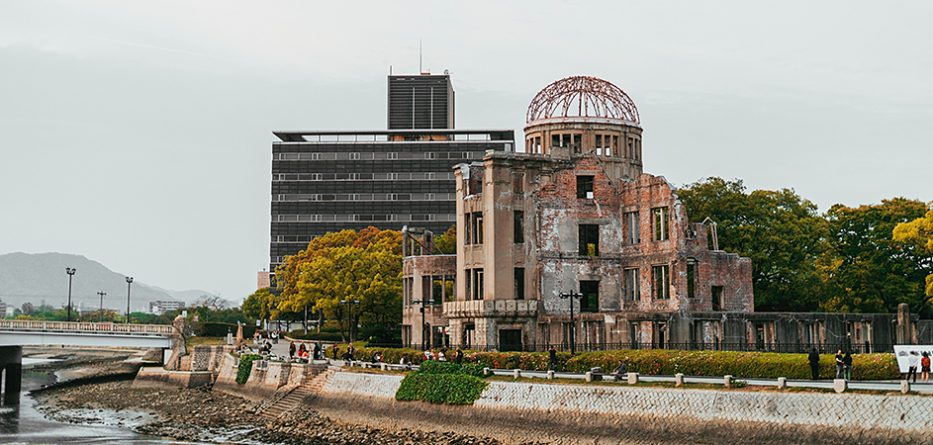
2025 marks the 80th anniversary of the atomic attacks on the Japanese cities of Hiroshima (6 August 1945) and Nagasaki (9 August 1945) during World War II.
6 August is the Feast of the Transfiguration of the Lord
6 August commemorates two very different stories. It is the Feast of Jesus’ Transfiguration. It is also the 80th Anniversary of the nuclear bombing of Hiroshima. One is a feast of light, of celebrating a life and the promise of a world transformed. The other recalls a brief and terrible light followed by darkness and death, and threatening silence. Together, they ask which light will guide our lives as human beings, as Christians and as human beings.
Both these days invite us to attend to life and to death, and to follow a path that holds them together in the right order. On the mountain, Jesus is revealed in dazzling light as the Son of God. The disciples had a vision of a world transformed in harmony, clarity, love and joy. In it all things came together. No wonder Peter wanted to set up house on the mountain and to stay there forever! He had seen a glimpse of the world transfigured by the God whose coming Jesus had promised, a world in which he and the other disciples were to be involved in shaping. When they came down from the mountain together, however, Jesus set them straight about the path that led to transfiguration. It lay through the death and darkness of Golgotha.
That is the darkness which followed the light over Hiroshima. Mercifully, it was the first and last time that nuclear weapons have been used in war. But they have been stored in the thousands around the world and many people now take them for granted. On the eightieth anniversary of their first use, it is helpful to recall the eyewitness account of Fr Pedro Arrupe, later Jesuit Superior General. He was present in Hiroshima:
“I was in my room with another priest at 8.15 when suddenly we saw a blinding light, like a flash of magnesium. As I opened the door, which faced the city, we heard a formidable explosion similar to the blast of a hurricane. At the same time doors, windows and walls fell upon us in smithereens.
“We climbed a hill to get a better view. From there, we could see a ruined city: before us was a decimated Hiroshima. Since it was at a time when the first meal was being prepared in all the kitchens, the flames contacting the electric current turned the entire city into one enormous flake of fire within two and a half hours.
“I shall never forget my first sight of what was the result of the atomic bomb: a group of young women, eighteen or twenty years old, clinging to one another as they dragged themselves along the road.
“We continued looking for some way of entering the city, but it was impossible. We did the only thing that could be done in the presence of such mass slaughter: we fell on our knees and prayed for guidance, as we were destitute of all human help.
“The explosion took place on August 6. The following day, August 7, at five o’clock in the morning, before beginning to take care of the wounded and bury the dead, I celebrated Mass in the house. In these very moments, one feels closer to God, one feels more deeply the value of God’s aid. Actually the surroundings did not foster devotion for the celebration for the Mass. The chapel, half destroyed, was overflowing with the wounded, who were lying on the floor very near to one another, suffering terribly, twisted with pain.”
In Fr Arrupe’s description of the Mass that he celebrated after the bomb fell, we can see a religious tension that remains with all of us. He describes the presence of the sick and wounded as not fostering devotion. But his hospitality to the sick and wounded places them at the centre of the mystery that he is celebrating in the Eucharist. He leaves Christians to ask ourselves how we bring together the different aspects of devotion: the presence of God in prayer and silence, and the presence of God in the world’s wounded.
Fr Andrew Hamilton SJ writes for Jesuit Communications and Jesuit Social Services.