

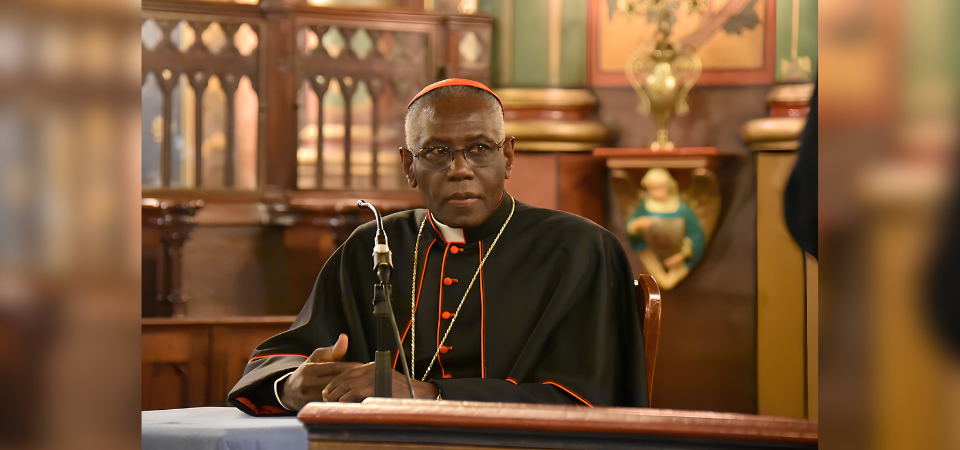
Diane Montagna’s full interview with Cardinal Sarah is available to paid subscribers of her Substack. She has also posted a free excerpt, with audio, focused specifically on his remarks about Traditionis Custodes: “Cardinal Sarah Makes the Case for Letting ‘Traditionis Custodes’ Wither and Die”. I’d encourage readers to listen to that exchange for themselves before reading what follows — and to support Diane’s independent reporting, which deserves it regardless of where one lands on this question.
Diane Montagna’s July 16 interview with Cardinal Robert Sarah is worth a serious reading, and I have given it one. His Eminence’s spiritual seriousness is not in question — the man who wrote against the idols of an easy Christianity has earned an attentive hearing. His articulation of lex orandi, lex credendi, lex vivendi is, on its own terms, sound theology; it is the very grammar this Substack has used from its first post. But a shared grammar does not necessarily produce a shared argument, and on the substance of Traditionis Custodes — its authority, its rationale, and what he proposes should become of it — Cardinal Sarah’s reasoning, from my perspective, does not hold together. I say this respectfully but without the customary softening, because he himself does not soften, and a serious engagement deserves a serious answer, not the benefit of the doubt extended out of deference to the red that he wears as a Cardinal.
Recollection, or Passivity?
Cardinal Sarah offers, almost in passing, a claim that deserves far more scrutiny than the interview gives it: that the older liturgy “fosters more recollection, more silence,” and that young people are drawn to it for this reason. Let us ask the question he does not ask himself. Is silence, as such, the nature of the liturgical act — or is it the byproduct of a rite that structurally excludes the assembly from an audible, intelligible, embodied share in its own offering? Sacrosanctum Concilium did not call for participatio actuosa because the Council Fathers had a taste for noise. They called for it because the liturgy is, by its nature, the action of the whole Body of Christ, head and members, not a clerical action performed for a silently observing laity. A congregation reduced to watching the back of a priest, following along in a hand missal while the actual words of consecration are inaudible to them, is not “recollected.” It is spectating. There is a real difference between contemplative silence within active participation — the silence the reformed Missal itself provides for, after the readings, after Communion — and the imposed silence of exclusion from the rite’s own language. Cardinal Sarah never draws this distinction, and his argument suffers for the omission.
An Ecclesiology With No Laity In It
This is not incidental. It follows from — and exposes — a conception of the Church in which the lay faithful barely appear as participants at all. One reads this interview and wonders whether His Eminence has returned lately to Lumen Gentium‘s (Dogmatic Constitution on the Church) fourth chapter, or to Apostolicam Actuositatem, (Conciliar Decree on the Laity) both of which insist that the laity possess a genuine, non-derivative share in the Church’s priestly, prophetic, and kingly office by virtue of baptism — not as a concession granted by the clergy, but as a constitutive fact of who they are. Cardinal Sarah’s entire treatment of the liturgy assumes an Ecclesia docens (teaching church) addressing an Ecclesia discens (listening church) that exists primarily to receive, to kneel, to submit, to watch. Teaching authority belongs properly and irreplaceably to the bishops in communion with the Successor of Peter — no one on this Substack has argued otherwise, least of all against the excesses of a “synodality” untethered from that structure. But teaching authority is not the whole of ecclesial life, and a Church in which the laity’s only role is submissive silence is not the Church of the Council. It is not the ecclesiology of Lumen Gentium. It is the ecclesiology it was written to correct.
This same asymmetry shapes his impatience with the Synod on Synodality. Cardinal Sarah cannot locate “listening,” “accompanying,” “walking with” anywhere in the Church’s self-understanding, as though these were novelties invented in 2021 rather than the pastoral posture of a Good Shepherd who leaves the ninety-nine to find the one — the posture, not incidentally, that animated an entire pontificate he seems determined not to credit even where crediting it costs him nothing. One need not endorse every procedural choice of the Synod’s implementation to recognize that dismissing accompaniment itself as beneath the Church’s mission is not orthodoxy. It is clericalism, precisely the disorder Pope Francis named and confronted with more consistency than almost any pontiff before him — the conviction that the hierarchy’s business is to speak and the faithful’s business is to receive, full stop.
A Prefect Who Governed His Preferences, Not the Council’s Vision
There is a further irony here that the interview does not acknowledge and that I will not pass over. Cardinal Sarah did not arrive at these convictions as a private theologian. He held, for nine years, the office charged with ensuring that the whole Church — not one liturgical constituency within it — received the conciliar vision of worship as the universal pastor had articulated it. That office is not a pulpit for personal liturgical taste. Yet it is a matter of record, not speculation, that in July 2016, as Prefect of the Congregation for Divine Worship, he told the Sacra Liturgia conference in London that priests should begin celebrating ad orientem “wherever possible,” beginning the following Advent — a public campaign for a change in universal practice, mounted from the very office charged with communicating the Pope’s mind rather than substituting one’s own. Pope Francis met with him days later, and the Holy See Press Office took the unusual step of clarifying, publicly, that no such change was coming and that the reformed Missal remains the ordinary form of the Roman Rite. A prefect who spends his tenure lobbying against the reigning pontiff’s own settled preference, from the office meant to serve that pontiff’s governance of worship, is not a model of docility to the Magisterium. He is the thing Cardinal Sarah warns against in every other paragraph of this interview, applied to himself.
Cafeteria Catholicism, By Another Name
Which brings me to the point that most needed saying, and I will respectfully not temper my candor. Cardinal Sarah is a churchman who insists, rightly, that a moral or doctrinal teaching cannot be set aside because a Western synodal study group finds it inconvenient — that documents cannot simply circulate and take on a life of their own without the Holy Father’s considered judgment. And yet, asked directly whether Traditionis Custodes — a legislative act of the Roman Pontiff, promulgated with full authority, addressing the very unity of Catholic worship he claims to prize above all things — should be abrogated, his answer is not an argument. It is a strategy, and a disingenuous one: let it go unenforced, let no one abrogate it formally, let it simply “disappear gradually, day after day, year after year,” until non-compliance has done quietly what he lacks the standing to ask the Pope to do openly.
I do not know a more precise definition of cafeteria Catholicism than this: selective, undeclared non-observance of a magisterial act one finds unwelcome, defended by a churchman who elsewhere insists that doctrine and discipline alike must never simply be allowed to drift by popular sentiment. If a bishops’ conference proposed managing an unwelcome moral teaching by simply declining to preach it until it faded from memory, Cardinal Sarah would rightly call it what it is. He does not extend to himself the same scrutiny.
What Actually Stands
Let the record be precise, since His Eminence’s history is not. Traditionis Custodes does not touch some timeless, 1,600-year-old rite frozen at a single point; the Missal it addresses is a sixteenth-century codification of a continuously developing tradition, no more exempt from legitimate reform by competent authority than any other stage of that development. Cardinal Roche’s own account, on record, confirms that Pope Leo XIV has no intention of reversing it. The Holy Father’s letter to the French bishops asks for pastoral generosity in its application — not a referendum on the ecclesiological judgment beneath it: that the pre-conciliar Missal cannot be permitted to function as a standing, parallel rite in implicit rivalry with the reform an ecumenical council willed for the whole Latin Church.
Where the Ground Is Actually Shared
I will not deny Cardinal Sarah what is owed him. His alarm at doctrine settled by majority sentiment, his insistence that the Synodal Study Group 9’s findings not be released without the Holy Father’s own considered judgment, his refusal to let moral teaching be voted upon — these are convictions I share without reservation, and I have spent much of this Substack defending them against pressure from the opposite direction. His closing conviction, that the Church remains the light of Christ not by our engineering but by Christ’s own fidelity, is simply the Gospel, and deserves an unqualified Amen.
But conviction about Christ’s fidelity to His Church is not license to govern the Church’s own discipline by attrition, silence, and hope. If Cardinal Sarah believes Traditionis Custodes is wrong, the path he elsewhere insists on for every other question — put it before the Holy Father, argue it openly, submit to what is decided cum Petro et sub Petro — remains open to him. What is not open, to him or to anyone, is asking the rest of the Church to quietly stop obeying a legitimate act of the Magisterium while insisting, in the same breath, that no one else may treat inconvenient teaching the same way.
With thanks to Liturgy and Truth and Msgr. Arthur Holquin, S.T.L., where this article originally appeared.