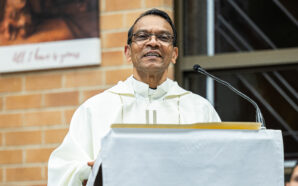


Most Reverend Vincent Long Van Nguyen OFM Conv DD STL, Bishop of Parramatta
Homily for the 23rd Sunday in Ordinary Time, Year A
Readings: Ezekiel 33:7-9; Romans 13:8-10; Matthew 18:15-20
Renewed commitment and shared responsibility for our common home
Dear friends,
This Sunday, the Church begins the Season of Creation which is a graced time for reflection, renewed commitment and shared responsibility for our common home. By embracing both faith and action, communities around the world are called to become sources of hope and renewal—allowing care for creation to flow into everyday life, shaping a more just, sustainable, and life-giving future for all. The time has come for Christians to show the alternative pathway of hope, justice and sustainability against the ingrained culture of denial, fear and defence of the status quo. Pope Francis was fond to say that if we want a different world, we must become a different people. Ecological conversion, that is, a profound spiritual transformation that leads to a harmonious way of living in communion with creation begins with us.
This is also the message of the prophet. In the first reading, Ezekiel was called to be a sentry to the House of Israel and to be God’s mouthpiece. He was to watch for danger and sound a warning when it appeared. Ezekiel lived during one of the most tumultuous times in Israel before the exile. The Jewish monarchy had declined and the nation had fractured. The ruling elite had no concern for the poor, but instead manipulated the political chaos to their advantage.
It was in this abysmal situation that Ezekiel was commissioned to speak God’s Word. He was not afraid to challenge the power that be. He condemned the ruling class who was indifferent to the cry for the poor and oppressed. He summoned the courage of God’s people and invited them to look beyond their present predicament to the time of renewal and restoration. More importantly, he called them to commit themselves to working afresh for the realisation of God’s dream. The exile proved to be the most critical spiritual exodus.
Today, amid many situations of seeming hopelessness, it is easy for us to be overwhelmed and numbed. We feel powerless and unable to make a difference to the lives of many suffering people. Yet the prophet reminds us that what is needed is the strength of faith and the power of love. When we are on the side of the poor, the vulnerable and when we stand in solidarity with those without hope and act together, we can be channels of hope. In opening our eyes and hearts to the sufferings of our world, hope can be awakened, a hope that allows us to see things from the perspective of God.
In the Gospel, Jesus teaches his disciples how to go about healing division and protecting harmony of a common life for all. When difficult circumstances arise, it is the duty of the whole community to come together and address them. When a brother or a sister strays, it is the duty of the whole community to restore him/her. In effect, we are called to be our brothers/sisters’ keepers. In our increasingly litigious society, Jesus provides us with the alternative Christian model of fraternal correction, care, accompaniment. Rather than allowing us to just walk away, Jesus calls us to explore possibilities that might lead to reconciliation. He outlines a deliberate, intentional process that involves listening, discerning and growing together.
Dear brothers and sisters,
It is not easy for us to be the healers and restorers of what is broken and damaged in our interpersonal relationships or in the public sphere. Yet, that is our calling even as we were baptised and anointed like Christ as priest, prophet and king. We need to see, judge and act in a way that brings the Gospel to life. In particular, we need to be the voice for the voiceless, the force for justice and equity, the defence for the defenceless and vulnerable. St Paul reminds us that we should avoid getting into debt, except the debt of mutual love. We owe that debt especially to the poor, the needy and the suffering around us and beyond.
In the midst of the environmental, economic, social and moral crisis, God’s Word cannot be more pertinent to us. Our culture is often committed to continuity or amnesia, even when it is time to question the benefit of the status quo and to embark on a new and more sustainable pathway. We are organised in our lives, in our society and even in our churches around order, control and predictability. We fear disruption and resist change. But this can be a negation of the Spirit who does new things within the people of God.
Let us pray that we may become catalysts for global action in the way that Pope Francis through his teaching in Laudato Si has so prophetically challenged us. The world we live in is on a trajectory that needs to be courageously corrected, if we are to flourish into the future. God calls us to become a community of disciples and pilgrims of hope with our fellow human beings. Let us form ourselves into a force for the common good and social transformation. May we become the leaven in the dough, so that we can influence others for the sake of a better world and a better future for all.