

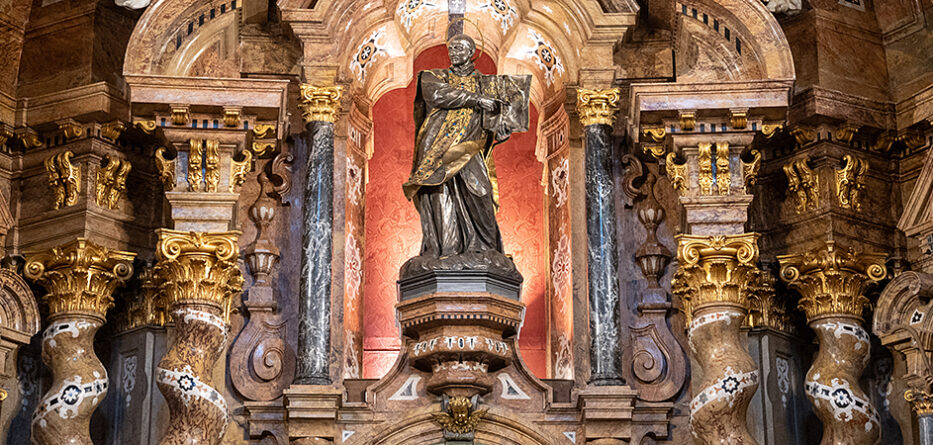
31 July is the Memorial of St Ignatius of Loyola.
Like St Thomas More, St Ignatius is a man for all seasons. Not because he fits comfortably into any culture, but because he invites us to enter our own culture, reflect on it, and finally to stand at a distance from it. He never quite fits into our images of him. This edginess explains why so many writers have tried to capture him.
In a fascinating recent book, United States Jesuit Rob McChesney sees him through the lens of counselling. He spent many years in Jordan counselling refugees after their often-horrific experiences. He later became aware of new branches of trauma counselling that addressed specifically the trauma suffered by people whose moral or religious view of the world and behaviour had been shattered by what they had suffered, done or been exposed to. To find healing, they need to find help in addressing this moral or religious wound. McChesney recognised in this study his own experience of exposure to trauma. It also led him to see St Ignatius’ life and his Spiritual Exercises in a startling and illuminating way.
McChesney highlights Ignatius’ upbringing as the youngest son in a large family of lesser nobility who would have to make his own way in a violent society. He lived in a culture that glorified ambition, courage, a noble appearance, idealisation and exploitation of women, and victory in battle. It was also an intensely Catholic culture in a Spain that was freeing itself from Muslim rule. In his late twenties, he was fully a man of his time, ambitious, a courtier and soldier given to violence, ambition in love and war. His faith was tribal and stood in unrecognised tension with his way of living.
While defending a castle against a massively stronger force, he refused advice to surrender, was wounded by a cannonball, had his leg set and reset when it left him with a limp and so physically ugly, unable to excel in war and bored with only religious books to read. It was then that he began to reflect on his future, torn between his dreams of winning a noble woman and living the spectacularly holy life of the saints. The latter thoughts gave him deeper satisfaction and, as noble knights do, he prayed and handed his sword over in a church before embracing a life of prayer.
His experience of solitude, however, was traumatic as he faced the reality of the loss of his aspirations and bodily integrity and of his total failure to live by the faith to which he now wanted to give his life. The consolations of prayer turned to distance and anxiety, and he had suicidal thoughts. His moral and religious assumptions and his hopes had been dashed.
All the time, however, he noted carefully his experience and found the understanding and words that helped him listen to and guide others in similar conditions. These became embodied in the structure and the imaginative prayer in the Spiritual Exercises.
Through the Spiritual Exercises, Ignatius enabled people to live reflectively, recognise the gap between their faith and their actual way of life, and to commit themselves to the Gospel in the Church.
When people wished to follow Jesus more closely, however, Ignatius invited them to seek poverty rather than wealth, humiliation rather than honour, and humility rather than worldly wisdom. These values set people apart from the values and culture of their day.
What Ignatius discovered in following Jesus was indeed alien to the values of our day of seeking comfortable wealth and living, social acceptance and public acknowledgement of our achievement. Ignatius was fully embedded in such a world and its people, but his heart was with Christ. That is his challenge to us.
Fr Andrew Hamilton SJ writes for Jesuit Communications and Jesuit Social Services.