

The Solemnity of the Epiphany of the Lord, Year A
Readings: Isaiah 60:1–6; Psalm 71(72):1–2, 7–8, 10–13; Ephesians 3:2–3, 5–6; Matthew 2:1–12
4 January 2026
“We saw his star as it rose and have come to do him homage.” – Matthew 2:2
The practice of reading the stars has been around for thousands of years. Even today, many people read their star signs. For some, it is a bit of harmless fun in that it can be quite amusing because the stars always seem to have something positive to say, as if nothing ever goes wrong in life, and they are so general that with hindsight you can look back and read almost anything you like into them. Perhaps others take it more seriously.
But for me, there is a risk that, if taken too seriously, the reading of star signs can become a bit of a navel-gazing exercise. What do the stars say about me today, as if the stars and the universe revolve around me. Whereas, the story of the Wise Men from the East reminds us that the stars do not actually say anything about ourselves. The stars do not point to me.
The Wise Men followed a star which eventually guided them to Bethlehem where they found the child Jesus, the Emmanuel, God appearing among us (Mt 1:23). The stars, and indeed the whole of creation, do not point to us, but rather, they point towards God. Creation points to the Creator and tells us something about the Creator (Rm 1:20), just as a piece of artwork points to the artist and tells us something about the artist. Creation reminds us of the existence of God, just as a piece of artwork only exists because there was an artist who made it in the first place.
Lord, help me to see your reflection in the beauty of this world. Amen.
Fr Antony Jukes OFM
Artwork Spotlight
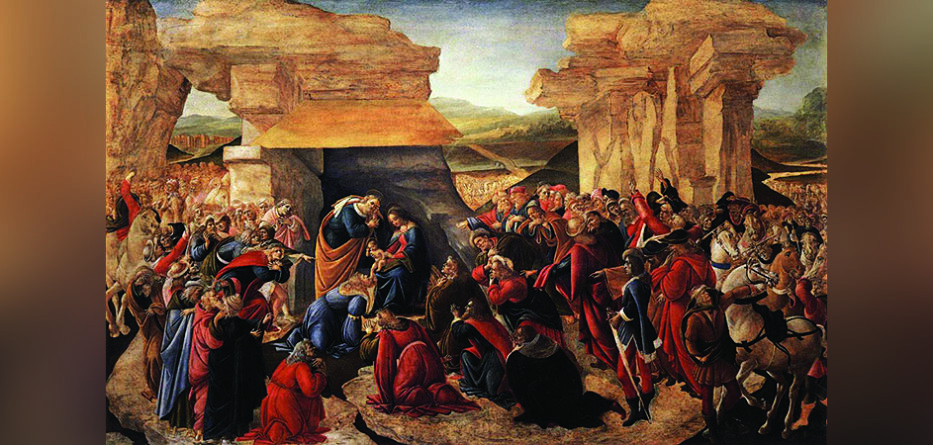
Adoration of the Magi by Sandro Botticelli (1444–1510)
Adoration of the Magi (c. 1480-1500). Tempera on panel, 108cm x 173 cm. Galleria degli Uffizi, Florence, Italy. Public Domain.
Many imagine the Magi seeing a bright star in the eastern sky, jumping on their camels and following it unerringly, first to Jerusalem where it momentarily disappeared, and then to Bethlehem where they found the Christ child. Put like that, it sounds very simple and exciting.
But the Gospel does not say that. The Gospel says they saw the star “as it rose”. It says nothing about the star actually guiding the Magi. All that is suggested is that the star was a sign that something very unusual had happened, perhaps even that someone special had been born.
The next time the star is mentioned is when the Magi were approaching Bethlehem—that is, as they reached the end of their journey. The text says: “There in front of them was the star they had seen rising” (Mt 2:9). So, we must conclude that in between, the Wise Men had travelled in darkness. And to keep going they had to seek and enquire. Their journey would have been neither simple nor easy. They must have had doubts since the journey was so long, and they must have faced dangers along the way. But they persevered, and their perseverance won them their reward.
This is why their story has such relevance for us and our faith journey. When we started out in our particular vocation, we were probably attracted by something bright—an ideal or a hope. But this initial “star” does not always remain in our sky. At times it may grow dim or seem to disappear altogether. Clouds get in the way.
We must expect to run into difficulties and doubts. Some people think they are losing their faith when they experience doubt. We should not be surprised when this happens to us. Like the Magi, we must not be too proud to ask for guidance—even professional guidance. No one of us has all the answers. We have to believe that the darkness will pass. Many of the great saints said they experienced a “dark night of the soul”.
St Peter gives us good advice: “For a short time yet you must bear all sorts of trials; so that the worth of your faith, more durable than gold, which is perishable even if it has been tested by fire, may be proved” (1 Pt 1:6–7). He suggests we listen to the words of the prophets “as to a lamp for lighting a way through the dark until the dawn comes and the morning star rises in your minds” (2 Pet 1:19).
When the Wise Men found Christ, they offered him their gold, frankincense, and myrrh. This shows what happens to those who find Christ. When we offer our love to him, he will help us to open up the treasures of goodness that lie buried inside us, so that we can offer them to our brothers and sisters, especially those who are poor as Christ was, and those who may have lost their way.
The spectacular Adoration of the Magi, with more than 80 characters, is one of Botticelli’s most successful works. The original was a tempera on monochrome wood of sepia tint. The painting was over-coloured in oil by one or more unknown painters between the 16th and 17th centuries.
The Uffizi Gallery in Florence, where the work is housed, dates the painting between 1480 and 1500. This is important because it highlights the characters present in the composition. On 23 May 1498, the Dominican monk, Savonarola, was executed in Florence’s main square, the Piazza della Signoria. He was prior at the Convent of San Marco (where Fra Angelico also lived). Savonarola did not mince his words in his preaching of the Gospel, much of his criticism directed at the current papacy. Botticelli was one of those heavily influenced by the friar’s ideas. Savonarola is on the left of the painting pointing out the Christ Child to Lorenzo the Magnificent, head of the Medici dynasty. He seems to be telling Lorenzo that one can only have faith in God who is the true sovereign of us all. The Medicis were Botticelli’s protector and sponsor.
Now, turn to the right of the painting. Between the character dressed in blue and the pounding horses is a tall and dignified man dressed in a red cloak— Botticelli’s friend, Leonardo da Vinci. And kneeling in front of the Holy Family are not three kings, but eight! Critics believe they represent the eight leaders of the Republic of Florence.
Three roads lead to the crib—the whole world is heading to the scene, which perfectly fulfils the prophecy of Isaiah (Is 60:3–7), read at today’s Mass.
Mons Graham Schmitzer
Fr Antony Jukes OFM, from Chingford, East London, joined the Franciscan Order of Friars Minor in 2002 and was ordained in 2009. He has served in a parish, youth retreat centre, and a Franciscan Study Centre, and is now the novice director in Killarney, Ireland.
Monsignor Graham Schmitzer is a retired parish priest. He was ordained in 1969 and served in many parishes in the Diocese of Wollongong. He was chancellor and secretary to Bishop William Murray for 13 years. Prior to ordination, he worked for the Department of Attorney General and Justice before entering St Columba’s College in 1962. He enjoys travelling and visiting major European art galleries.
With thanks to the Diocese of Wollongong, who have supplied this reflection from their publication, The Promise: Advent and Christmas Daily Reflections 2025. Reproduced with permission.