

Jesus uttered one of his most telling remarks when he began speaking to his close band of followers at their last meal together. He said: ‘I have wanted so much to eat this Passover meal with you before I suffer’ (Luke 22:13). We can picture Jesus giving expression to his deep feeling of connection with this group of followers. He goes on to call them ‘my friends’ raḥmi, which, in Aramaic indicates union and affection at a heightened level of intimacy that is way beyond just being companions or disciples.
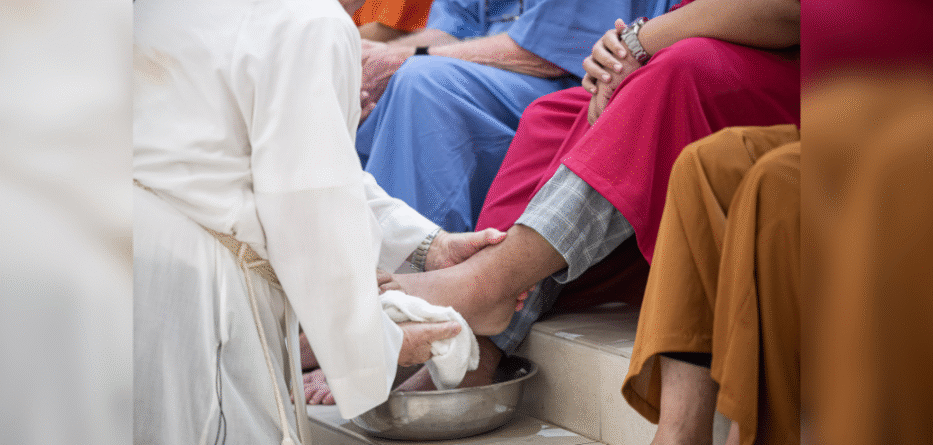
He has demonstrated his attachment to his friends by stripping down to his undershirt and loincloth and kneeling to wash their feet. In the culture of the day he is practically naked. What a gesture of service this was! It was usually the action of a servant who relayed the hospitality of the master to the honoured guest, but here it is a deliberate and totally focused gesture of service by Jesus. That’s why Peter protests. He does not want his master getting down to wash his feet. But Jesus insists on showing hospitality through his respect for and connection with ‘his own’.
When Jesus resumed his place before the food he told his friends that they should be ready to wash each other’s feet. In other words, to show the same level of connection, appreciation and love for one another as he just did. He is saying that at this thanksgiving meal, this Eucharist, they would do well to take stock of their relationship with each other. We are called to do likewise, and this involves seeing Christ in the other.
In Jewish culture back in the time of Jesus, meals were considered to be sacred acts and the same applies today. The blessings before and after the meal sanctify the gathering and the eating, and they remind those present of the goodness and bounty of God, and the value of their relationship with each other. A prime cultural value attached to a meal with family and friends was, and still is, the expression of hospitality and thanksgiving. And we have just considered how the last meal of Jesus with his friends was marked with ties of love, union, appreciation and gratitude. It is not hard to see how Jesus and his friends at that supper must have felt profoundly united and gifted.
Eucharist is not just something that becomes real at Communion time at Mass. It is not just a ‘Jesus and me’ event. Eucharist means thanksgiving and we can enrich our spirituality by seeing it as a ‘thank you’ for feeding our spiritual hunger. We hunger for connection and belonging and our union with Christ can serve to heighten our mindfulness of our union with others, with the people around us who are gathered in worship and prayer. The outflow of this is our resolution to cherish the relationships in our life. Is there someone we can reach out to; is there a relationship in my life that needs fixing?
Similarly, our union with Christ in the Eucharist is a moment of healing and forgiveness. We turn to Christ when we seek healing and we can hear his words of forgiveness, telling us that there is no end to the kind of forgiveness that is liberating. In Hebrew the common verb to forgive, between human beings, is nasa, which literally means to lift, as in lift the burden from someone. In the Greek of the New Testament forgive is aphíēmi, which means to let go, dismiss.
The Christ we welcome in the Eucharist urges us to let go of hurts and offences and lift the burden from anyone who has caused us pain. It is not a case of, ‘I forgive you’ but simply an act of refusing to hang on to an offence. It’s about letting go, looking for and appreciating the good in the other, and moving on.
It follows, then, that the spiritual nourishment we obtain from Christ in the Eucharist not only ‘fills’ us but ‘shapes’ us in our striving to become more generous and whole in our growth to human and spiritual maturity. The words of Jesus at that first Eucharist give us meaning and purpose as we nourish our relationships with him and with others. ‘Just as I have loved you, you also should love one another’ are words that inspire us to serve one another.
This article was originally published in the 2026 June | Winter edition of the Catholic Outlook Magazine. You can read it online here or pick up a copy in your local parish.