

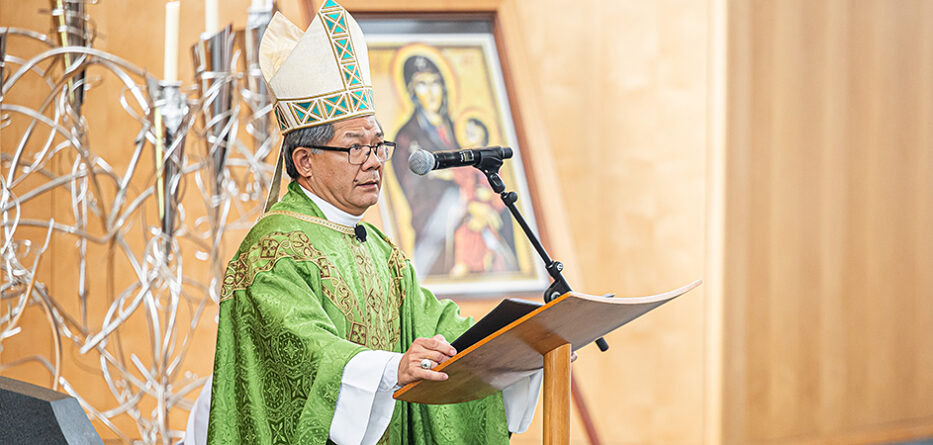
Most Reverend Vincent Long Van Nguyen OFM Conv DD STL, Bishop of Parramatta
Homily for the 26th Sunday in Ordinary Time, Year A
Readings: Ezekiel 18:25-28; Phil 2:1-11; Matthew 21:28-32
God’s radical love reaches the forgotten and discarded
Dear friends,
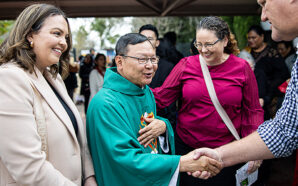
This morning, we gather to commend to God our new Pastor Fr Jobi Payyappilly -a missionary of Our Lady of La Salette- who has generously accepted this ministry of pastoral care and leadership. We pray that together Fr Matthew Dimian, Deacon Jerome Emmanuel and above all the faithful of St Aidan’s, he will further enrich the great tapestry of faith, witness and community engagement here at Rooty Hill. Just a few weeks ago, we celebrated the 45th anniversary of the parish. We paid tribute to the faith, dedication and selfless service of our pioneers, pastors and parishioners. Today, we renew our commitment to follow their footsteps as we begin a new chapter of the parish life with Fr Jobi.
As disciples of Jesus, we are called to distinguish ourselves by the way we live and share our faith. We are especially challenged to accommodate those who are marginalized and excluded by the society so that they may feel welcomed and empowered to achieve their potential. Following the God of the Covenant and inspired by the boundary-breaking way of Jesus, we are committed to build a community that lives by the power of the Crucified and reflects his radical solidarity with the outcasts and expendables of our world.
The liturgy today affirms God’s self-disclosure that no one is beyond his merciful love. In the first reading, Ezekiel speaks to the second generation of Jewish exiles who felt hard done by. They were caught up in this struggle that began before they were born. Isn’t this the common refrain even in our own time? “We are not responsible for the mistakes of our forebears” we often hear it said. Ezekiel proposes a different course. The experience of injustice and hopelessness is not an inescapable fate. It is possible to break free from this if we all contribute to the change. Personal and collective conversion to truth, justice, love and compassion will end the sad legacy of sins and cross-generational inequities.
In the Gospel, Jesus continues to portray a God who is interested in reaching out to those on the margins and making outsiders insiders. Last Sunday’s parable of the workers in the vineyard is a lesson in radical neighbourly care and generosity. In the parable, Jesus subverts merit-based mentality and demonstrates a divinely inspired model of outreach, inclusion and flourishing for all. Today’s story continues the theme of God’s boundary-breaking and subversive way. He makes himself close to the undesirables rather than those who pride on their merits.
In a culture of honour and shame, tax collectors and prostitutes carry the worst possible social stigma. By crafting the parable in their favour, Jesus reverses the table. The lowly and despised who avail themselves of God’s mercy are reckoned righteous. The privileged who see no need of repentance are condemned for their arrogance. In God’s Kingdom, the outsiders can really become insiders, and the insiders can become outsiders. There is no one who we can write off as being too far outside God’s reach.
Jesus’ critique is not limited to individuals. We must be humble enough to examine whether our faith community has a kind of a “second son” culture, that is, we display symptoms of a judgemental, closed and insular community. Pope Francis was fond of saying that the Church is not a museum for saints or an enclosure for the virtuous. It is more like a field hospital, which heals the wounded, strengthens the weak and lifts up the lowly.
Dear brothers and sisters,
When we survey Jesus’ interactions with the people, those who showed great faith, openness and receptivity to him were not always the standard bearers, not always those who were of his race, religion, or even kindred. Instead, we found to our surprise, they were the unlikely characters: the lepers, the beggars, the foreigners, the tax collectors, even prostitutes and sinners.
The Gospel today challenges us to be a model community of mercy, inclusion and solidarity. Jesus who associated himself with the lowly and at the same time laid bare the narrow mindset of the privileged. At the end of the day, it is by our works of love, outreach and care for the oppressed and disadvantaged that set us apart as his true disciples. The world operates like an organised pyramid scheme. The model that Jesus teaches us is one that ensures the weakest links among us are not forgotten and disregarded.
St Paul gives us a magnificent reflection of the self-emptying of Christ which is a pattern for all of us. It is his downward journey in order to demonstrate God’s radical love that sees him raised as the King of kings and Lord of lords. For those who follow him, the downward journey is the path of transformation. Let us endeavor to live the radical grace of God that turns outsiders into insiders. As we recognize our own need of repentance and conversion, let us be the Church that is the agent of justice, reconciliation and healing in the world. Let others recognise the power of our God at work within and even beyond our own circle.