

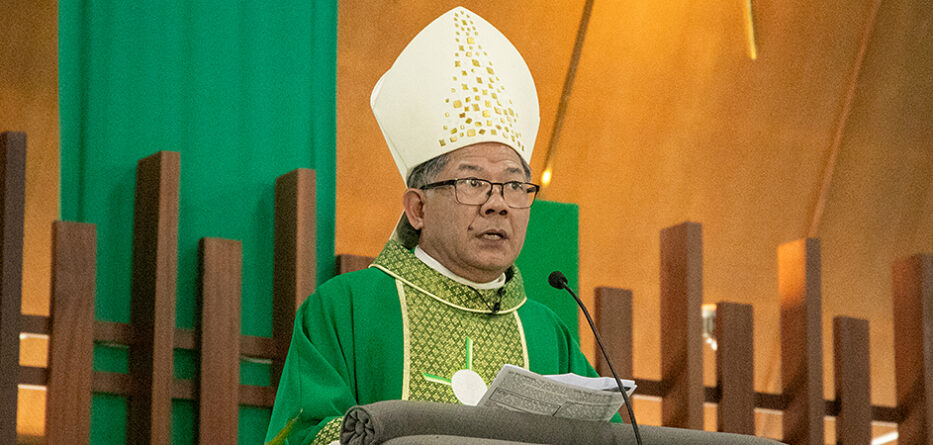
Most Reverend Vincent Long Van Nguyen OFM Conv DD STL, Bishop of Parramatta
Homily for the 28th Sunday in Ordinary Time, Year A
Readings: Isaiah 25:6-10; Phil 4:12-20; Matt 22:1-14
Authentic discipleship by faith in action
Dear sisters and brothers,
We live in a world where individual success is pursued more than the common good, self-survival is prioritized over shared security, domestic interests are sought at the expense of international obligations. Yet we also know that we are all connected and that no one is safe until everyone is safe. The pandemic, the climate crisis and other global events have shown that if we are to flourish into the future, we need to move beyond self-interest and our narrow framework of resource competition.
The Word of God today speaks to us about the call to be a community of hospitality, inclusion and care for all people. Equipped with the Gospel and the best of our Judeo-Christian heritage, we can be the antidote to the destructive scapegoating forces in our society. The Church can become a place where God’s love, compassion, healing and restoration can be manifest. In Jesus, God calls us and forms us into the living embodiment of hope for the hopeless and dignity for all.
In the first reading, we hear a hopeful message from the prophet Isaiah who lived during a very tumultuous time in Israel’s history. His people had known humiliation, displacement, suffering and death through a long harrowing exile in Babylon. Isaiah speaks to these painful experiences. He maintains against all evidence to the contrary that God will refashion a battered nation. A veil of mourning will be removed, and a banquet of rich foods will be prepared for the poor and the remnant faithful. Isaiah reframes the experience of his people in new and hopeful horizons. The exile, he insists, will have a transformative effect.
Isaiah’s mountain banquet of rich foods and fine wines is not an imaginary utopia. The mountain has long been a symbol of God’s presence and of Israel’s vocation as a beacon for a divinely fashioned humanity. She is to be God’s vehicle of healing and restoration “all peoples and all nations”. Through her own painful experiences, Israel learns to be the healer only to its own citizens but to all suffering peoples of the world. This is the call to care for universal justice and empathy by Isaiah.
Banquets and feasts are also familiar symbols in the teachings and actions of Jesus. We recall the many times he shared food and drink with the poor, the hungry, the sinner, the disenfranchised and marginalised. He showed what God’s love was like. It transcends all human barriers; it overcomes fears; it empowers even the write-offs among us to be their best. We also recall the many parables that have to do with banquets. These are not just food sharing events. They invite the guests to play an active part in the project of God’s Kingdom. The banquets are metaphors for mission. The guests don’t simply eat and drink. They participate in God’s plan for the transformation of the world.
Matthew often uses small but significant symbols to highlight the importance of missionary discipleship. Thus, for instance, the guest without the proper garment is removed. The garment stands for one’s commitment to Christian living without which there is no admittance to the kingdom. Likewise, in the parable of the bridesmaids, there is no substitute for the oil of service, love and compassion.
For Matthew and the early Christian community, it is faith-in-action that matters. True discipleship consists in living out its demands, especially the duty of care to the least and the last, the disadvantaged and the forgotten. Today’s parable can only be better appreciated in conjunction with the parable of the sheep and goats. In other words, it is not one’s self-made status, privilege and connection but discipleship in action that counts. Matthew’s wake-up call to rank-and-file Christians is as uncomfortable and challenging today as it was 2000 years ago. In God’s scheme of things, those who think better of themselves may be outdone by the outsiders.
Dear brothers and sisters,
In time of fear, uncertainty and scarcity, many choose to withdraw into a self-centred mode and grievance against others is becoming more mainstream. We can learn to act according to our better natures. The Word of God calls us to see our fellow human beings in the spirit of Jesus. Like the first Christian community, let us choose and make the Church a place where everyone experiences the divine hospitality, kindness and generosity. Let us become a banquet hall that admits everyone and a society that mirrors God’s inclusive embrace. St Paul assures us that whatever we do to others, God will lavishly fulfill our needs. For he is never outdone by hospitality, kindness and generosity.
Guided by the kingdom vision of Jesus, we can live up to our prophetic call to be a beacon hope for humanity. We can be a Church that advocates life at all costs and promotes peaceful life in a war-torn and violent world; a Church that models justice in an age of greed, consumerism, and power; a Church centred on the risen Christ, empowering a consciousness of the whole. As we share at the table of God’s plenty, let us endeavor to reflect his goodness to us in the way we care for one another. Let us be known as authentic disciples by way of our faith in action.