

Isaiah 25:6-10a; Psalm 23; Philippians 4:12-14,19-20; Matthew 22:1-14
Listen at soundcloud.com
Just when you thought Jesus’ parables about the kingdom of heaven could not get any more violent, we have today’s wedding parable from Matthew Chapter 22. Last Sunday we listened to vineyard tenants who assaulted and killed the owner’s workers. Today we have invited wedding guests deciding to kill the king’s servants who simply came to remind the guests that they were invited to the son’s wedding and that all was now in readiness. The king then takes his revenge. He sends his troops to kill the murderous guests and to burn their city. All this before the toast to the bride and groom.
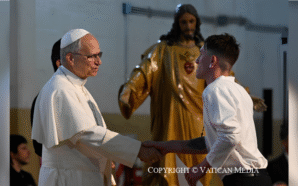
Even those invited guests who did not involve themselves in murder declined to attend the wedding banquet. They all had better offers. So the king gets the servants to go out to the highways and byways to invite anyone they come across. All are invited, good and bad alike. None are excluded. It’s reminiscent of Pope Francis at World Youth Day proclaiming ‘Todos, todos, todos.’ No one is excluded. Everyone has an invitation to the table of the banquet.
But then lo and behold, one guest who has come straight from the byways has turned up without a wedding garment. He probably couldn’t afford one, and even if he could, he probably had no time to go home and change. The king then descends on that underdressed guest and gets his attendants to bind him hand and foot, casting him out into the darkness where there will be wailing and grinding of teeth. Where’s the justice in that? Where’s the mercy in that? After this one last violent act at this sumptuous wedding banquet, Jesus simply declares: ‘Many are invited, but few are chosen.’
So what point is Jesus wanting to make? Or more accurately, what point is Matthew wanting to make to the Matthean community embellishing a wedding parable which Jesus often told? Remember that this is a mixed Jewish and Gentile community which has witnessed the destruction of the Temple in AD 70 as well as the mistreatment of early Christian missionaries. They are used to violence. They hear promises of the kingdom when surrounded by violence.
Scripture scholar Daniel Harrington tells us: If Matthew is describing ‘the events of AD 70, then one can see Matthew’s interpretation of the destruction of Jerusalem: God brought it about because some in Israel rejected the invitation to God’s kingdom (the gospel) and mistreated his messengers (especially Jesus). Since the parable was directed to the chief priests and Pharisees, the ones really responsible for Jerusalem’s fall were its alleged spiritual leaders.
‘The parable of the wedding feast is an outline of salvation history from a Christian perspective. It explains the fall of Jerusalem and the inclusion of marginal people in God’s kingdom. But it also provides a warning that mere admission is not enough; an appropriate response is needed.’[1]
For us moderns, the excessive violence in the parable can be very off putting. But there are times when we need to consider the violence in a situation in order to comprehend the grace and giftedness at work.
I have just spent a fortnight in the Kimberley in Western Australia. At Warmun, I visited the local Aboriginal community which has a disproportionate number of artists, one of whom was the late Hector Jandany. Hector often pointed out the whipping tree where Aboriginal persons like his grandmother were chained and whipped. The punishments would be meted out by white pastoralists for cattle theft or simply because the offenders were judged to be wild and uncontrollable. When the Josephite sisters built a school at Warmun in 1979, Hector insisted that the school should face the whipping tree. He told the sisters:
‘This is our place
This is the heart, this bloodwood tree.
At this place we remember the story of suffering,
being chained and “belted”.
At this place we remember
and we forgive.
Now we walk on together.’
This year, the whipping tree was cut down and part of it was preserved in resin. It now adorns the entrance to the school, together with George Mung Mung’s sculpture Mary of Warmun. Earlier this year, Hector’s grand daughter Roberta Daylight planted a healing tree where the whipping tree used stand. Last week, George Mung Mung’s son Patrick welcomed me to the school and showed me his father’s sculpture and the beautifully preserved portion of the whipping tree, polished and mounted in resin. On the wood is a plaque bearing those words of healing which Hector spoke to the sisters:
‘This is our place
This is the heart, this bloodwood tree.
At this place we remember the story of suffering,
being chained and “belted”.
At this place we remember
and we forgive.
Now we walk on together.’
I contemplated the violence of the frontier four generations ago which found expression in that whipping tree. And here we were celebrating the healing which is possible when the present generation walk together. I could not contemplate the story, I could not understand the significance of what I was seeing, except by considering the wanton violence practised in that place. It’s the violence of the whipping tree that gives such significance to the healing tree that has been planted in its place.
The Matthean community could not comprehend the giftedness of the kingdom of heaven and the bounty of the banquet without considering the violence which accompanied Jesus’ invitation to all, including the old religious authorities who resisted and rejected his call.
Contemplating Hector’s grandmother chained to the whipping tree and Hector’s grand daughter planting the healing tree, we rejoice that the invitation to the kingdom is extended to all, no matter how adverse the circumstances. As Isaiah puts it in today’s first reading:
The Lord God will wipe away
the tears from every face;
the reproach of his people he will remove
from the whole earth; for the Lord has spoken.
On that day it will be said:
‘Behold our God, to whom we looked to save us!
This is the Lord for whom we looked;
let us rejoice and be glad that he has saved us!’
For the hand of the Lord will rest on this mountain.
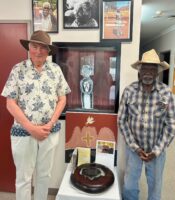
Fr Frank Brennan with Patrick Mung in the presence of Mary of Warmun and the Whipping Tree in Resin
Fr Frank Brennan SJ AO, Adjunct Professor of Thomas More Law School at ACU and Adjunct Research Professor at the Australian Centre for Christianity and Culture, is a former Rector of Newman College, University of Melbourne, and CEO of Catholic Social Services Australia (CSSA). His latest books include Pope Francis: the Disruptive Pilgrims Guide (ATF Theology, 2025), and Equality, Reconciliation and Social Cohesion: The Inspiration of Sir William Deane (Connor Court, 2026).
[1] Daniel J. Harrington, The Gospel of Matthew, Sacra Pagina Series (Collegeville, MN: Liturgical Press, 2007), 308.