

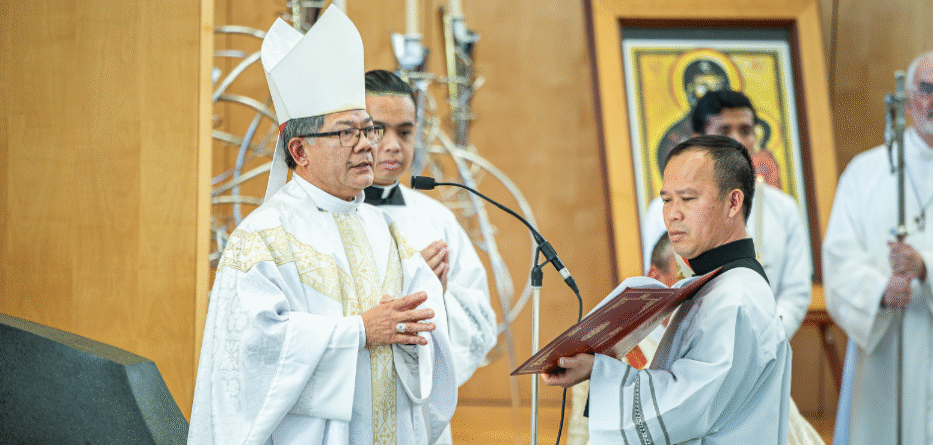
Most Reverend Vincent Long Van Nguyen OFM Conv DD STL, Bishop of Parramatta
Homily for the Solemnity of Christ the King 2026
Readings: Ez 34:11-17; 1Cor 15:20-28; Mat 15:31-46
The King who is one with the neglected, abandoned and forgotten
Dear sisters and brothers,
Today, Catholics and other Christians around the world pause to celebrate the Feast of Christ the King. In many places including here in Sydney, the celebration involves street procession with Catholic symbols, banners, prayers and hymns.
In recent years, though, this ancient proclamation has increasingly been used for less than noble purposes. “Christ is king” and similar phrases have been chanted at political rallies, posted on social media, and proclaimed in speeches by voices that are hostile and contemptuous towards minority groups in the community.
Nothing can be further from the truth than the idea of Jesus being associated with the worldly power and dominance to the exclusion of non-Christians. The Gospel is at pains to point out that Jesus was not the king of this world. In fact, he was a king who turned upside down the conventional understanding of kingship. He was a king who rode on the back of the donkey, who mixed with the outcasts and washed the feet of others. He was not a warrior but a peacemaker. He was not a conqueror through domination and violence but a humble servant who sought out the neglected, abandoned and forgotten.
The Word of God today challenges our assumptions, certitudes and prejudices. The kingship of Jesus is not about asserting Christian supremacy but about rendering service to those on the receiving end of societal indifference. Our Christian faith will be less than authentic if it does not break down every barrier, or bring close those who are distant, unite strangers, and reconcile enemies. For Christ the King demands nothing short of a radical alignment of our attitude and behaviour with his vision of a dignified life for all.
In the first reading, Ezekiel speaks to the weary exiles and consoles them with a prophecy of the good-shepherd king. Both in Palestine and now in Babylon, the Jewish people have experienced largely a succession of oppressive and ruthless regimes. Ezekiel condemns the ruling class who fails in their duty of care for the people. He reassures them that God will triumph over the forces of evil and oppression. The new ruler will bring about a new era of justice, equity and righteousness. He will be like a caring shepherd who will “look for the lost sheep, bring back the stray, bandage the wounded and make the weak strong”.
We can hear echoes of Ezekiel’s prophecy in the way Jesus critiques the ruling elites of his time. He often condemns them for being more concerned about their status and power than integrity, justice and love. For him, the ultimate requirement, the litmus test of authentic leadership has to do with service and especially service rendered with humility to the vulnerable and the outcast.
The Gospel parable of the final judgment makes this litmus test crystal clear. The king does not judge his subjects on any other criteria than their ability to recognise and serve him in their fellow human beings. The parable subverts our idea of who and what constitutes the ideal, the normative and the worthy. The more deserving of God’s loving embrace turn out to be the ones we often neglect and reject. In Jesus who surrounds himself with the outcast, we see a God of solidarity and vulnerability. In Jesus, we meet a God who disturbs our comfort and pushes us out to the periphery to be with the least of his brothers and sisters.
Jesus is the King, but one who identified himself with the marginalised. He walked the dangerous walk with people who were kept at a distance from the powerful and the privileged. We must challenge the prevalent mindset of dominance and exclusion. We must follow his example in forging common bonds of humanity in the face of fear.
Dear brothers and sisters,
Today, we commend to God our young leaders involved in Youth Ministry and School Leadership. I am proud of the way you are committed to sharing and witnessing to our Catholic faith. In so many ways: Good Friday Night Walk, Food Van, Lifted Live, Faith in Action and Social Justice Initiatives, Special Religious Education etc, our young people are living out the compassion of Jesus the King. We may not enjoy the institutional popularity, influence. and affluence of yesteryears, but we can be sure that faith lived integrity, humility, empathy and generosity will make us into a force of leaven for the world.
We are called to build a new kingdom in which the cosmic Christ is its centre. In a time of rising tensions and divisive ideologies, our challenge is to embody the inclusive kingdom vision of Jesus –one that is rooted in justice, compassion, solidarity and service. Only by living that vision fully as the Body of Christ, can we become a lighthouse for the world. Let us renew our commitment to bring the kingdom vision to life in all of our endeavours, confident of the day that St Paul says, “everything is subjected to him, so that God may be all in all”.