

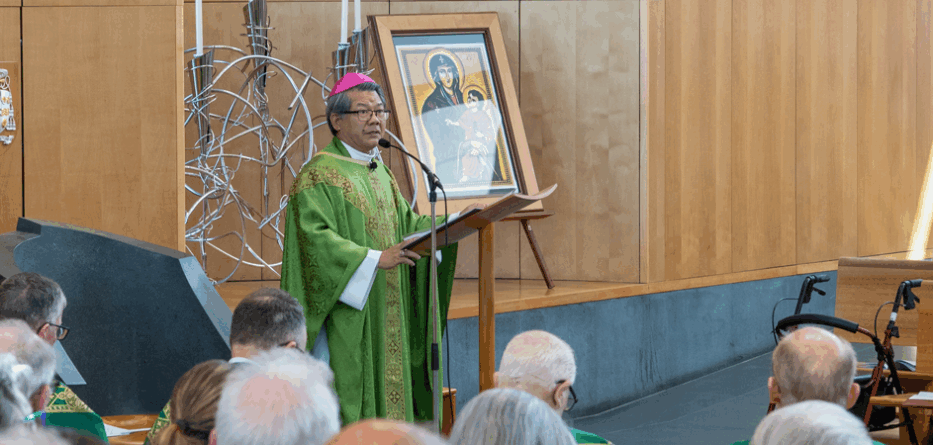
Most Reverend Vincent Long Van Nguyen OFM Conv DD STL, Bishop of Parramatta
Homily for the 24th Sunday in Ordinary Time, Year A
Readings: Ecclesiasticus 27:33-28:9; Romans 14:7-9; Matthew 18:21-35
Embracing forgiveness and reconciliation in times of division
Dear brothers and sisters,
We live in a world where violence which is directed against an enemy can become a solution during times of crisis. This has been illustrated by the so-called war on terror that followed the infamous day of September 11th, 2001. Not only vengeance and retaliation are directed to the enemies abroad, among armed groups, rebel militias and hostile regimes, suspicion and hatred are also aimed at those among us who are seen as outsiders. The fear of the other has become corrosive and destabilizing to the very fabric of our multiracial and multicultural society. In the time of economic hardship, this fear is fuelled even more by discontent and frustration.
As people of faith, we are called to resist this impulse and choose the path of peace and reconciliation. In the face of violence and despair, our belief in the message of the Resurrection compels us to act with justice and compassion. As Catholic people whose faith by its name is universal, we must unceasingly uphold the dignity and value of all human beings.
It is in this context that the Word of God speaks to us. It calls us to build a community where relationships are nurtured, and lives are transformed. The message of love, mercy and compassion within God’s vision of communion, solidarity and distributive justice is set against the ruthless, competitive, inhumane, survival-of-the-fittest mindset of the world. We are challenged to stretch the limits of our capacity to love in the way that mirrors the boundless mercy of God himself. Only by living and witnessing to the message of love, mercy and compassion can we be the authentic disciples of Jesus and the voice of conscience for our society.
The book of Ecclesiasticus exhorts us to show love in place of hate, compassion in place of resentment and forgiveness in place of anger. Jesus likewise teaches us to forgive not 7 times but 77 times those who have offended us. This is a way of saying forgiveness is an essential requirement for faithful Christian discipleship. Forgiveness is meant to be our way of life. There is no limit to forgiveness just as there is no limit to love, which is revealed in Christ.
At face value, the command to forgive again and again seems humanly impossible. But the good news in all this is that we are not alone when we are called to forgive or to seek reconciliation. In it all, God is with us. God has incorporated us into his own very being by his gift of life and love to us. He has shown us the ultimate image of forgiveness when Jesus died on the cross for us all. Forgiveness is only possible if we remember God is within and God is our strength. That promise upholds us even when our willingness to reconcile with another or forgive is rejected.
We are called as Christians to witness to the incredible forgiving love of God in Christ. “Forgive us our sins as we forgive those who sin against us”. Forgiveness is possible because we have been reconciled with God in Christ. Within his life, suffering death and resurrection, there is a relationship that holds –a relationship between God and humanity revealed as indestructible. A love crucified but not destroyed. It is this love that has lived and poured out life and love and forgiveness ever since. From here on, human struggles for life, love and forgiveness will not be in vain.
Our mission is to forgive, and to reveal the forgiveness of God, in and through Jesus Christ. We learn to be a forgiving and inclusive Church – a Church that reaches out to those who struggle and fall short of the Christian ideal; a Church that does not demean or marginalize people on account of their estrangement for one reason or another. It is a Church that dialogues, accompanies, encourages, engages with people’s struggles, wounds and failings.
Brothers and sisters,
Jesus today presents a new model of solidarity -not violence and destruction—that will ultimately open up a space to enable change and address the roots of social crises. His death and resurrection mean that God has reset the cycle of human behaviour. It has enabled us to build a new future with the very people whom we regard as outsiders and enemies. We must follow his example in forging common bonds of humanity in the face of fear. We must be a community of hospitality, compassion and neighbourliness that serves as reminder to what our nation can be and should be.
May we learn to experience the depth of God’s forgiving love in Christ and may we in turn learn to expand our hearts, stretching its limits to match the breadth and the height, the length and the depth of God’s love.