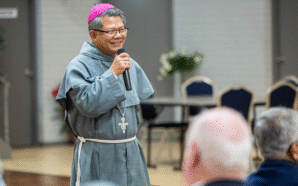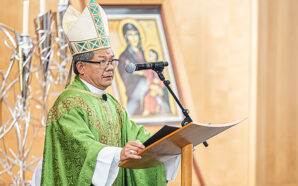


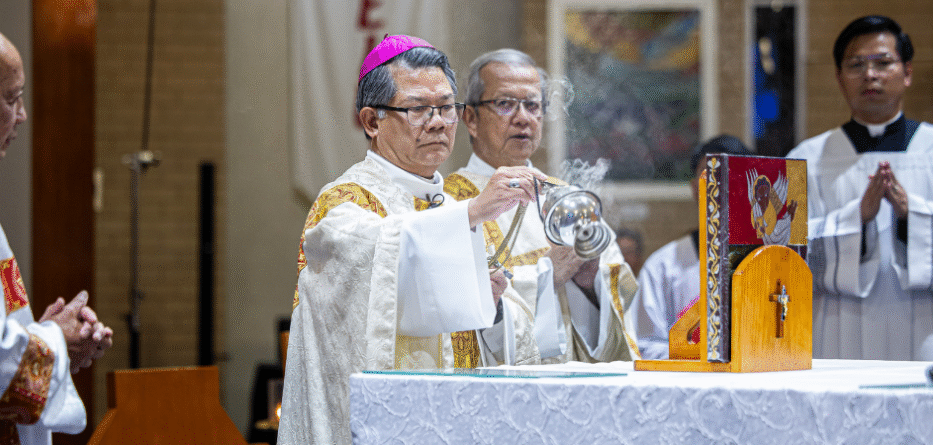
Most Reverend Vincent Long Van Nguyen OFM Conv DD STL, Bishop of Parramatta
2026 Corpus Christi – Embodying Jesus’ generous, daring and subversive love
Readings: 8:2-16; 1Cor 10:16-17; John 6:51-58
Dear friends,
Corpus Christi is one of the most cherished feasts in our Christian calendar. When I was a child preparing for First Communion, it was the most exciting experience to dress your Sunday’s best and walk behind the priest carrying the monstrance. In some countries, there are many folk traditions attached to this feast such as street processions, dances, floral decorations and other popular festivals.
Corpus Christi, however, is much more than the outward symbols that are part of the cultural Catholicism of yesterday. It challenges us to be the Body of Christ for others. Just as Jesus gave himself to us, we are to be his body broken and his blood poured out for others. The Eucharist nourishes us with the life and love of God totally poured out in Christ so that we can love and serve one another as he commanded us. It strengthens us as we follow the way of Jesus in transforming lives and relationships and thus bringing about God’s plan for all humanity.
Scriptures today speak of transformation as the ultimate goal of Christian discipleship both individually and collectively. Moses in the first reading interprets for the people the meaning of their experience in the wilderness. “God humbled you,” he says “and made you feel hunger and then fed you with manna in order to make you understand that man does not live on bread alone but on God’s word.”
In the exodus, Israel was called to a higher destiny which was to become the beacon of the new humanity. The miracle of manna was not simply meant to satisfy their physical hunger. It was a sign that God acted outside Pharaoh’s monopoly and formed them into an alternative society. Israel was made to understand that they must pursue God’s covenant of mercy, justice and shared dignity rather than Pharaoh’s system of self-interest and greed. “Living on God’s Word” is a metaphor for a spiritual resistance. This antidote against the imperial paradigm of competition, dominion and zero-sum game would run throughout the sacred history.
In the Gospel story which follows the miracle of the loaves and fishes, Jesus challenges the people to look beyond their daily preoccupations and immediate concerns. He points them to the deeper level of human living and flourishing, which is made possible not through the self-centred and survival-oriented behaviour but through the self-giving love made manifest in his own life.
This fundamental teaching of Christ is already implicit in the feeding of the multitude. The miraculous meal was not just a stopgap measure and a temporary relief to a group of hungry individuals. It typifies the way Jesus reaches out to the poor, the humble, the dispossessed, the hungry and the oppressed of the world. We think of the many meals Jesus eats with the ordinary and the unworthy. Those who participate at God’s table must meet the needs of others in the style of Jesus. In the words of Mary McKillop, we cannot see a need and remain indifferent to it. We cannot but respond with the generosity and compassion of God shown in Christ.
We are challenged to reclaim our identity as Eucharistic people. St Augustine put it like this: “Receive what you already are and become fully what you have received”. Corpus Christi is to become what we eat, to be another Christ for others, to be Eucharistic in our self-giving love, in our reaching out and in our embrace of all people in the manner Jesus showed us. St John Chrysostom, a contemporary of St Augustine shows the link between the Eucharist and love of others in this way: “If you cannot find Christ in the beggar at the Church door, you will not find Him in the chalice.” Indeed, communion with the poor is the pathway to God. We can therefore only be true to our Eucharistic identity when we recreate Jesus’ self-giving love for others; when we enflesh God’s abundant and limitless love for the world.
Dear friends,
Today, we joyfully mark the 61st anniversary of our parish family. Like the story in the Gospel, in which Nathanael asks Philip if there is anything good coming from Nazareth, we also want to say to the naysayers to Mt Druitt, “Come and see”. Yes, come and see how the Catholic people here worship joyfully, celebrate their incredible diversity, serve the poor, engage with indigenous people and embody God’s daring and subversive love. From the Baabayn Centre to the Aboriginal Catholic Services, from the Ignite Shop to SVdP Hub, from the Holy Family School to Ambrose Centre, this community is alive with the Gospel spirit. We endeavour to demonstrate the richness, vitality and beauty of diversity like the first Pentecost.
Corpus Christi highlights for us what it means to be a disciple and what it means to be a body of Christ. Let us strive to imitate the self-giving nature of our God himself. Let us commit ourselves to the journey of transformation, individually and collectively. May we grow daily into the Eucharistic Christ who reaches out to all people and leads them to the heart of God. May we model our lives on the one who came to that all have life and have it to the full.