

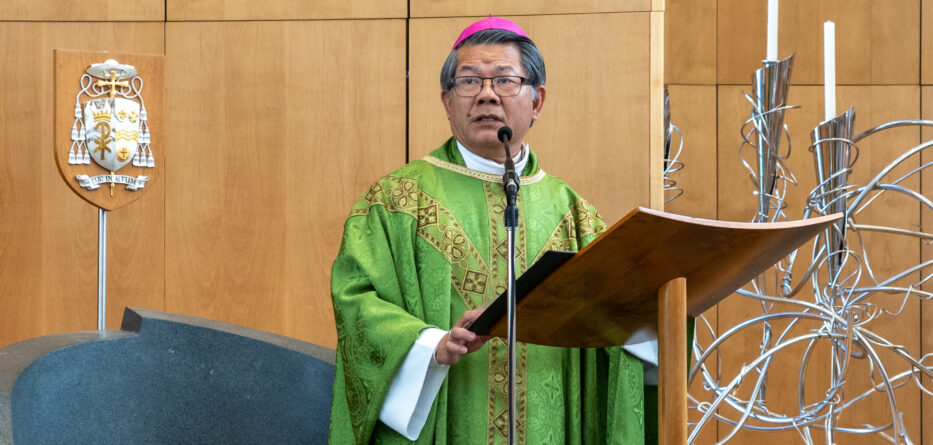
Most Reverend Vincent Long Van Nguyen OFM Conv DD STL, Bishop of Parramatta
Homily for the 20th Sunday in Ordinary Time, Year A
Readings: Is 56:1-7; Romans 11:13-32; Matthew 15:21-28
Dear brothers and sisters,
We live in a time of heightened tension. Economic hardships, including the housing crisis and the cost-of-living pressure, have created a fertile environment for fear, suspicion and grievance. The rise of populism has shaken the long-cherished sense of Australia fair which encapsulates the best of our spirits. We pride on being an egalitarian, decent, caring, looking after the battler and fair-dinkum kind of society. Yet increasingly, we are challenged to confront the forces of divisiveness and the “us versus them” mentality. Positive change will not be facilitated by the scapegoating of those deemed to be less deserving. Transformation will not flow freely through the barriers of our fear, entitlement and exclusion
As Catholics, we are galvanized by the conviction that only a society which is aligned to God’s pathos is viable. It is more important than ever that we do not lose sight of our mission, which is a sacrament or a vehicle of God’s all-embracing love for the world. Against the forces of self-interest, we therefore prioritize the social transformation rooted in civility, dignity, solidarity and flourishing for all.
The Word of God today reminds us of our duty to bring people into the fullness of God’s shalom, rather than shutting them out in a zero-sum game. We are inspired by Jesus’ word and example to enable strangers and outcasts to be stakeholders in new social possibilities. This is essentially the best of the Judeo-Christian heritage. It is the distinguishing mark of the early Jesus movement. The Church continues to be stewards of this noble enterprise.
In the first reading, the prophet Isaiah reminds the people in exile: “Have a care for justice, act with integrity and the Lord’s salvation will come”. He then goes on to spell out in concrete terms what it means to care for justice and to act with integrity. It means to embrace foreigners and others who are considered outsiders. “My house, Isaiah proclaims, shall be called a house of prayer for all peoples.” This proclamation is no small matter to the Jewish exiles. It amounts to a seismic shift in their understanding of who God is and what it means to be his people: a tribal deity gives way to a universal and all-embracing God. Through her own suffering, Israel learned to bring God’s healing not only to its own citizens but to all suffering peoples of the world. Perhaps, that was the greatest learning for God’s people in the time of trial. It was a silver lining in the dark cloud of the long exile.
In the Gospel, the message of Isaiah is further reinforced and enhanced by the example of Jesus. The story of the Canaanite woman is a powerful vehicle for the radical vision of what the kingdom of God is like. It breaks down the walls that separate us because of race, gender, status and the like. The story is an example of God dismantling these walls. In challenging societal prejudice and stereotyping against her, the Canaanite woman defends her place in God’s household.
Jesus recognizes the strength of her faith and courage. He praises her “Woman, you have great faith. Let your wish be granted.” In recognizing the faith of a Gentile woman, Jesus makes a hero out of an antihero in conventional wisdom. This is his trademark. He makes a hero of a Samaritan leper, a Samaritan woman, a tax collector Zaccheus, a blind beggar Bartimaeus and other marginalized characters. He turns our sense of privilege and entitlement on its head. He shakes us out of our comfort zone. He challenges us to cross new thresholds and boundaries in order to appreciate “the otherness” of God.
Paul understands the implications of God reconconciling all and reconfiguring a new reality in Christ. He writes in the second reading that the admission of the pagans into the household of God is nothing less than a resurrection from the dead. The pagans here can be understood not only in terms of non-Jewish people but also those considered outsiders by virtue of their class, status, nationality, gender or circumstances. Hence, elsewhere he writes “In Christ, there is neither Jew nor Greek, slave nor free, male nor female, for you are all one in Christ Jesus.”
Dear brothers and sisters,
In the light of the Scriptures today, we pledge to create an environment where fear of differences is replaced by encouraging all people to share their gifts. The default social system often turns us into rivals, but God calls us to a different way: working together, needing each other, being the body of Christ.
This weekend, we also celebrate Mary’s Assumption. She is glorified in this way because of her divine motherhood. But insofar as she is also the mother of all who those who are members of God’s household, she is the sign of hope for humanity. Her faith and active discipleship enabled the victory of God to manifest itself in the world. She followed the downward journey of Christ in serving others in every kind of need. May we who honour Mary today be inspired by her to live out our discipleship of commitment and service. Then we too may be counted among her sons and daughters in the glory of God’s kingdom at the end of time.