

It’s not just about the liturgy.
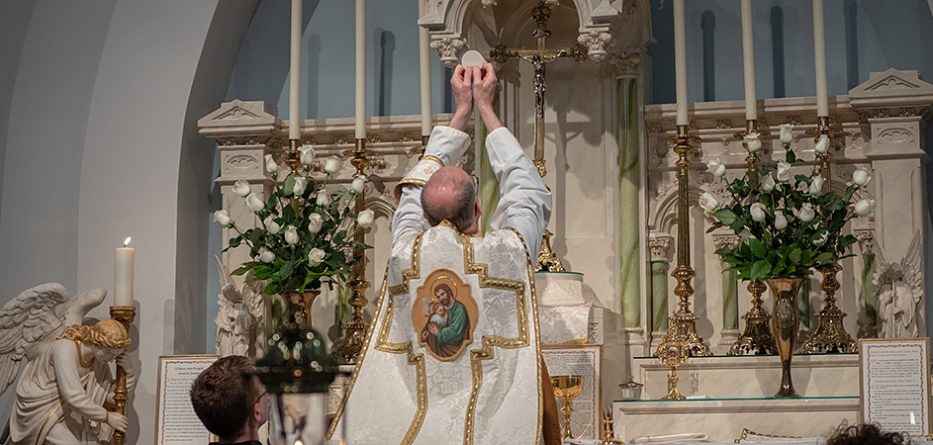
I wonder what Bishop Marcel Lefebvre would make of Cardinal Raymond Burke celebrating the pre–Vatican II “Latin Mass” in St. Peter’s Basilica on October 25. Lefebvre, of course, was a seminal figure in traditionalist Catholicism, who early on distanced himself from the reforms of Vatican II and in 1970 founded the Society of Saint Pius X (SSPX) to train traditionalist seminarians. The SSPX was canonically suppressed by the Holy See in 1975, but Lefebvre termed the action illegal and decided to ignore it. Then, in 1988, Pope John Paul II declared that Lefebvre was automatically excommunicated for consecrating four bishops that year without the Vatican’s permission.
The years between 1970 and 1988 were an uncertain period of negotiations between Lefebvre and Rome as it tried to contain a visible but fairly small movement. In July 1977, the year after the publication of his pamphlet I Accuse the Council!, in which he called Vatican II “the Yalta agreement of the Church with its worst enemies [and], in reality, a new betrayal of Our Lord Jesus Christ and His Church,” Lefebvre embarked on a tour of the Americas, including the United States. Mexico refused him entry; governments in other countries prohibited him from holding public Masses, and he was subjected to strong criticism from Church hierarchs in Argentina, Brazil, Chile, and Colombia.
That was almost fifty years ago, when Catholic traditionalism was led by a French prelate based in Switzerland, with a global but small following and a theological posture defending the tradition unadulterated by Vatican II. Today, the traditionalist movement is still small, but less marginal than it was in the 1970s, and its geographical center of gravity has shifted from French-speaking Europe to the United States. Its normalization relies on, and parallels, the crisis of faith in our liberal and democratic systems.
Living in the United States for twenty years, I observed the rise of Catholic traditionalism in a country consequential for the global Church. In articles I wrote for Commonweal, I looked at the trajectories of the traditionalist movement: the differences between the early post–Vatican II French-speaking traditionalism and the new English-speaking and American neotraditionalism; the connections between nineteenth-century integralism and contemporary political illiberalism; and the anti-Roman turn of American Catholic traditionalism during Francis’s pontificate. We may now be facing a new chapter in the history of Catholic traditionalism. With the death of Benedict XVI on the last day of 2022, traditionalism’s adherents lost the most powerful advocate in favor of their liturgical agenda. The embattled implementation of Pope Francis’ motu proprio Traditionis custodes, which restricts the celebration of the Tridentine Mass of the Roman Rite, became the showdown Benedict never imagined. His dream of a virtuous coexistence between the two forms of the Mass (expressed in his letter to the bishops in 2007, on the same day of the publication of Summorum Pontificum) was never realized: “It is a matter of coming to an interior reconciliation in the heart of the Church.” The opposite occurred. The death of Francis and the election of Leo XIV have raised hopes among traditionalists that a reversal of Traditionis custodes is in the offing.
But Catholic traditionalism has more than the reversal of liturgical reform on its agenda. The fight against Vatican II has morphed into a fight against synodality and related topics, like the shift from clericalism to co-responsibility and calls for a more visible and official role for women in ministry and inclusion of LGBTQ+ Catholics. The traditionalist movement still has visible clerical leaders because they are, by default, necessary to reversing liturgical reform. But clerical leaders are more marginal now than at the time of Lefebvre; other voices (organizations such as the Napa Institute, right-wing U.S. Catholics drawn to Orbán’s Hungary, and a crowd of online influencers) are running the show.
Consider the excommunication of former papal nuncio Carlo Maria Viganò in July 2024 and the removal of Bishop Joseph Strickland from his position as leader the diocese of Tyler, Texas, in November 2023: these decisions made the Vatican’s stance clear, yet they have not diminished the strength and vigor of the traditionalist movement. As with political populism, institutional leaders who try to rein in these movements find they have zero influence on those lured by appeals to “resistance” against the establishment. The current strain of Catholic traditionalism isn’t a conservative defense of the existing system but a rejection of it, driven by the desire to return what was allegedly taken away sixty years ago—less a recovery than a reinvention.
The energy around the current movement has in some ways made the SSPX far less relevant for Catholic traditionalists. When Pope Francis granted faculties to SSPX priests in November 2016 and in March 2017 for the valid and licit celebration of the sacraments (confessions and marriages), it was not a concession to the descendants of Lefebvre but an acknowledgment that traditionalism had mutated from an ecumenical or theological foreign-policy problem to an issue internal to Roman Catholicism.
Obviously, Catholic traditionalism has high media and social-media visibility. But the phenomenon is bigger than that. Its broader agenda has become more attractive to the younger generation of priests and to those who return to the Church, even in Europe—often without knowing anything about Marcel Lefebvre and the SSPX. Meanwhile, there are more signs of the convergence of populist politics with Catholic traditionalism, including in France, where the self-professed atheist former presidential candidate Éric Zemmour (an admirer of Adrian Vermeule) has outflanked the Catholic right in calling for a Christian reconquest of the country.
In the United States especially, the situation has changed substantially in the last three decades. Writing in the mid-1990s, Michael Cuneo characterized the Catholic traditionalist subculture as a social movement characterized by a network of associations, organizations, publishing initiatives, homeschooling programs, priories, religious orders and foundations, and chapel and Mass sites. That was before the internet, which had an effect on religious traditionalism comparable to that of the printing press on the Protestant Reformation. Sociological and institutional impulses are now accompanied by theological ones less related to Vatican II per se. Meanwhile, conciliar theology is increasingly taken for granted or marginalized (even within the progressive theological left).
Once the criteria were more obvious: on one side a “conservative Catholic” reception of the council (critical of some aspects of Vatican II’s theology and its reception and application but not rejecting its legitimacy) and on the other side a “radical-traditionalist” rejection of Vatican II (like the SSPX, which does reject the legitimacy of Vatican II and questions the validity of its teaching). The old understanding—“conservative Catholic” vs. “Catholic traditionalism” —no longer holds. Today’s emergent neotraditionalism often exhibits no particularly evident, conscious, or explicit convictions about Vatican II either way.
Most voices of online militant “trad” Catholicism today were born after Vatican II and have no memory (and know little of the history) of the actual preconciliar Church. The movement has a more “ecumenical” character: it takes up social and cultural issues along the same lines as Evangelical Protestantism, in the interests of “preserving” something pure. It is more ideological and political, fueled by the culture wars. It is less sectarian, pushing back against modern theology with an appeal to younger generations of Catholics who do not share the “veterans’ sentimentality” that sometimes animates Vatican II Catholics. The radical opposition against Vatican II is still a minority, but it’s no longer timid or marginal. And it has grown more extreme since the heyday of the French founders, something Cuneo was already recognizing in 1997: “As unlikely as it may sound, the SSPX actually occupies a moderate position within the broader world of Catholic traditionalism.” The anarchic subversivism of contemporary traditionalism is a departure from the old rupture with Rome; it is more like an “insider’s sedevacantism” and was very visible as the heart of the opposition to Francis. Though this posture has current political relevance, it is actually expressive of a fundamentalism that has a long history in America, as Mark J. Massa notes in his book Catholic Fundamentalism in America.
The refusal to declare enemies to the right, both in politics and in the Church, has produced a sorcerer’s apprentice effect. Now, it’s less about theology than about the Christianist agenda driving American politics. The transition from Christianity as pillar of “civil religion” to a Christianist “political religion” has accelerated the politicization of the faith through a highly dynamic religious ecosystem—from one church to another, from one brand to another. The White House (especially J. D. Vance, and even more after the assassination of Charlie Kirk) espouses a particularly visible political theology about interreligious relations and an exclusive and ethnonationalist idea of America based on privileged heritage and bloodlines that is incompatible with Catholic teaching.
Just as “the border between respectable conservatism and the far-right demimonde remained quite permeable” in American politics (as Michelle Goldberg put it in The New York Times), the same is true in the Catholic Church. Antisemitism is becoming more mainstream; even though being a Catholic traditionalist does not automatically entail adopting antisemitic views, these views can find legitimization in a traditionalist interpretation of Vatican II. The rejection of antisemitism was an integral part of a post–Vatican II consensus that is no longer taken for granted. On the floor of Vatican II, there was no shortage of antisemitic pamphlets circulated during the debates on Nostra aetate. Rejecting the discontinuities between Vatican II and the previous tradition can lead easily to rejecting Nostra aetate and its stance on Jewish-Catholic relations—something that Leo XIV reiterated on October 29: “Since then [Nostra aetate], all my predecessors have condemned anti-Semitism with clear words. And so I too confirm that the Church does not tolerate anti-Semitism and fights against it, on the basis of the Gospel itself.”
Lefebvre broke away from communion with Rome slowly but clearly. Today, Catholic traditionalism operates from within the Church. More and more, the veneration for the authority of tradition passes through the performative contempt for the authorities of the Church. It is entirely possible for “radical traditionalist” Catholics to operate within the canonical structures of the Church, maintaining an uncompromising identity and creating a parallel post–Vatican II (that is, non–Vatican II or anti–Vatican II) Catholic Church. The “Latin Mass” was the beginning of traditionalism, and it’s still the symbolical battleground, but it’s far from the only thing. And even if the “insider’s sedevacantism” waged against Francis by American traditionalism is more difficult to imagine with a U.S.-born pope, recent years have demonstrated how reality can surpass imagination—even in the Church.
Massimo Faggioli is professor in the Loyola Institute at Trinity College Dublin. His most recent book is “Theology and Catholic Higher Education: Beyond Our Identity Crisis” (Orbis Books). Follow him on social media @MassimoFaggioli.
Reproduced with permission from Commonweal.