

The Kingdom: A Wise Investment
Fr Rooney, Homily for the 17th Sunday in Ordinary Time year A 2026 A.D.
Thales of Miletus was your head-in-the-clouds, pie-in-the-sky sort of guy. As legend goes, this 6th-century BC figure, dubbed the father of Western philosophy and astronomy, was walking along one night and, while caught up in the wonder of the stars in the night sky, stumbled into a well. A nearby slave girl thought this a perfect opportunity to mock this intellectual, commenting something to the effect, “How can you know so much about what’s up in the heavens, and not what’s under your feet?”
Fed up with the taunts of his family and friends, he set out to prove that he was more than capable. Utilising his scientific knowledge, confident that the world was ordered and comprehensible, he predicted a particularly fruitful olive crop harvest and used what little money he had to invest in olive presses.
This would prove to be an extremely enriching business venture. Although such a monopoly might be seen as a bit dodgy in modern business dealings, Thales demonstrated that he was more than capable of acquiring great wealth. But, as a true philo-sophia (lover of wisdom), he knew there were greater intangible treasures to gain, like wisdom and truth, worth more than worldly riches.
In our first reading today, we hear the famous story of the young King Solomon, who was offered anything his heart desired. As a newly minted king, as with any young man thrust into a position of authority, he was understandably insecure about his shortcomings. Solomon could have asked for a powerful army, fawning subjects, or immense wealth to induce esteem from his people and the surrounding nations, but Solomon knew that a truly good leader required something of even greater value.
In what proves to be a humble and sincere prayer, he says, “I am a young man, unskilled in leadership… give your servant a heart to understand how to discern between good and evil.” Solomon was already wise enough to know that what he lacked could not be substituted by cheaply gained worldly privileges. God, in recognising his humility, granted him his most valuable prize: “a heart wise and shrewd.”
We might ask what we would do if we were given such an offer, to have our wish or heart’s desire granted. Not everyone would be as meek as Solomon. For example, the legendary King Midas wished that everything he touched turned to gold, showing how a greedy heart can destroy us, whereas someone like Dr Faust, who sells his soul for knowledge and power, exposes the inevitable folly of such vain ambitions.
It is devastating when we witness many young (and older) people who find themselves skyrocketing to a life of celebrity riches, fame, and influence, only to sadly descend into indulgent and soul-destroying lifestyles. Only the rare gem of a person can pray with integrity the words of our psalmist: “The law from God’s mouth means more to me than silver and gold.”
In our Gospel today, we reach the end of our three-week meditation on St Matthew’s chapter 13, the third of Christ’s discourses on the “Kingdom parables”. The first two of our parables today follow a similar pattern: something of value is found, its value surpasses all else they possess, and everything is sacrificed in order to possess it.
A curious element of today’s first parable, the hidden treasure in the field, is that its discoverer could have simply stolen the treasure without the burden of selling his possessions to buy the seemingly superfluous land. However, the treasure of the Kingdom is unique. It cannot be acquired unjustly, and it must come at a cost. Much like the pearl of great price, its value lies not in possessing it alongside other things of varying worth, but in all else being sacrificed, ordered to, or offered up for that true treasure, which is beyond the net value of all else one could possess.
The good news of this parable is that this treasure of the Kingdom is already within our grasp. This pearl of great price is Christ Himself offered on the altar, hidden in the treasure chest of the tabernacle. Our saints show us the radical response to which we are challenged today. St Anthony of the Desert, after receiving a rich inheritance from his late parents, uncovered this great treasure when he heard Christ speak to him through the Gospel encounter with the rich young man.
St Anthony sold his riches, gave his money to the poor, and entered a solitary life in the stark, barren desert. St Francis, a medieval nepo baby, who could easily have maintained his self-indulgent life on daddy’s dime, stripped the clothes from his very back and returned them to his father, standing naked in the public square before a bishop, as he realised his true benefactor was his Father in heaven.
After one of the world’s greatest intellects had spent his life in pursuit of theological excellence, our Lord appeared to him from the cross, saying, “Thou hast written well of Me, Thomas; what reward wilt thou have?” The Angelic Doctor responded, “Lord, nothing except You.” Later, he would describe his still-revered genius works as being no more than straw.
Despite the apparent foolishness of forfeiting all one has worked hard to gain in life for the pearl, a true connoisseur who can recognise its value might consider it to be a savvy business move. I think we should be careful not to presume ourselves so pious and astute. For how many of us receive this great treasure each week in the Eucharist and then re-bury it and forget about it? How many claim citizenship in the Kingdom and yet don’t want the burden of the Law, which ensures its flourishing and prosperity?
We leave the field and spend our spiritual currency on furthering lesser pursuits; we forfeit the possibility of obtaining the treasure. We ignore the pearls of wisdom in the law of God, taught by the Apostolic Tradition of the Church, when we sell ourselves out by lying or cheating to get that promotion or to make ourselves look better.
We see it when our children bypass the long-learned wisdom of forming a truly enriching relationship, “shack up” together or enter additional unions, or exclude God from their homes, exchanging priceless hard earnt love for cheap lust.
We carry the tax of anger, resentment and unforgiveness against our family and friends. We stubbornly refuse to give away the debt of our pride by avoiding the sacrament of Confession or an honest and confronting examination of conscience, while the unrelenting high interest of sin keeps compounding.
How often do we indifferently pass over the field and leave the treasure hidden, unwilling to stop by the church on the way home or establish a time of prayer in our homes?
Are we challenged to be generous with our wealth and recognise the value of charity in giving to the Church and other good causes, or would that interfere with our desire to budget for multiple streaming services and other extras?
Would answering the needs of our community and the less fortunate exceed the limitations of how we fill our time?
I think we can often recognise that the pearl is valuable, but we just aren’t willing to pay its price. Solomon would forfeit his priceless pearl in exchange for cheap thrills, which would prove to be a far more costly venture in the end.
We have before us these priceless treasures, but to possess them, we must first truly seek and desire them, not just “know about them”.
Let us be as radical and daring as the merchant and the ploughman, as Sts Anthony, Francis, and Thomas, to be entrepreneurs of the spiritual life, seeing that leaving behind the priceless pearl will incur a far greater cost in the end.
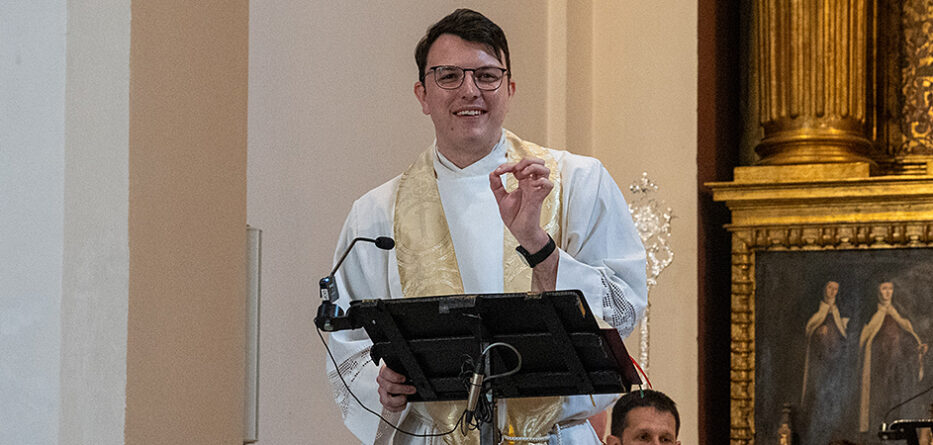
Fr Andrew Rooney is the Assistant Priest at the St Patrick’s Cathedral Parramatta.