


Homily for the 4th Sunday of Lent
Readings: I Samuel 16:1b, 6-7, 10-13a; Psalm 23; Ephesians 5:8-14; John 9:1-41
Listen at soundcloud.com
In our second reading from the Letter to the Ephesians today, we read:
Try to learn what is pleasing to the Lord.
Take no part in the fruitless works of darkness;
rather expose them, for it is shameful even to mention
the things done by them in secret;
but everything exposed by the light becomes visible,
for everything that becomes visible is light.
During the week, Cardinal Robert W. McElroy, the archbishop of Washington, shed a light in the darkness. He unequivocally condemned the US-Israel War against Iran.[1] He observed: ‘Almost everyone rightly believes that the Khamenei regime has been for decades a brutal and repressive government that has spread terrorism throughout the world and should be replaced. But there is immense concern that this war will spiral out of control and embroil the United States in ever greater depth.’
McElroy said the goals and intentions of the US going to war ‘are absolutely unclear’ and that ‘it is far from clear that the benefits of this war will outweigh the harm which will be done’. He insisted: ‘The criterion of just cause is not met because our country was not responding to an existing or imminent and objectively verifiable attack by Iran. As Pope Benedict declared categorically, Catholic teaching does not support preventative war, i.e. a war justified by speculation about events in the future. If preventative war were to be accepted morally, then all limits to the cause for going to war would be put in extreme jeopardy.’
Cardinal McElroy was definitive: ‘At this present moment, the U.S. decision to go to war against Iran fails to meet the just war threshold for a morally legitimate war.’ Remember: this war was not authorised by the UN; it was not authorised by the US Congress; and it is not supported by the American people.[2]
We all hope and pray that this war can end soon. We hope and pray that the benefits of the war will outweigh the harm done. The war has spilled over into other Gulf states. This week when committing an aeroplane and defence personnel ‘in support of the collective self-defence of Gulf nations’, our Prime Minister Mr Albanese said: ‘Australia supported action aimed at preventing Iran from getting a nuclear weapon and preventing Iran from continuing to threaten international peace and security. Our position remains that we do not want to see the conflict continue to escalate.’ [3] Mr Albanese and his Foreign Minister Penny Wong have continued to claim: ‘we are not in a position to determine the legal basis of decisions that the United States and Israel have made, which is why we have said that is a matter for them to determine’.[4]
Though fervently hoping that this conflict will end soon, our government has endorsed this war and has now joined in this war, having to accept that the instigators of this war could not satisfy the criteria for a just war. If Messrs Trump and Netanyahu succeed in this war, we know that preventative war will be an option for all nations in the future, despite its failure to comply with the conditions of a just war. If they fail, prudence and self-interest, as well as morality, should dictate that preventative war be taken off the table as an option by future governments. Pedro Sanchez, the Spanish prime minister, was right to slam the decision to attack Iran as ‘playing Russian roulette with the fate of millions of people.’ He said, ‘We’re not going to be complicit in something that’s bad for the world, nor contrary to our values and interests, simply to avoid reprisals from someone.’[5]
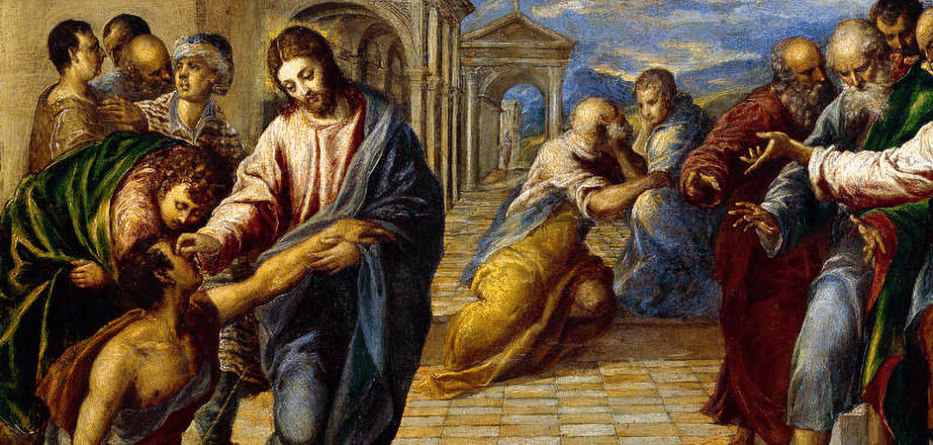
In today’s gospel we hear the account of the blind man who is cured by Jesus. Scripture scholar Frank Moloney tells us: ‘The man born blind moves toward full sight, but this journey is also marked by the growing “blindness” of the Pharisees. As the once blind man has a final encounter with Jesus, so do the Pharisees.’[6] Jesus declares: ‘Night is coming when no one can work. While I am in the world, I am the light of the world.’
On the sabbath, Jesus makes some clay, applies it to the blind man’s eyes and then tells him to go and wash. The man can see. His parents do not want to say how his sight was restored. When asked by the Pharisees, the parents tell them to ask their son. They want to be left out of it. Like many of those in the first Johannine community, they are afraid that they will be expelled from the synagogue if the profess faith in Jesus.
The cured man, with neither fear nor guile, tells the Pharisees straight out that Jesus made him to see. The Pharisees are fixated on the fact that Jesus made the clay on the sabbath. He sinned. He was a sinner. So he is not from God. The man does not profess to know the flash theology of the Pharisees. He simply knows that Jesus cured him and that Jesus is a prophet. When quizzed a second time, he says, ‘If he is a sinner, I do not know. One thing I do know is that I was blind and now I see.’
The Pharisees invoke the teaching of Moses and attempt to demonstrate their superior learning. The man replies: ‘This is what is so amazing, that you do not know where he is from, yet he opened my eyes. We know that God does not listen to sinners, but if one is devout and does his will, he listens to him. It is unheard of that anyone ever opened the eyes of a person born blind. If this man were not from God, he would not be able to do anything.’
The Pharisees are completely blind to what has gone on. They cannot concede a single point to this uneducated man. They throw the man out. Jesus finds him. The man comes to see Jesus as he truly is. He calls Jesus Lord and worships Jesus as the Son of Man.
With this wretched war in the Middle East overflowing with dire consequences from Iran to beyond, many are blind seeking answers and the light; others are sure they have the answers and are blind. We pray that the blind might see. In today’s gospel, Jesus declares: ‘I came into this world for judgment, so that those who do not see might see, and those who do see might become blind.’ This is a message not just to the man in the gospel scene, his neighbours, his parents, and the Pharisees. It’s a message for us, flaying about in the fog of a war without clear strategic objectives and without legal or moral justification.
The Lord is my shepherd; there is nothing I shall want.
The Lord is my shepherd; I shall not want.
In verdant pastures he gives me repose;
beside restful waters he leads me;
he refreshes my soul.
The Lord is my shepherd; there is nothing I shall want.
He guides me in right paths
for his name’s sake.
Even though I walk in the dark valley
I fear no evil; for you are at my side
With your rod and your staff
that give me courage.
The Lord is my shepherd; there is nothing I shall want.
Fr Frank Brennan SJ AO, Adjunct Professor of Thomas More Law School at ACU and Adjunct Research Professor at the Australian Centre for Christianity and Culture, is a former Rector of Newman College, University of Melbourne, and CEO of Catholic Social Services Australia (CSSA). His latest books include Pope Francis: the Disruptive Pilgrims Guide (ATF Theology, 2025), and Gerard Brennan’s Articles and Speeches: Maintaining the Law’s Skeleton of Principle (2 volumes) (Connor Court, 2025).
[1] See https://www.cathstan.org/us-world/in-interview-cardinal-mcelroy-says-u-s-entry-into-war-with-iran-not-morally-legitimate-citing-catholic-just-war-teaching
[2] ‘About half of registered voters — 53% — oppose U.S. military action against Iran, according to a new Quinnipiac Poll conducted (last) weekend. Only 4 in 10 support it, and about 1 in 10 are uncertain. That’s similar to the results of text message snap polls from The Washington Post and CNN, both conducted shortly after the joint U.S.-Israel attacks began, which also indicated that more Americans rejected the military action than embraced it.’ See https://www.pbs.org/newshour/politics/polls-show-what-americans-think-about-the-war-in-iran
[3] See https://www.pm.gov.au/media/australia-provide-defensive-military-assistance-gulf
[4] See https://www.foreignminister.gov.au/minister/penny-wong/transcript/interview-david-speers-abc-insiders-1
[5]See https://www.reuters.com/business/aerospace-defense/spains-sanchez-trump-you-cannot-play-russian-roulette-with-destiny-millions-2026-03-04/
[6] Francis J. Moloney, The Gospel of John, Sacra Pagina Series (Collegeville, MN: The Liturgical Press, 1998), 291.