

Homily for the 22nd Sunday in Ordinary Time
Readings: Jeremiah 20:7-9; Psalm 63; Romans 12:1-2; Matthew 16:21-27
Listen at soundcloud.com
While contemplating today’s readings during the past week, I have been preparing a talk on Catholic lawyers in the Australian public square.
In today’s first reading from the prophet Jeremiah, the prophet knows that proclaiming a message of truth and justice will land him in trouble – both with the mob and with the elite in society. Every time he speaks the word of the Lord, it brings him derision and reproach. But in the end, Jeremiah cannot hold back.
I say to myself, I will not mention him,
I will speak in his name no more.
But then it becomes like fire burning in my heart,
imprisoned in my bones;
I grow weary holding it in, I cannot endure it.
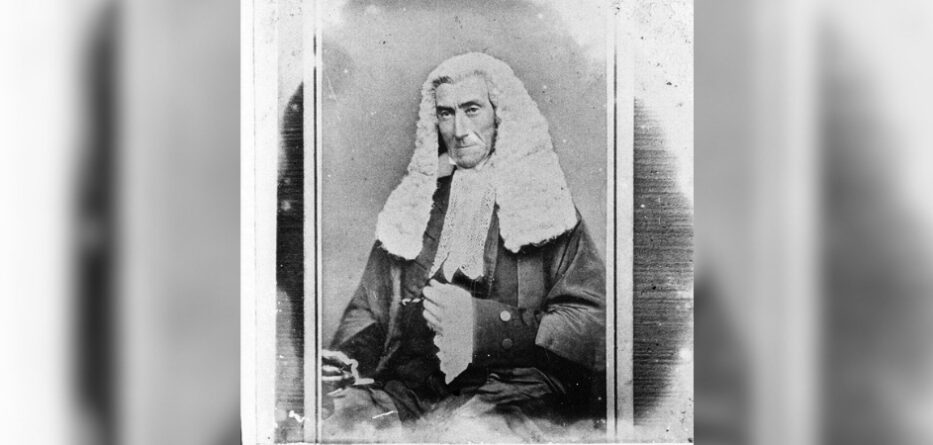
In Australian legal history, the Irishman John Hubert Plunkett who migrated to New South Wales being Solicitor General from 1832 and then Attorney General from 1836 to 1856 has always stood as a model for Catholic lawyers. Early in his time as Attorney-General, Plunkett insisted on prosecuting those responsible for the infamous Myall Creek Massacre. There was little sympathy in the colony for the plight of Aboriginal people. Eleven white farmers and farm workers had rounded up at least 26 Aboriginals including women and children, killed them and then burnt their bodies at Myall Creek in 1838.
At the first trial, the jury took only 20 minutes to acquit the accused persons of all charges. One of the jurors said, ‘I look on the blacks as a set of monkeys and the sooner they are exterminated from the face of the earth, the better. I knew the men were guilty of murder but I would never see a white man hanged for killing a black.’ Plunkett insisted on charging seven of those acquitted with further murder charges at a second trial. The mood of the colony was summed up by the Sydney Herald that editorialised:
“We want neither the classic nor the romantic savage here. We have far too many of the murderous wretches about us already. The whole gang of black animals are not worth the money the colonists will have to pay for printing the silly court documents on which we have already wasted too much time.”
Second time around, the seven accused of a different set of murders at Myall Creek were found guilty and hanged. This was the first time white men were punished and brought to justice for killing Aboriginal people. The hanging of the Myall Creek murderers caused great outrage in Sydney. There were some colonists who were outraged at the massacres of Aboriginal people. However, their voices were few among many. The Myall Creek massacre became headline news and caused a scandal that split colonial society.
Ten years after the convictions and hanging of the murderers, Plunkett was taunted in Parliament with the claim that the hangings were ‘judicial murder’. The Sydney Morning Herald reported Plunkett as having replied: ‘He, loud as the outcry might be against him, would be ashamed of himself as a man and as a public officer, if he had taken any different course’.[1]
In today’s second reading, Paul says to the Romans: ‘Do not conform yourselves to this age but be transformed by the renewal of your mind, that you may discern what is the will of God, what is good and pleasing and perfect.’
Plunkett’s obituary in The Freeman’s Journal on 15 May 1869 summed up his life of public service: ‘Just, when to be just was heroic – liberal, when intolerance was mistaken for firmness – uncorrupted and incorruptible amidst great and constant temptation – what remains to be said of one whose life adorned the service of his Queen and the history of his country.’[2]
You can almost hear Plunkett asking himself the question posed by Jesus in today’s gospel: ‘What profit would there be for one to gain the whole world and forfeit his life?’
The Sydney Morning Herald which had so often been in the vanguard of Plunkett’s critics said that Plunkett was ‘not free from failings; not exempt from infirmities, but pure in his life; not a man of vast intellect, or of great eloquence, but one who always spoke the truth as he believed it to be; who always stood up for right; where he understood that right to exist; who hated wrong with an intensity which only corrected the impulses of his kindly heart… This is the unanimous judgement of those who have known him the longest’.[3]
150 years on, we give thanks for John Hubert Plunkett who refused to conform himself to the age. Rather he stuck to his principles and sought justice according to law, discerning the will of God, what is good and pleasing and perfect.
My soul is thirsting for you, O Lord my God.
You are my help,
and in the shadow of your wings I shout for joy.
My soul clings fast to you;
your right hand upholds me.
My soul is thirsting for you, O Lord my God.
Fr Frank Brennan SJ AO, Adjunct Professor of Thomas More Law School at ACU and Adjunct Research Professor at the Australian Centre for Christianity and Culture, is a former Rector of Newman College, University of Melbourne, and CEO of Catholic Social Services Australia (CSSA). His latest books include Pope Francis: the Disruptive Pilgrims Guide (ATF Theology, 2025), and Equality, Reconciliation and Social Cohesion: The Inspiration of Sir William Deane (Connor Court, 2026).
[1] Quoted in Tony Earl, Plunkett’s Legacy: An Irishman’s Contribution to the Rule of Law in New South Wales, Australian Scholarly Publishing, 2009, 112.
[2] Ibid, 214.
[3] Ibid, 214, quoting Sydney Morning Herald, 18 May 1869.