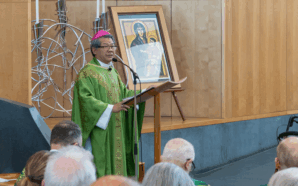



Homily for the 7th Sunday in Ordinary Time 2025
23 February 2025
Readings: Samuel 26:2, 7-9, 12-13, 22-23; Psalm 102; 1 Corinthians 15:45-49; Luke 6:27-38
On this very day 50 years ago, I joined nine others entering the Jesuit novitiate at Canisius College in Sydney. I was about to turn 21. Two days previously, I set out by car with my parents from home in Brisbane. I well remember bidding farewell to younger siblings lined up in the garage. None of us knew what lay ahead. I think it was hard for all of us. On this very evening 50 years ago, Mum and Dad dropped me at the front door of Canisius College as late as possible but so as not to miss the 7.30pm curfew. My life as a Jesuit then began, taking many twists and turns, but always with a sense of direction. It’s been a very graced life, thus far.
Listen on SoundCloud.
February 1975 was only nine years since the end of the Second Vatican Council. One of the last acts of the Council was to approve the Declaration on Religious Freedom to which the American Jesuit John Courtney Murray was a major contributor. I did not know it at the time, but that Declaration gave me a sense of true north for my life as a Jesuit and as a priest when it declared: ‘The human person perceives and acknowledges the imperatives of the divine law through the mediation of conscience. In all their activity a human person is bound to follow their conscience faithfully, in order that they may come to God, for whom they were created. It follows they are not to be forced to act in a manner contrary to their conscience. Nor, on the other hand, are they to be restrained from acting in accordance with their conscience, especially in matters religious.’ This statement was revolutionary in the Church; it was controversial and it has required quite some unpacking and discussion these last 50 years.
At Murray’s funeral just 18 months after the promulgation of the Declaration, the eulogist declared: ‘How confident Murray looked as he predicted that the post-conciliar experience of the church would parallel the experience of the bishops in council: we will begin with a good deal of uncertainty and confusion, must therefore pass through a period of crisis and tension, but can expect to end with a certain measure of light and of joy.’ Think only of the papacies of Paul VI, John Paul II, and Francis – for me, somewhat emblematic of each period.
A week after my arrival in the novitiate, I turned 21 and the Jesuits concluded their 32nd General Congregation (GC32) in Rome. They published a decree entitled Jesuits Today. The decree commenced: ‘What is it to be a Jesuit? It is to know that one is a sinner, yet called to be a companion of Jesus as Ignatius was’. It then asked: ‘What is it to be a companion of Jesus today? It is to engage, under the standard of the Cross, in the crucial struggle of our time: the struggle for faith and the struggle for justice which it includes.’ The decree went on to state: ‘Coming from many different countries, cultures, and social backgrounds, but banded together…, we try to focus all our efforts on the common task of radiating faith and witnessing to justice’.
So there it was. In my first weeks in the novitiate, I received my mission – to radiate faith and witness to justice in all my efforts. Many Jesuits with their word processors in conference have fine tuned and finessed these words of mission over the past half century. But I have remained unashamedly a GC32 Jesuit. Having been asked to minister mainly in Australia, my home country, it is no coincidence that I as a lawyer was asked to focus mainly on the rights of those on the margins of our society, especially the First Nations peoples and refugees and asylum seekers. And what a privilege it has been.
In 2008, our 35th General Congregation hit the right note for me when they said:
‘The complexity of the problems we face and the richness of the opportunities offered demand that we build bridges between rich and poor, establishing advocacy links of mutual support between those who hold political power and those who find it difficult to voice their interests. Our intellectual apostolate provides an inestimable help in constructing these bridges, offering us new ways of understanding in depth the mechanisms and links among our present problems.’
As I’ve said so often to church social justice groups: make sure you’re eyeballing both the decision makers and the marginalised persons affected by their decisions. At least it will stop you from becoming sanctimonious.
It’s easy for us Jesuits to retire into ourselves, looking after ourselves and seeing the world only through Jesuit eyes. Only recently my spiritual director brought to my attention a wonderful reflection on our religious vows from John Courtney Murray way back in 1947:
‘By taking vows of poverty, chastity, and obedience, we risk irresponsibility, childish immaturity and purposelessness. We avoid the risks by keeping them integrally….. Truly poor equals responsible; integrally chaste equals mature; absolutely obedient equals enterprising and purposeful.’
Despite all the shortcomings in the Church, and there are many, I am blessed to have been a member of the Society of Jesus these past 50 years, chalking up 40 years as a priest later in the year. As David says to his enemies in today’s first reading: ‘The Lord repays everyone for uprightness and loyalty.’ As church ministers, I think, I hope, that we Jesuits have become more compassionate, less judgmental and more generous in our individual lives and in our corporate undertakings. We take to heart those words of Jesus in today’s gospel:
‘Stop judging and you will not be judged.
Stop condemning and you will not be condemned.
Forgive and you will be forgiven.
Give, and gifts will be given to you;
a good measure, packed together, shaken down, and overflowing,
will be poured into your lap.
For the measure with which you measure
will in return be measured out to you.’
After this weekend’s mass with my two fellow Jesuits who joined me 50 years ago, we will share a takeaway pizza with a bottle of Grange Hermitage given us by a generous benefactor. We will give thanks to God and his people for your generous acceptance, love, support and encouragement of us this past half century in the least Society of Jesus. Thank you.
[1] Dignitatis Humanae #3
[2] Walter Burghardt, ‘A Eulogy’, Woodstock Letters, August 1967, 419.
[3] Jesuits Today, General Congregation 32, Decree 2, #1.
[4] Ibid, #26.
[5] Challenges To Our Mission Today Sent To The Frontiers, General Congregation 35, Decree 3, #28.
[6] John Courtney Murray, ‘The Danger of the Vows’, Woodstock Letters, August 1967, 427.
Fr Frank Brennan SJ is serving as part of a Jesuit team of priests working within a new configuration of the Toowong, St Lucia and Indooroopilly parishes in the Archdiocese of Brisbane. Frank Brennan SJ is Adjunct Professor of the Thomas More Law School at ACU and is a former CEO of Catholic Social Services Australia (CSSA). Fr Frank’s latest book is An Indigenous Voice to Parliament: Considering a Constitutional Bridge, Garratt Publishing, 2023 and his new book is ‘Lessons from Our Failure to Build a Constitutional Bridge in the 2023 Referendum’ (Connor Court, 2024).