

Readings: Exodus 34:4-6,8-9; 2 Corinthians 13:11-13; John 3:16-18
Last Sunday, we culminated our Lenten and Easter celebration with the celebration of Pentecost or the coming of the Holy Spirit upon Jesus’ disciples before sending them to all the nations to preach the good news.
And now, we return, for the rest of the liturgical year, to the ‘Ordinary’ Sundays of the Year until it brings us up to Advent and the beginning of another liturgical year cycle. This transition is commemorated each year by our celebration of the Feast of the Holy Trinity. So, this Sunday, according to the liturgical calendar, is the solemnity of the Most Holy Trinity.
Oftentimes, when we enter the church or before we begin our prayer, we normally start with the sign of the cross. Most of us will just do it out of natural instinct without even thinking, what does it imply or it really means for us. I think it is providential that as we celebrate this solemnity today, we have to ask ourselves, why there is One God but in three different persons? And how do we completely understand this very dogma of our Catholic faith?
Frankly speaking, the doctrine of the Trinity is one of the most fundamental teachings of our Catholic faith, but this is the doctrine which many of us have difficulty construing. Even priests encounter the same dilemma as we try to preach this credo of our faith in a way comprehensible. Because of its intellectual deepness, we often refer to it as a ‘mystery’.
In the New Testament, the word ‘mystery’ (Greek mysterion, musterion) refers primarily to some truth which God has made known to us and which we otherwise would not have discovered entirely. The Trinity, that in God there are three Persons, really is a mystery in this sense. It is also, of course, difficult for us to understand how one can be three persons just as it is difficult for us to understand how Jesus can be both God and human (the mystery of the Incarnation).
I think it will be more prudent to bring our memory back into the history of the formulation of the Nicene Creed.
In brief, this doctrine of the Trinity leads us back to the 4th century to the debate within the early church over a famous heresy known as the Arian heresy. And what Arius argued was that the 2nd person of the Trinity, the Son, was not eternal, but that he was just a creature, created by the Father. However, Arius also declared that of all creatures created by the Father, Jesus is the highest of all.
And so, in response to that claim, that the Son was just merely created by the Father, great saints like Athanasius rose up to defend the eternal Sonship of Jesus Christ, that Jesus is not just fully human, but that he is also fully divine, that he has also existed from all eternity with the Father. More so, that he is equal to the Father in his substance, in his divine nature.
And to prove this argument, notice what the gospel today is telling us as Jesus says to Nicodemus; “For God so loved the world that He gave his only Son.” The Greek word here ‘for his only Son’ is ‘monogenes son’. Mono is the word for only. Genes comes from the verb gennao and simply means to bear or beget.
So, in the Greek it literally says, “God gave his only begotten Son, so that whoever believes in him might not perish.” Now, one reason that is important is because it sets Jesus out as a unique kind of son. And then the following line of our gospel today says: “for God sent his Son into the world, not to condemn that world, but to save through him”.
By saying God sent his only begotten son into the world, what St John’s gospel is talking about here is the fact that Jesus is the eternal son of God. So, unlike the angels – the angels are created sons of God – Jesus is the uncreated son of God. Angels have a beginning, human beings have a beginning, Jesus has no beginning as the eternal Son. He is uncreated and he is eternally begotten of the Father. He always was the Son of the Father. In other words, he is the Son and he always will be the divine Son of God.
Now, what about the Holy Spirit. Well, if we go back to the first reading, from the Book of Exodus, where it says: “And the LORD descended in the cloud and stood with him there and proclaimed the name of the LORD.” What it means is that, in the spiritual sense, the cloud is an image of the Holy Spirit. If we can also recall, the pillar of cloud was with the Israelites guiding them at the time of their exodus. On Jesus’ transfiguration, the cloud that is hovering on Jesus and the voice that came out says that “this is my son, the beloved, listen to him.” Moreover, the clear manifestation of the Holy Spirit was seen during our celebration of Pentecost last week when the disciples received the Holy Spirit like a tongue of fire. In a sense, the Holy Spirit is given to us with a different image and symbol, but how it is being revealed does not change the fact the Holy Spirit is with the Father and the Son right from the beginning of time.
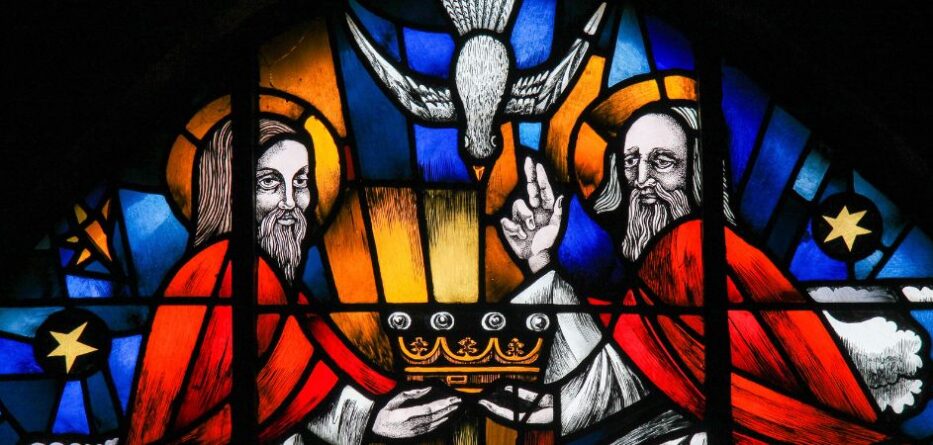
And so, this is what forms the object of the feast today that there is one God and in this one God there are three Divine Persons: the Father is God, the Son is God, the Holy Spirit is God. Yet there are not three gods, but one, eternal, incomprehensible God! The Father is not more God than the Son, neither is the Son more God than the Holy Spirit. The Father is the first Divine Person; the Son is the second Divine Person, begotten from the nature of the Father from eternity; the Holy Spirit is the third Divine Person, proceeding from the Father and the Son.
The Father sent His Son to earth, for “God so loved the world as to give His only begotten Son“. The Father called us to the faith. The Son, our Saviour Jesus Christ, became man, lived liked us except sin and died for our sins, he gave his life up on the cross so that we can share His divinity.
He redeemed us from the consequence of sin and made us children of God by virtue of our baptism. He ever remains the liturgist par excellence to whom we are united in all sacred functions such as our celebration of the Holy Eucharist. After Christ’s ascension the Holy Spirit, however, became our Teacher, our Leader, our Guide, our Consoler. The Holy Spirit leads us to the complete truth, as another gospel narrative tells us.
Perhaps, this story and simple analogy will help us understand the feast that we are celebrating today.
“There was an old African man who has a hut with two small windows. During that week, he hosted a bible study group, and they were discussing the Trinity and how they seemed to be puzzled in trying to understand. Then he entered the discussion. He said, “I’m old and I’m not really well educated but this is how I understand the Trinity. Whenever I wake up in the morning, I see the rays of the sun coming in my window and because of it, it warms the house. When I look out of the window, I see the sun who I describe as God the Father, because he is the source of light. Then when I see the rays coming in my window, I see Jesus Christ because he is sent by the Father. And when the house warms because of the sun, that’s the Holy Spirit. Because you may not see the Holy Spirit, but you can feel its presence.”
Well, this is just a simple explanation of the Trinity for us. One distinct quality of the Trinity is their relationship. A communion of love. A unity and joy in the relationship among the Father, Son and Holy Spirit which is the supreme model of our relationship as Christian families.
My brothers and sisters, we can only become a truly Christian family when we live in a relationship of love with God and with others. What the world needs now is “depth” in our relationships with others. Unfortunately, we have taken the easier and more uncompromising way of ‘shallow’ relationship. How often do we use the word “bonding” to signify that we spend time with one another? In the end we simply “shallow bond” with one another.
Being truly Christian and baptised in the name of the Father and the Son and the Holy Spirit, we belong to the family of the Triune God. And it is only in the spirit of Trinitarian relationship that we can experience true bonding. The blessed Trinity challenges us to live our relationships in the true spirit of selflessness, no longer the “me, myself and I” principle of individualism, and no longer the consumerist and string-attached approach of dealing with others. We are simply called to become more like the Triune God in all our relationships. As God the Father, Son and Holy Spirit are one love, so we, too, are also called to live with each other as one family in this One God. Amen.
Fr Galbert Albino is the Parish Administrator of the Holy Cross Parish, Granville.