

“God is love,” scripture says, “and whoever abides in love abides in God and God abides in him or her.”
Too often, we miss what that means because we tend to romanticise love. We’ve all heard this passage read at weddings; appropriate surely, but, within that circumstance, all too-misunderstood for it is pictured as romantic love, as falling-in-love, wonderful and holy though this may be. Thus, at a wedding, we can easily miss the sense of what this text means. It might best be rendered this way: “God is community, family, parish, friendship, hospitality and whoever abides in these abides in God and God abides in him or her.”
God is a trinity, a flow of relationships among persons. If this is true, and scripture assures us that it is, then the realities of dealing with each other – in community, at the dinner table, over a bottle of wine or an argument, not to mention the simple giving and receiving of hospitality – are not pure, secular experiences but the stuff of church, the place where the life of God flows through us.
By definition, God is ineffable, beyond imagination and beyond language, even the best language of theology and church dogma. God can never be understood or captured adequately in any formula. But God can be known, experienced, tasted, related to in love and friendship. God is Someone and Something that we live within, and which can flow through our veins.
To make God real in our lives, therefore, we needn’t sneak off, shamrocks and triangles in hand, to try to somehow picture how three-can-be-one and one-can-be-three. Nor indeed need we read academic books on theology, valuable though these may be. No. God is a flow of relationships to be experienced in community, family, parish, friendship, and hospitality. When we live inside of these relationships, God lives inside of us and we live inside of God. Scripture assures us that we abide in God whenever we stay inside of family, community, parish, friendship, hospitality – and, yes, even when we fall in love.
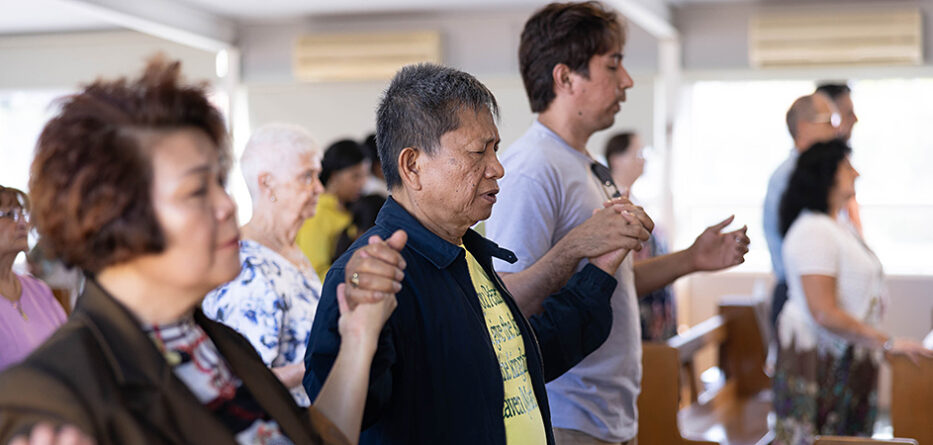
This has huge consequences for how we should understand religious experience: Among other things, it means that God is more domestic than monastic (monks will be the first to tell you that). It means too, that in coming to know God, the dinner table is more important than the theology classroom, the practice of grateful hospitality is more important than the practice of right dogma, and meeting with others to pray as a community can give us something that long hours in private meditation (or, indeed, long years spent absent from church life) cannot. Such a concept also blurs all simple distinctions between “religious” and “purely secular” experience. Finally, importantly, it tells us that, since God is inside of community, we should be there too, if we wish to go to heaven. Simply put, we can’t go to hell if we stick close to family, community, and parish.
The most pernicious heresies that block us from properly knowing God are not those of formal dogma, but those of a culture of individualism that invite us to believe that we are self-sufficient, that we can have community and family on our own terms, and that we can have God without dealing with each other. But God is community – and only in opening our lives in gracious hospitality will we ever understand that.
This is an edited version of an article by Ron Rolheiser OMI. Used with permission.
This article was originally published in the 2026 June | Winter edition of the Catholic Outlook Magazine. You can read it online here or pick up a copy in your local parish.