

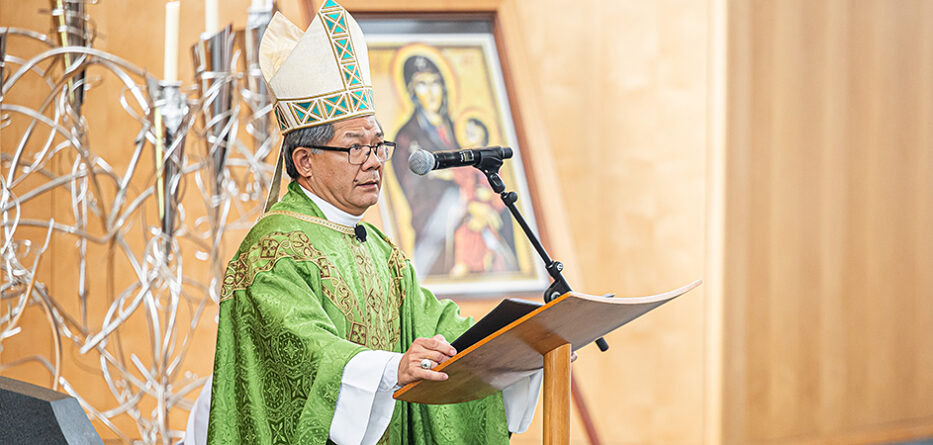
Most Reverend Vincent Long Van Nguyen OFM Conv DD STL, Bishop of Parramatta
Homily for the 25th Sunday in Ordinary Time, Year A
Readings: Isaiah 55:6-9; Philippians 1:20-27; Matthew 20:1-6
Living the paradox of the Gospel, embracing God’s unconventional way
Dear sisters and brothers,
We live in the world in which people with status, power, success and wealth often dominate the headlines. People who are poor, disadvantaged and afflicted, on the other hand, are relegated to the margins. But this is where our biblical tradition cautions us to be open to God’s unconventional way. He frequently uses insignificant people and places to reveal his divine power. He frequently works from the margins rather than through domination. Might is right according to the logic of the empire, but God often upends this logic; he works through vulnerability, powerlessness and insignificance.
Today’s liturgy of the Word teaches us God’s ways are contrary to human ways. In the first reading, Isaiah challenges his people to change their default position of conforming to the logic of the empire. “Let the wicked man abandon his way … Let him turn back to the Lord,” he announces. The wicked way in the context of the exile refers to the unjust, greedy and self-centred practices that were common in the culture of the empire.
Being a covenant community requires them in some fundamental sense to be non-conformist and even subversive in respect of the societal norms and conventions. They are to adopt God’s ways which are above human ways. They consist in the covenantal practice of radical neighbourly justice, mercy and compassion as opposed to the prevalent grab-what-you-can and the survival of the fittest mentality. The believing community must witness against the individualism and exclusivism that are often the default characteristics of the empire.
Jesus expands on this notion of the covenantal practice. In one of the most intriguing and confronting parables, he upsets the expectations and the commonly held views of the status seeking and result-driven society. He makes it clear that the economy of the kingdom is not based on individual merit, competition, success and achievement. Rather, it is all about making sure that not one is lost or left behind. It is the ethic of care and concern for others that must set us apart from the world’s trickle-down and winners-take-all system.
In the parable, the owner of the vineyard goes into the market square and hires workers to work in his vineyard. He does this at different hours of the day and still he employs them, some as late as the 11th hour. At the end of the working day, the owner pays them their wages starting with the last arrival. These receive a generous day’s payment even though they have only worked for less than a day. Seeing this, the other workers are excited. Yet to their disappointment, they too get as much pay as the Johnny-come-latelies.
The way God works, as Isaiah says, is unlike our reward system that favours the strong and privileged. God takes care of the most disadvantaged and the most vulnerable among us. A denarius is much more than its actual monetary value. It is a metaphor for neighbourly justice, equity and compassion. The owner of the vineyard makes sure that even the last arrival or the most undeserving among us receives justice, equity and compassion rather than judgement and alienation. He also sees the faces of their children, who need bread and clothing. We are challenged to see and act with the same concern, generosity and compassion. We are called to create a society where the well-being of the most vulnerable is a matter of priority for everyone.
Dear brothers and sisters,
Pope Leo on the World Day of Migrants and Refugees this year focuses on the theme “Even just one of these children”. He draws attention to the dignity and rights of migrant and refugee children, including protection from trafficking, violence and forced displacement. His message serves as a powerful reminder of the need for compassion and affirmative action towards the least and last among us. We are challenged to see and to act in favour of those considered expendable in the harsh calculus of the political system.
Let us reject an economy of exclusion and inequality and instead seek one that is inclusive and sustainable – one that gives and nurtures life. We are called to work for an economy that is inclusive and capable of putting the needs of the poor before the wants of the rich. We envisage an alternative to marketplaces that are harsh and inhospitable: the vineyard, lush and green, sustainable in its growth and inclusive in its economy.
Jesus subverts merit-based mentality. He challenges the culture of entitlement and the survival of the fittest. He points us to the whole new way of living and relating. His is a new paradigm of shared humanity, equality, inclusion and human flourishing. Let us pray that we learn to operate out of Jesus’ new paradigm, which will transform us into humble servants of the kingdom. May our sharing at this table strengthen us in our commitment to live and relate according to the values of the Gospel. May we -filled with the fullness of life and love of God- share and live out the driving passion of Christ to be men and women for others.