

Homily for the 25th Sunday in Ordinary Time
Readings: Isaiah 55:6-9; Psalm 145; Philippians 1: 20-24, 27; Matthew 20:1-16
Listen at soundcloud
We Australians hate queue jumpers. Everyone should wait their turn. Everyone should wait in order. It’s only fair. At the bread shop or the coffee shop, everyone knows to take their place. In the migration queue, we know there is a case for separate lanes for business, family reunion and refugees. But everyone should keep in their right lane and keep in their proper place.
Tony Burke, our Minister for Immigration, knew what buttons to press when he announced this week: ‘Australia welcomes people who make a genuine contribution to our country. Australia does not support people who seek to rort or defraud the system. We’re making changes to give us more control over who arrives, who stays and who leaves.’[1]
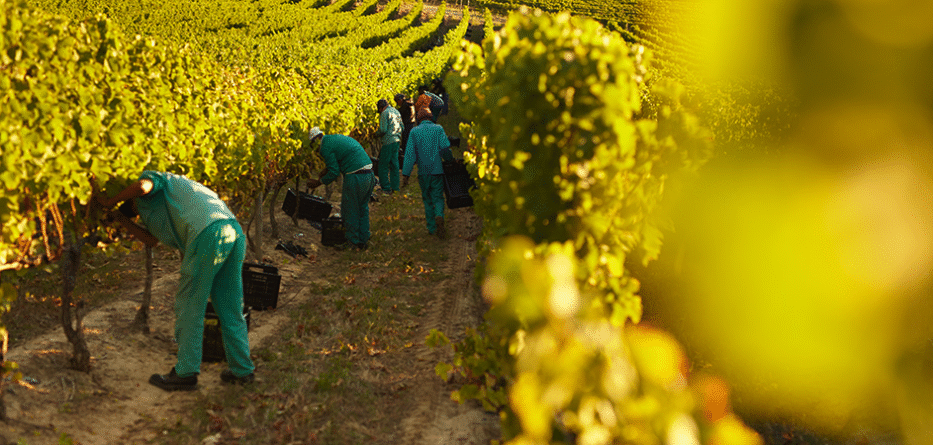
Today’s gospel highlights just how unAustralian Jesus could be when he got to describing the kingdom of heaven. He tells the story of the vineyard owner at harvest time. The vineyard owner needs casual workers to do the picking. He is so desperate for workers that he goes out five times during the day bringing in whoever he can round up – at dawn, at 9am, at noon, at 3pm and even as late as 5pm.
There would be nothing to the story if the farmer then did the natural and fair thing at the end of the day. The natural and fair thing would be to pay each worker according to the number of hours they worked.
If the farmer were minded to pay more per hour to those who came later, you would think he could have the decency to still pay the long time workers first so that they would be none the wiser that the farmer has paid more per hour to those who worked less. You would think the farmer would put the workers in a queue – with those who came first and who worked longest at the head of the queue and those who came last and who worked least at the end of the queue.
But no, in this kingdom proclaimed by Jesus it is natural, fair and decent to put the first last and the last first, to pay everyone the same regardless of how much or how little they have worked, and to make sure that those who worked harder, receiving less payment per hour knew that they were being treated differently.
It would be no way to run an HR Department or a Fair Work Commission.
The Prague theologian Tomáš Halík recently addressed a conference on ‘Shaping Synodality in Europe: From Vision to Roadmap’ under the auspices of the Council of European Bishops’ Conferences. He conceded, ‘Europe is no longer the political centre of the world, still less the centre of global Christianity.’ He boldly proclaimed: ‘Europe shows what can happen when the Gospel allies itself with power. Yet it also shows what can be born when faith allows itself to be purified through the loss of privilege. Its experience reminds the global Church that social influence is not the same as spiritual strength, and that institutional decline need not mean the absence of God’s Spirit.’[2] The kingdom of heaven is not just some eternal ideal nation state. It is not simply the idealised Europe of old.
Scripture scholar Daniel Harrington tells us: ‘There is a balance between God’s justice and God’s mercy. Those who were hired first receive a just reward, one to which they had already agreed (20:1–2). The fact that the latecomers received the same reward can be credited to God’s mercy (20:13–15).’[3]
We are called to work for the coming of this kingdom. And it’s not just about being fair, natural and decent. As Isaiah tells us in the first reading today:
My thoughts are not your thoughts,
nor are your ways my ways, says the Lord.
As high as the heavens are above the earth,
so high are my ways above your ways
and my thoughts above your thoughts.
In today’s gospel, those who worked longest and who were paid last understandably complain. The vineyard owner takes on one of them and says:
‘My friend, I am not cheating you.
Did you not agree with me for the usual daily wage?
Take what is yours and go.
What if I wish to give this last one the same as you?
Or am I not free to do as I wish with my own money?
Are you envious because I am generous?’
Jesus simply adds: ‘Thus, the last will be first, and the first will be last.’ This kingdom of heaven which motivates and entices us to follow Jesus is marked not only by justice but also by mercy, forgiveness, and love for all. It’s a big ask. It’s for this kingdom that we pray every day: ‘Thy kingdom come. Thy will be done on earth as it is in heaven.’
The Lord is near to all who call upon him.
The Lord is just in all his ways
and holy in all his works.
The Lord is near to all who call upon him,
to all who call upon him in truth.
The Lord is near to all who call upon him.
Let’s pray for the grace to extend justice to the deserving and mercy to the undeserving.
Fr Frank Brennan SJ AO, Adjunct Professor of Thomas More Law School at ACU and Adjunct Research Professor at the Australian Centre for Christianity and Culture, is a former Rector of Newman College, University of Melbourne, and CEO of Catholic Social Services Australia (CSSA). His latest books include Pope Francis: the Disruptive Pilgrims Guide (ATF Theology, 2025), and Equality, Reconciliation and Social Cohesion: The Inspiration of Sir William Deane (Connor Court, 2026).
[1] See https://minister.homeaffairs.gov.au/TonyBurke/Pages/migration-reform-end-rorts-bring-skills-australia-needs-strong-economy.aspx
[2] Tomáš Halík, ‘What Europe can offer the global Church’, The Tablet, 19 September 2026, 6, 8.
[3] Daniel J. Harrington, The Gospel of Matthew, Sacra Pagina Series (Collegeville, MN: Liturgical Press, 2007), 285.