

Brothers and sisters,
We live in a world that is exhausted. People are tired not only physically but emotionally and spiritually. Many carry the burden of financial pressures, family responsibilities, workplace stress, loneliness, anxiety about the future, and the constant demand to keep up with a fast-moving digital world.
We are more connected than ever through technology, yet many feel isolated and overwhelmed. Into this reality, Jesus speaks a remarkable invitation: “Come to me, all you who labour and are burdened, and I will give you rest” (Mt 11:28).
This is not merely a promise of a holiday, a weekend off, or a getaway on a long weekend, an escape from life’s problems. Jesus is offering something much deeper: rest for the soul.
A priest said: “Most of us want to give our burdens to Jesus – but only after we’ve worried about them for three weeks and made ourselves miserable!” Jesus’ invitation is much simpler: “Come to me first, not last.”
In the first reading, the prophet Zechariah consoles the Jews living in Palestine under Greek rule, promising them a “meek” messianic king of peace riding on a donkey, who will give them rest and liberty.
The responsorial psalm praises and thanks a kind and compassionate God who “raises up those who are bowed down” under heavy yokes. In the second reading, Paul tells the first-century Roman Christian community about two yokes –, namely, the “flesh” and the “Spirit” – and challenges them to reject the heavy and fatal yoke of the flesh and accept the light yoke of the Spirit of Jesus.
Christian spirituality, according to Paul, proceeds from the initiative of the Holy Spirit, and means living in the realm of the “Spirit” as opposed to the “flesh”.
In a Bible study on today’s gospel passage, a priest started off by asking the college student participants whether they really think that the yoke of Christ is easy, and his burden light.
The answer he got was a resounding “No!” Asked to explain, the students went on to recount the daily pains and discomforts they suffer in their attempt to be faithful to Christ’s teachings.
“I have this problem,” said Elena. “I pray about it constantly and I make all the effort I can, yet I keep falling into the same temptation over and over again.”
Johnson spoke about all his efforts to fight an addiction. “I have prayed about it. I have sought help. And I really try. Yet after a few days of apparent success, I find myself falling right back to where I started.”
Many of us can identify with the predicaments of these young people such as guilt, disappointment, or grief, family conflicts, loneliness, anxiety about the future etc.
Jesus does not deny these realities. He does not say, “your burdens are imaginary”. Instead, He says, “Bring them to me”. Jesus offers rest to those “who labour and are burdened” if they will accept his “easy yoke and light burden.”.
Jesus then goes on to show how: “Take my yoke upon you and learn from me; for I am gentle and humble in heart, and you will find rest for your souls” (verse 29). Looks like we have a problem here!
Is Jesus calling on those who are carrying heavy loads to come and add a yoke to their burden? Doesn’t that sound like adding affliction to the afflicted?
No; Jesus is asking us to cast away our burdens and take on his yoke. This is because, unlike the burdens we bear, his yoke is easy and his burden light.
There is, however, a better way of understanding the yoke of Christ. Among the Jews the yoke was put on the necks of two cattle so that together they could pull the plough as one. It always takes a pair to work a yoke.
When Jesus asks you to take the yoke, you might as well ask who your yokemate is. Your yokemate is none other than Jesus himself.
The yoke, in fact, belongs to Him and he only invites you to team up with him. “The yoke of Christ is not just a yoke from Christ but also a yoke with him.
To take the yoke of Christ is to associate and identify ourselves with him: our destiny with his destiny, our vision with his vision and our mission with his mission.
It is to know that we are not pulling the yoke alone and by our power but together with Christ and by the strength that comes from him”. He is a friend who helps face anything that comes our way.
There is a story of the Footprints on Sand that captures the essence of the yoke that Jesus is talking about.
A man dreamed that he was walking along a beach with the Lord. Across the sky flashed scenes from his life. As he looked back, he noticed that during most of his journey there were two sets of footprints in the sand— – one belonging to him and the other to the Lord.
However, during the most difficult times of his life, he saw only one set of footprints. Troubled, he asked the Lord: “Lord, you promised that you would always walk with me. Why, during the hardest times of my life, was there only one set of footprints?” The Lord replied: “My child, I love you and would never leave you. During those times of suffering and trial, when you saw only one set of footprints, it was then that I carried you.”
Taking on the yoke of Christ harnesses every one of us to Him. It aligns us correctly, allowing us to walk with Him, to work with Him; to work for Him. The yoke binds us into intimacy, changing us from the solitary and exhausted runner into a disciple who can finally be at peace.
The yoke of Christ does not prevent all pain; remove the rocks from our fields or take away our sorrow and burdens. Rather, the yoke teaches us that these burdens can be shared, transformed, taken up into the heart of God, and returned to us as life.
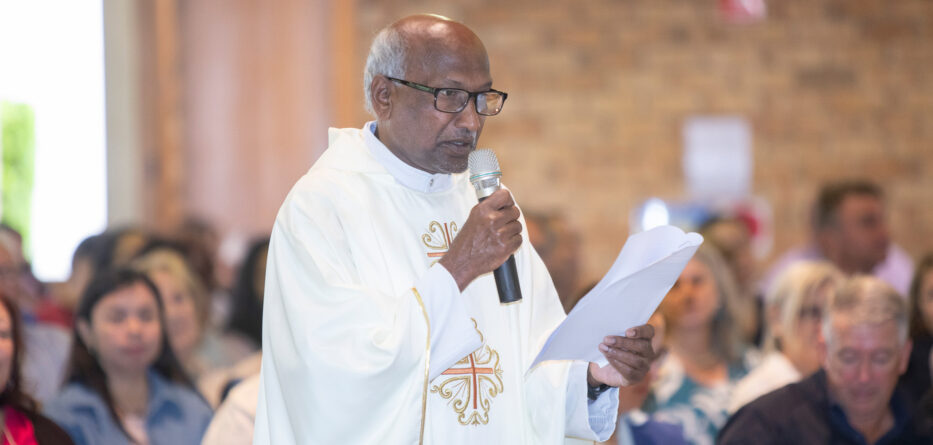
Fr Vincent Savarimuthu is the Parish Priest of the Holy Name of Mary Rydalmere Parish.