

The Feast of the Baptism of the Lord, Year A
Readings: Isaiah 42:1–4, 6–7; Psalm 28(29):1–4, 9–10; Acts 10:34–38; Matthew 3:13-17
11 January 2026
“This is my Son, the Beloved; my favour rests on him.” – Luke 1:68
These words of the Father, so powerful for all present in this moment of Jesus’ Baptism, have continued to reverberate through history—just as God intended—as his rescue mission for all of humanity continues to unfold.
In the ministry that would follow, Jesus urges us to call his Father, our Father. In turn, we are invited to call Mary—his Mother and Mother of the Church— our Mother. Being born again through the waters of Baptism and united with him by the indwelling of the Holy Spirit, we, the members of the Church, all those living now and in heaven, are in truth, brothers and sisters. As such, feel free to call on any, or all, of them for help! That’s what is supposed to happen in families.
Do not shirk away from the fact that you are a member of this Holy Family of God, it is simply not befitting of someone of your royal standing! Do not be surprised to learn, yes, even with your imperfections, that God truly delights in you and speaks the same words over you as he did for Jesus. That was his perfect plan from the start.
Today, be silent and hear the words of the Father, let them overwhelm you: “You are my beloved son, you are my beloved daughter, and I am well pleased with you.”
Father, help me to live in the joy, freedom and hope that is the birthright promised to all of your children. Amen.
Jude Hennessy
Artwork Spotlight
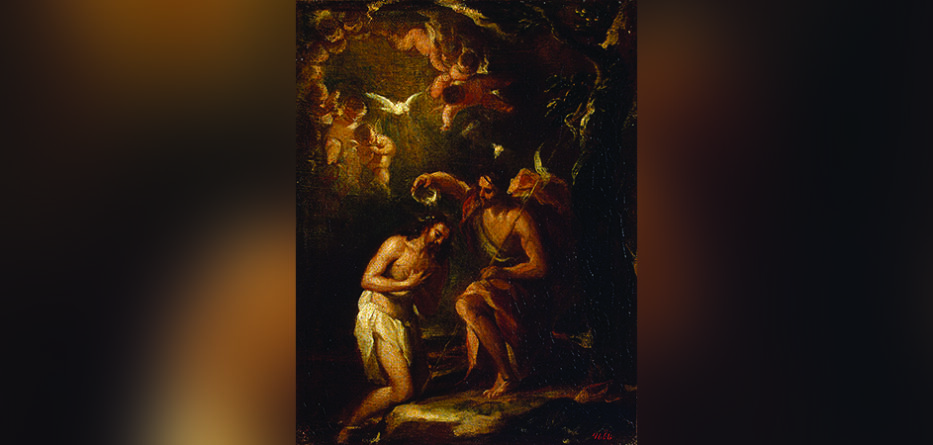
Baptism of Christ by José Claudio Antolinez (1635–1675)
Baptism of Christ (c. 1660–1675). Oil on canvas, 39cm x 30cm. State Hermitage Museum, St Petersburg, Russia. Public Domain.
The Baptism of the Lord is the final day of the Christmas season, poised on the threshold of Ordinary Time, yet already pointing us towards Holy Week. This is most evident from the inscription on the font in the ancient baptistery of the Basilica of St John Lateran in Rome: “This is the fountain of life which purges the whole world, taking its course from the wounds of Christ. Hope for the kingdom of heaven, you who are born in this font.”
The source of the waters of Baptism is the water flowing from the wound in Christ’s side as he hung on the Cross. St Augustine (+ 430) wrote that when the soldier struck Christ’s side with his spear, he opened the purse which held the price of the world’s redemption. We have been bought and paid for, and sealed with the Spirit as the guarantee.
Here on the banks of the Jordan is a new Epiphany. It was the angels who had announced to the world the Infant Christ. Now it is the Father presenting his Son to the world, “My son, my Beloved, with whom I am well pleased” (Mt 3:17). And over the Son’s head hovers the Spirit, the same Spirit who had hovered over the primeval waters of creation, bringing light out of darkness, order out of chaos, and life from death.
We who are baptised into Christ have the same assurance—we are beloved sons and daughters of God, not because of any good works we may have done, but simply because of God’s initiative. Nowhere is God’s graciousness more obvious than in infant Baptism. The vulnerable child who is plunged into the font has offered God nothing at this point.
Yet, we believe that in the water the child has been reborn—the beloved of the Father, the image of the Son, and the Temple of the Holy Spirit. The child must eventually say “yes” to this identity in the years ahead, but it will need help from family and friends. How sad that the many guests at baptisms so often do not realise that they must be more than mere spectators.
In today’s first reading, the prophet Isaiah promises that the coming Redeemer would bring justice— a word which means to give each person their rights. “This justice would not be judgmental, but consoling. It would not crush those already bruised by suffering nor extinguish their flickering hope” (Verna Holyhead SGS, Building on Rock).
So today, the Church does not want us to forget our joy at the birth of Jesus. Rather, she reminds us of our re-birth in Jesus, and what this means.
For the rest of the year just begun, we must be that “servant” pointed out by Isaiah: “I, the Lord, have called you to serve the cause of right” (Is 42:6). We will do that by working for justice, making sure that all in our community are afforded their just rights.
José Claudio Antolinez, active in Madrid during the second half of the 17th century, was an under-appreciated figure of the Spanish Baroque. His paintings often reflect quiet moments of divine grace—this would embrace the emphasis of the Church during the counter-Reformation on art inspiring piety and sacramental devotion.
In his Baptism of Christ (c.1660–1675), Jesus is shown kneeling, emphasising his humility—he is submitting to a ritual meant for sinners. His hands are crossed over his heart in a gesture of spiritual receptivity. Dressed in the traditional garb of a desert prophet, John pours water from a shell, an ancient Christian baptismal symbol.
Above the scene, the Holy Spirit descends in a burst of golden light. The presence of angels suggests this is not merely an historic moment, but a heavenly event with cosmic significance.
The painting’s composition expresses the mystery of the divinity—the Son being baptised, the Holy Spirit descending as a dove, and the light from heaven implying the voice of the Father. The painting’s small scale suggests it may have been intended for private use.
Mons Graham Schmitzer
Jude Hennessy is the director of the Office of Renewal and Evangelisation in the Diocese of Wollongong, overseeing ministries and initiatives to make Jesus known and loved. He hosts the weekly podcast The Journey, broadcast on 30 radio stations across Australia.
Monsignor Graham Schmitzer is a retired parish priest. He was ordained in 1969 and served in many parishes in the Diocese of Wollongong. He was chancellor and secretary to Bishop William Murray for 13 years. Prior to ordination, he worked for the Department of Attorney General and Justice before entering St Columba’s College in 1962. He enjoys travelling and visiting major European art galleries.
With thanks to the Diocese of Wollongong, who have supplied this reflection from their publication, The Promise: Advent and Christmas Daily Reflections 2025. Reproduced with permission.