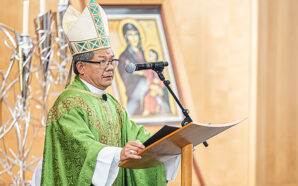


Most Reverend Vincent Long Van Nguyen OFM Conv DD STL, Bishop of Parramatta
The 5th Sunday of Ordinary Time, Year A
Readings: Is 58:7-10; 1 Cor 2:1-5; Matthew 5:13-16
Called to be the antidote and counteragent to division in the world
Dear friends,
We live at a time of deep division and partisanship, a time when global political authority seems to be in short supply. It is surprising that the papacy has emerged as the only world institution with a net positive reputation. Following the lead of his predecessor Pope Francis, Pope Leo XIV has continued to reach out to the poor and the suffering. He has been the voice for peace and the advocate for those on the receiving end of societal indifference.
In a recently published book, he writes these inspiring words: “We must look at our world, directly: we can no longer tolerate structural injustices in which those who have more always have more, and, conversely, those who have less become increasingly poor. There is the risk that hatred and violence will overflow, spreading misery among people: the desire for communion, recognising that we are brothers and sisters, is the antidote to all extremism.”
Christians are meant to be the antidote or counteragent to division and any form of corruption of society. That is a tall order. Yet that is exactly the scriptural lesson for this 5th Sunday in Ordinary time. We exist not to dominate and assert ourselves at the detriment of others. Rather, our Christian faith demands nothing short of a complete alignment of our attitude and behaviour with Jesus’ example of radical solidarity with the least of our brothers and sisters.
In the first reading, Isaiah exhorts the people to show particular concern for the poor, the marginalised and the vulnerable. They are to share their bread with the hungry, shelter with the homeless and clothe the naked. They are to do away with the yoke, the clenched fist and the wicked word. In other words, they must eradicate practices of oppression, violence and injustice. Only then, can they become the true people of God and the model society. Only then, can they fulfill their mission in being the light in the darkness for others to follow.
These prophetic injuctions had a profound impact to the people of the covenant in their historical context. They had witnessed the collapse of their once powerful nation, along with their proud national symbols such as the temple and the monarchy. They had learned the bitter lesson of the exile which was a dramatic fall from grace. Isaiah interpreted this harrowing experience in the light of their calling. In Palestine where they reached the zenith of political power, Israel had ironically betrayed their calling by engaging in practices of oppression, violence and injustice. They had adopted an unjust system. Solomon with his oppressive regime had become a new Pharaoh and Israel had become a new kind of Egypt, metaphorically speaking. Hence, the exile was a course correction, a reset and a conversion to being a humble, compassionate people and a fitting instrument for God’s purpose.
In the Gospel, Jesus further reinforces the message of Isaiah. On the back of his teaching on the Beatitudes, he now highlights the need for true discipleship. He warns us not to lose sight of our identity and mission as agents of change in the world. He speaks of tastless salt which is “good for nothing and can only be thrown out to be trampled underfoot by others”. Reading these compelling words in the context of the sexual abuse crisis, we cannot help but admit our being treated like tastless salt. Hence, as it was for the exiled Jews, it must be the same for us in recovering our Gospel compass. We must change course and reset ourselves to the task of rebuilding our diminished credibility. We must reclaim what Christ stands for, or we will forfeit our mission of being the light of the world. Christendom and for the most part of history, we have tried to be great, powerful and dominant. All of the metaphors and all of the dispositions of Jesus point to a humble church: a little salt, a little yeast and a little light.
Dear brothers and sisters,
The Word of God challenges us to show our true mettle by domination but by service. In a time of tensions and divisive ideologies, we must resist the temptation of returning to a triumphant and powerful Christendom of old. In fact, the early Christians got the message of Jesus and showed us the way. In the face of a fractured society, they shone like a lighthouse. Against the dominant system of exploitation, self-interest and greed, they enacted a Gospel ethos of communion, justice and compassion.
“You are the light of the world. A city built on a hill-top cannot be hidden”. These words of our Lord summon us to a life of witness and a prophetic community that shines a light on the darkness of the world around us. We draw our strength and inspiration, as Paul affirms in the second reading, from the crucified Christ and the power of the Spirit. We can not only envision a different world to the fractured, polarised and destructive one we are living in, but also live it out. In the Eucharist we enact and have the power to live the vision of Jesus. Let us go forward in our mission to make a difference in the world, confident of the victory of Christ and his promise to be with us till the end of time.