

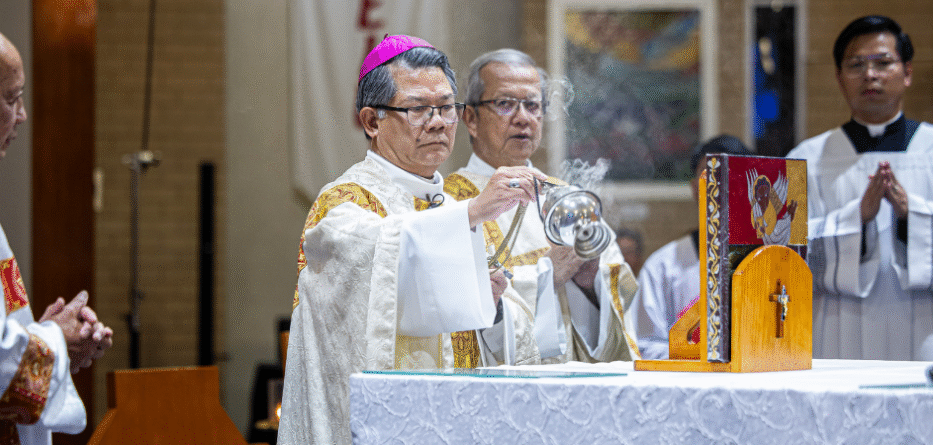
Most Reverend Vincent Long Van Nguyen OFM Conv DD STL, Bishop of Parramatta
Homily for the Feast of the Ascension 2026
Readings: Acts 1:1-11; Ephesians 1:17-23; Luke 24:46-53
The Church as the living testament of Jesus
Dear friends,
The death of a loved one can be the source of profound grief, but it can also be an opportunity for us to embody the best of that person and carry on his or her legacy. This has been the learning lesson for me since my mother died almost a year ago. While I still mourn for her, I do so with a deep sense of gratitude and resolve. Her death strangely has brought me closer to her and all who are dear to her, including my siblings. With both parents gone, I have a real sense that they live through me.
It is through this prism that I approach the feast of the Ascension today. Jesus, we are told, was lifted up and a cloud took him from their sight. But far from being a disappearing act, the Ascension situates Jesus in a new light. It marks a watershed moment for his disciples. Jesus is not bound any longer by the law of space and time. By ascending, he is with them in a new and powerful way. His followers are challenged to re-imagine their relationship with Jesus in a different way beyond his physical presence. More importantly, they are challenged to take responsibility for their discipleship which is to work for the kingdom inaugurated by Jesus.
Scripture today describes the Ascension in the language of the three-tiered universe of heaven, earth and the underworld. Thus, Jesus was seen to fly into the sky. This is to say that he exists as a cosmic Lord in a new dimension beyond the realms of space and time. Matthew’s symbolism of the mountain, too, lends itself to a profound theological appreciation. One is reminded of significant moments of God revealing himself to the Israelites on the mountain such as Abraham sacrificing Isaac or Moses receiving the Decalogue. The Ascension, therefore, constitutes a threshold of faith which can no longer be limited to a temple or a nation or a race.
In Galilee, Jesus directs his disciples to a new embodiment of the divine. They are to preach the Good News not only in Jerusalem but to the ends of the earth. Galilee is emblematic of Jesus’ radical, inclusive and boundary-breaking mission. It is where he healed the sick, championed the cause of the oppressed and transformed the lives of those on margins. Today, more than ever, we as the community of disciples must embody divine pathos of Jesus. Pope Leo this week raises his voice for the innocent people in Iran. “Every life lost is a defeat for humanity” he said. “There is no victory worth the sacrifice of the innocent.” His defence of the suffering, no matter where they are on either side of the conflict runs counter to the rhetoric of narrow nationalism and religious extremism that is reminiscent of the medieval Crusades.
“Go, therefore, and make disciples of all the nations”. This is a command not to conquer and to subordinate but to share God’s radical, inclusive and boundary-breaking love with everyone regardless of his or her race, ethnicity, class, gender and status. Making disciples of all the nations cannot be other than to imbue the world with the spirit of Jesus. It cannot be other than to make his messianic agenda of healing the sick, binding the wounded, lifting up the lowly and releasing the indebted -our own agenda. We Christians cannot live in the world without regard for peace and justice. If we do not make the world a better place than we found it, if we allow ourselves to be indifferent to the suffering world, then we will have forfeited our task of being a changing agent and a force of leaven.
Far from retreating into fear and indifference, the Christian movement launched itself forward after the Ascension as a force to be reckoned with in the world, a force not to dominate but to serve, not to rule but to transform from within. In the world where people are motivated by short-term gains, we Christians work on a long-term plan for a shared destiny of hope, communion and life-flourishing for all. This is the work of the Church and the testament of the risen Jesus.
It is a daunting task to embody the divine and to be the Body of Christ for the world in which we live. But we are inspired by the example of the early Christian community. In the face of seemingly insurmountable odds, they showed to the world what it was like to be a force for social transformation. Against the ruthless imperial system and the indifference of many, they formed an alternative society under God’s rule, a community of radical inclusivity, equity and organized charity.
Dear brothers and sisters,
Scriptures today encourage us to discern God’s will and to boldly walk into the future God calls us into. Thus, the critical moments of our lives, individually and collectively can be new horizons of possibility, for us but also beyond us, to future generations and to the world that God loves.
Let us not be afraid of embracing and enacting the new future inaugurated by Jesus. Let us go out and make disciples of all nations, acting not like a crusaders’ army but like gentle leaven in the dough. We have left behind the powerful Christendom with its penchant for triumphalism, exclusivism, pomp and ceremony. Our task during this time of cleansing and purification is to become what we are meant to be: salt for the earth and light for the world. In the midst of diminishment and powerlessness, we can learn to grow not in temporal power but in depth and impact. May the ascended Christ’s promise to be with us be our strength as we carry out his mission on earth.