

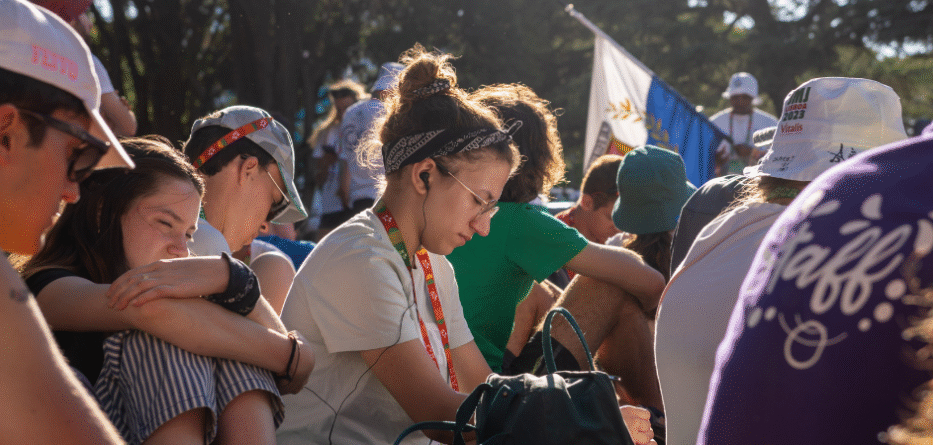
Pope Leo XIV calls on young people across Portugal, Peru, and Brazil to channel their inner restlessness into service, authentic holiness, and disciplined digital engagement in the lead-up to World Youth Day 2027.
Three video messages from Pope Leo to young people, delivered over three days—summer days, at least in Rome—and spanning two continents in a single week: Peru, Portugal, and Brazil.
One is a greeting to a diocesan gathering, another an encouragement for a national youth day, and a third, a word of applause for a music festival. Set side by side, as if on a single page, they become something else.
The thread running through Leo’s messages to the young is one of restlessness.
To the kids of Lamego gathered for Portugal’s National Youth Day, the Pope says: do not be afraid of the restlessness within you.
It is not a flaw to be corrected; it is, if anything, an engine. This is the restless heart of Augustine’s Confessions—and, sure enough, Leo speaks of the beauty “ever ancient, ever new.”
Restlessness, rather, is to be given direction: it becomes a question—Lord, what do you want me to do? — and then a vocation.
In the Andes of northern Peru, addressing the young people of the prelature of Chota and Cutervo, a territory bordering his own Chiclayo, the same restlessness takes a harsher name: holy rebellion.
Jesus, he says, does not want you to be a couch-bound youth, dozing in the comfort of “we’ve always done it this way.”
This is not a call to activism. It is a demand to transform landscapes of suffering into spaces of hope by serving the most forgotten—for it is there that the suffering face of Christ is found.
Leo XIV does not idealize the young, nor does he treat them as a fragile category in need of protection. He takes them seriously
In Fortaleza, before the hundreds of thousands at the Halleluya Festival, comes the most carefully guarded move. The Pope, holding up Carlo Acutis as a model, advises using social media and artificial intelligence with moderation and discipline.
The reason is not moralistic: these tools can project us into an unreal world where the ephemeral and mere appearance end up taking the place of true values. It is a warning about reality, not about technology.
Here, then, is the single message. Restlessness is to be kept, not anesthetized. Not discharged into noise, nor surrendered to an image of the self-constructed elsewhere. It is to be inhabited, then spent in schools and universities, in the fields and on the streets.
There is also a matter of tone that is as important as the content.
Leo XIV does not idealize the young, nor does he treat them as a fragile category in need of protection. He takes them seriously—restlessness and questions included—and from there he sends them back out.
At Lamego, he puts it in a formula that amounts to a definition: God always calls to holiness, and the saints are profoundly human.
The ending is the most Augustinian word of all. The Pope asks young people to become living stones in the building of the “city of peace”—or, as Augustine would say, the City of God present within the city of man.
And there is a date on the horizon: Seoul, August 2027, for the World Youth Day. The summons, it would seem, has already begun.
With thanks to Global Catholic and Antonio Spadaro SJ, where this article originally appeared.