

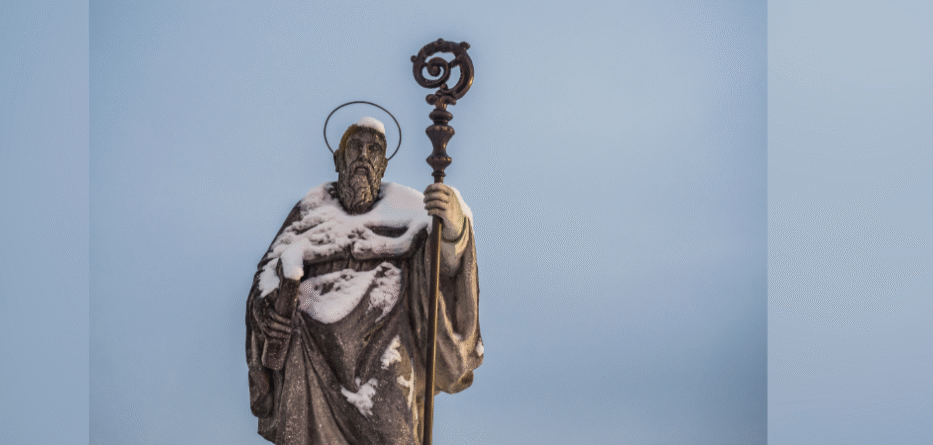
Pope Leo XIV made an unannounced visit to Montecassino while his envoys were working in war-torn Ukraine, underscoring the Benedictine vision that peace begins when prayer is paired with action.
On the morning of Monday, July 20, a car left Castel Gandolfo and took the road that climbs toward Cassino. No announcement, no livestream.
When Leo XIV walked into the abbey, the Benedictine community found itself face-to-face with the Bishop of Rome on an ordinary July day. The abbot, Dom Antonio Luca Fallica, would later speak of an unexpected gift.
The Pope paused to pray at the tomb of St. Benedict; the Holy See Press Office noted that he had entrusted to the saint his plea for peace in those regions of the world marked by blood and conflict.
Then Sext with the monks, a visit to the archive and the library, lunch with the community, the drive back. That was all: an hour and a half, and no document.
Montecassino is the place where, in 1964, Paul VI returned to consecrate the church risen from the rubble of the bombardment and proclaimed Benedict the principal patron of Europe, calling him Pacis Nuntius—herald of peace.
After him came John Paul II and Benedict XVI. Each time, the same grammar: a pope going to seek, in a monastery rebuilt stone upon stone, the non-political measure of the word “peace.”
In that millennium and a half, Montecassino has been destroyed four times— by the Lombards, by the Saracens, by an earthquake, by Allied bombers—and four times rebuilt.
While Leo was climbing to Cassino, another man of the Church of Rome was crossing a country at war. That same week, Archbishop Paul Richard Gallagher, the Secretary for Relations with States, spent five days in Ukraine as the Pope’s envoy: Lviv, Kyiv, Berdychiv.
On Sunday, July 19, at the Carmelite shrine of the Queen of the Steppes, he presided over a Mass marking 35 years since the reopening of the Latin Church’s institutions and 25 years since Wojtyla ’s visit.
The next day, he stood among the ruins of a Kyiv neighborhood struck by missiles. On arriving, he had said that the right conditions must be created for a just peace.
In the days before, Cardinal Matteo Zuppi had been in the same country as a special peace envoy of Pope Francis: speaking for prisoners, deported children, the missing, and bodies to be returned. A relay.
The two scenes seem to belong to different worlds: the half-light of a crypt and the dust of a crater. In fact, they are the same gesture at two altitudes.
In the Prologue to his Rule, Benedict quotes the psalm: seek peace and pursue it. Two verbs, not one. To seek is an interior movement—waiting, the work of years. To pursue is a hunter’s verb: it implies a road, insistence, dirty hands.
The Benedictine tradition has held the two together for fifteen centuries, and the diplomacy of the Holy See does little more than conjugate them: the prayer at the tomb and the negotiation over humanitarian corridors are the same desire at two speeds.
The monastery, meanwhile, is preparing for the jubilee of 2029, fifteen hundred years after its founding.
In that millennium and a half, Montecassino has been destroyed four times—by the Lombards, by the Saracens, by an earthquake, by Allied bombers—and four times rebuilt.
Perhaps this is why popes go up there when the world is burning: not to find comfort but to test a hypothesis—that what has been razed to the ground can be raised again, and that the long view is not merely an alibi for the defeated.
With thanks to Global Catholic and Antonio Spadaro SJ, where this article originally appeared.