


As the Catholic Church in Australia marks National Vocations Awareness Week (2–9 August), we talk to Nerissa and Arts Calub. Married later in life, they have spent more than 20 years learning what their vocation was asking of them. The Penrith couple now prepare engaged couples from across the Diocese for marriage every year, and they speak openly about grief, surrender, and where their love was directed instead.
Almost every day in the Calub household begins the same way. A kiss, a hug, and a ‘Good morning.’
“A conscious decision we made when we got married,” Arts says, “to start each day by deciding to be happy, to laugh, and enjoy what life brings, no matter how simple it may be.”
Nerissa puts it this way: “We thank the Lord for a new day to live as a couple bonded by love and grace.”
Nerissa, 66, and Arts, 65, are parishioners of St Nicholas of Myra, Penrith. Both are now retired, Nerissa as a group accountant and Arts from a long career in IT. Both married later than most.
Learning to call it a vocation
Arts dated Nerissa for more than eight years before he proposed. People asked, often, when he was going to get on with it.
“In some of the more meaningful and serious conversations I had,” he recalls, “I responded, ‘I haven’t reached the spiritual level of my relationship’. Until the day came.”

“You don’t even call [marriage] a sacrifice, because love benefits both,” Arts says. Image: Supplied
Two decades on, he describes the vocation in terms he didn’t have at the time.
“My married life is living life in the Catholic Church – a call to unity, a call to faithfulness, a call to love beyond the limits of one’s endurance and ego, truly living for the good of the other,” he says. “You don’t even call it a sacrifice, because love benefits both [spouses]. I see faith in God as hand-in-hand with faith in marriage.”
Nerissa’s sense of the vocation came earlier. Inspired by her parents and siblings, she knew that “marriage is a very special relationship of man and woman blessed by God,” and prayed that someday she would marry too. Years later, the nudge came. “I responded and said ‘I do’ to the man that I believed God sent to me,” she says.
Love redirected
Among the four elements of the vocation of marriage that the Calubs teach – free, total, faithful, fruitful – it is the last that they hold differently. Fruitfulness is the call to generate life, and they teach it as a couple who prayed for children and were not given them.
“We were open to procreation, but sadly we were not blessed,” Nerissa says. “At the time that we realised it’s not happening to us, I couldn’t help but feel disappointed, sad and hurt. Similarly my husband was feeling the same. I knew, and I felt that.”
Then one day, Arts took Nerissa’s hand.
“He held it tightly, and with his compassionate look he said to me: ‘Sweetheart, let us not be sad, but rather be thankful, because God blessed us with each other.’
“We hugged, prayed, and lifted everything to God, seeking strength and answers.”
“By the grace and love of God, we’ve accepted God’s leading to continue to extend our love to many,” Nerissa says. “This vocation can’t be isolated, but rather be shared as living witness of God’s love.”
They gave years to caring for their elderly parents. They took up ministry after ministry at St Nicholas – liturgy team, parish council, choir, church set-up.
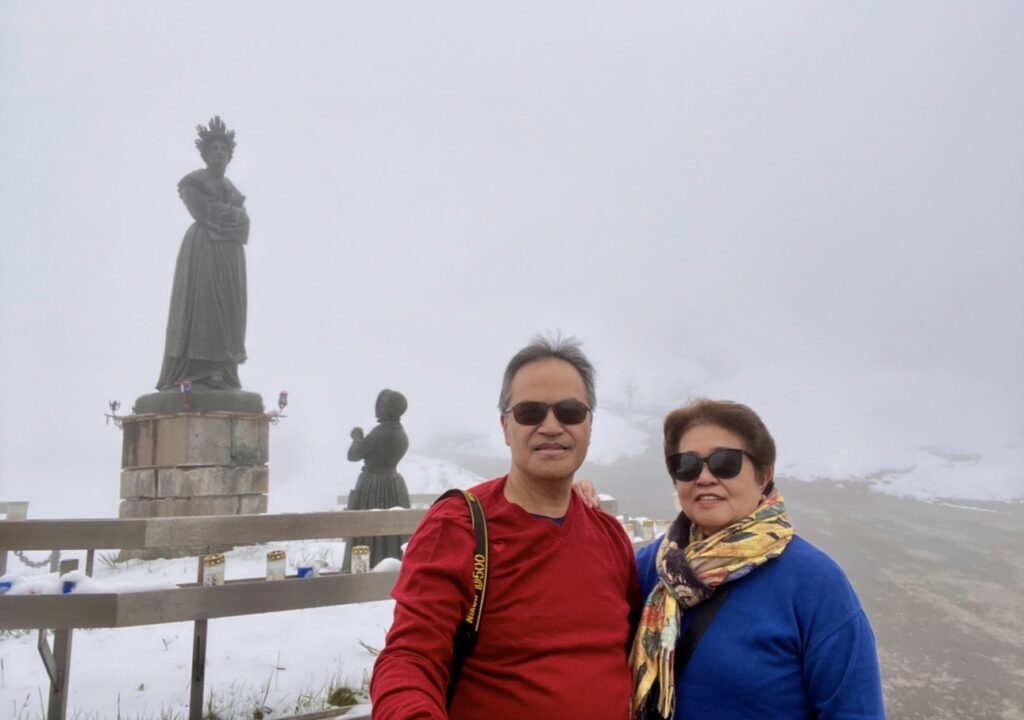
Between them the Calubs prepare more than 70 couples a year for marriage. Image: Supplied
Arts has found language for what happened to them. “The fruitfulness of our marriage moved us from ‘we are’ to ‘we care’,” he says. “Without children, our energies and ministry have become more widespread beyond our domestic church.”
By teaching, we learn
The couple inherited the parish’s pre-marriage seminars from a retiring team, along with an old compilation of notes. Wanting better material, they approached the Diocese, and found themselves invited to become educators themselves.
“We were stunned,” Nerissa says. “But thinking about it, we thought we would learn more if we taught the subject.” They observed two courses, did a trial run, and have been leading sessions ever since. Between them, they now prepare more than 70 couples a year for marriage.
“I used to teach people about computers, and I have always carried in my mind that to master a subject, you don’t just learn it, you have to teach it,” Arts says.
“Reading through the syllabus and notes, what we thought we knew about marriage and relationships suddenly started to expand,” he says. “Family of origin? Expectations? True meaning of Catholic vows? Forgiveness in marriage? Wow, we have to read some more.”
A marriage others can see
The Calubs are aware that in Penrith they are, as Arts puts it, ‘public figures’, known from the parish community and the marriage seminars.
“Every so often we meet people in the shops or in cafes who would smile and say they’ve seen us in church, and also comment how we are always together and how we work as a team.”
Mentioning that they are marriage educators is often enough to open a far more intimate conversation. “Indeed, we feel that this is the ministry we are called to do, and hope to be a witness to the gift of marriage each and every day.”
Love, Nerissa says, is “an action and not emotion” and is “meant to be shared to many”.
Arts describes it as learning self-sacrificial love, as Jesus loved the Church. “I cannot be perfect, my wife cannot always be perfect in my expectations, but God is continuously teaching and moulding me to be the best I can be.”
For Nerissa, the call is plainer. Scripture asks them to be imitators of Christ, and a married couple sharing their love with many is, she says, “a mission that we would live on with Christ Jesus in us”.
“We believe that if God is in us, nothing is impossible.”
This National Vocations Awareness Week (2 – 9 August 2026), stories like these remind us that God calls each of us by name, and rarely in the way we expect. Nerissa and Arts’ journey aligns with the Diocesan Pastoral Plan priorities of Prayer and Formation.
To learn more about responding to God’s call, visit Discern My Vocation.