

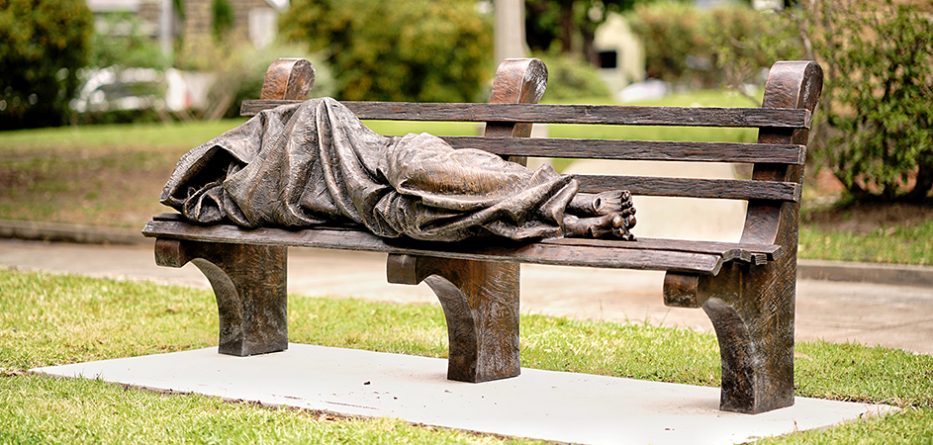
It is the antithesis of the Parable of the Good Samaritan. A man lay untended near a busy thoroughfare. A hundred thousand commuters stream past, unseeing. He dies.
The Guardian recently published the report about Bikram Lama, a young man whose decomposing remains were found beside bushes at an entrance to St James train station in the city.
The report has shocked the wider community into facing up to the stories of the unseen, invisible incidences of present-day homelessness.
It has also come at a time when the Sisters of St Joseph of the Sacred Heart and the Josephite Justice Network are agitating for change through a 150-day advocacy campaign. The ‘A Home for Every Neighbour’ campaign was launched last month on the eve of the Feast of St Joseph.
Who is my neighbour?
The Parable of the Good Samaritan was Jesus’ response to the question, “And who is my neighbour?” The Josephites’ 150-day campaign begins with the call to see the neighbour without a home.
The campaign, which will run until Social Justice Sunday on 30 August, seeks to combine “faith-based action with public advocacy to mobilise communities, influence decision-makers, and secure lasting commitments for housing justice”. It is being rolled out in five month-long stages.

The memorial service was an opportunity for the community to remember and honour lives lost and to grieve for all individuals who have died on the streets, or in shelters, over the past year. Photo: PAYCE foundation
This month’s theme is understanding the crisis and its solutions.
“We want participants to truly understand and see that homelessness is not just an individual issue, but a systemic issue that is shaped by poor policies and structures,” said Violet Cabral, Community Engagement Officer with the Josephite Justice Network.
Some of the key systemic changes needed, she said, include increasing social and affordable housing, reforming tax settings like negative gearing, and investing in early intervention and support services.
Gathering to address common themes
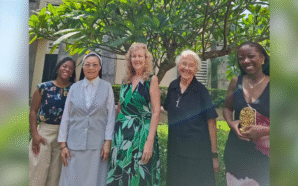
In support of this campaign, the Justice and Peace Office of the Archdiocese of Sydney brought together representatives from our parishes that are actively working on housing and homelessness to meet with the Josephite Justice Network.
Representatives of St Patrick’s, Mortlake, St Columba’s in Leichhardt North, St Vincent’s in Ashfield and St Joan of Arc in Haberfield spoke about their groups’ experiences and encounters with those in housing crisis.
There is a pressing need to raise awareness, advocate for change and hold political leaders to account, they said.

A festive meal is prepared lovingly by dozens of volunteers from St Canice’s Kitchen for hundreds of people who are homeless or struggling with the rising cost of living. Photo: Alphonsus Fok
A few themes emerged, resonating among all who participated in the meeting:
- That the housing crisis is a result of policy failure, not personal failure. People are not choosing to be homeless.
- Falling into homelessness can happen to people who have worked and earned an income all their lives. A person who can’t afford a home is someone like you and me.
- A return to public housing as spaces of community, where shelter is provided as a basic human right.
Dr Monica Dutton from Mortlake parish spoke from her extensive involvement with St Vincent de Paul Society and her parish, St Patrick’s in Mortlake. She said people can easily tip into homelessness, through sudden loss of a job, relationship breakdowns, loss of a partner, or escaping domestic violence.
The greatest increase in number she’s seen, through her involvement in her parish and in Vinnies, is among women over the age of 55.
The reasons for this include the fact that women typically retire with less superannuation than men thanks to the gender disparity in salaries; insufficient savings on retirement due to part-time work and caregiving roles; and the fact that older women find it tougher to secure a job or get a bank loan.

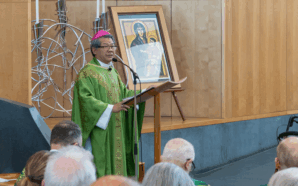
Bishop Terry Brady leads prayers for the homeless at a gathering in Elizabeth Bay in late June. Photo: Giovanni Portelli
“The reality of the situation is sometimes hidden,” she said.
A return to community through public housing
Public housing came up repeatedly as an answer to the crisis.
Sr Jan Barnett rsj said that to overcome housing shortage immediately after World War II, Australia built, from virtually nothing, a public housing system that viewed housing as a right rather than as an investment.
Dr Julie Macken, social justice facilitator with the Sydney Archdiocese’s Justice and Peace Office, recalled growing up “knowing no distinction between people living in public housing and people living in a cottage in Balgowlah”.
“We talk a lot about how climate change will displace communities,” Dr Macken said, “but we fail to recognise the economic tsunami that has internally displaced people,” which is, housing treated as an investment option rather than as a home.
Chris Baulman, who is now in his 70s, spent eight years homeless. He is securely in community housing and campaigns for a return of the village and community.
Baulman wasn’t at the meeting with parishioners, but spoke on a different occasion.

Members of organisations serving and working with the homeless come together in Elizabeth Bay to pray for the homeless who have died on the streets of Sydney. PHOTO: Giovanni Portelli
“The biggest hurdle to going back to public housing is society’s perception of public housing,” he said. “Society thinks it’s degraded and they’re bludgers, people getting something for nothing. It’s dirty. It’s graffiti. It’s crime. It’s drugs.”
“The pathway back to public housing has to go through changing that perception of it being slums.
“It has to at least start to describe a situation where public housing could be the community hub for neighborhood development; community gardens where not just the tenants but anyone could come; with arts festivals or libraries for tools, or car share.”
Bishops urge action
The Australian Catholic bishops, in their 2025-2026 Social Justice Statement issued a strong call: “The growing crisis of homelessness in Australia demands immediate and sustained action.”
“The health, educational, and economic consequences of homelessness are profound, and the longer homeless people are left without support, the more difficult it becomes for them to rebuild their lives,” the statement says.
The bishops recognised the complexity of the crisis and suggested supporting the work of Church and community organisations which advocate for better policies.
“The impact of homelessness is not just a crisis for the individuals affected – it’s a crisis for society as a whole.”
With thanks to Catholic Weekly and Pauline Jasudason, where this article originally appeared.