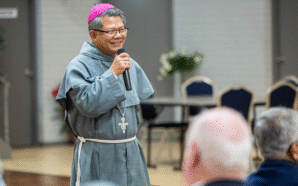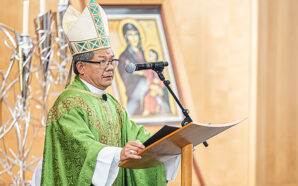


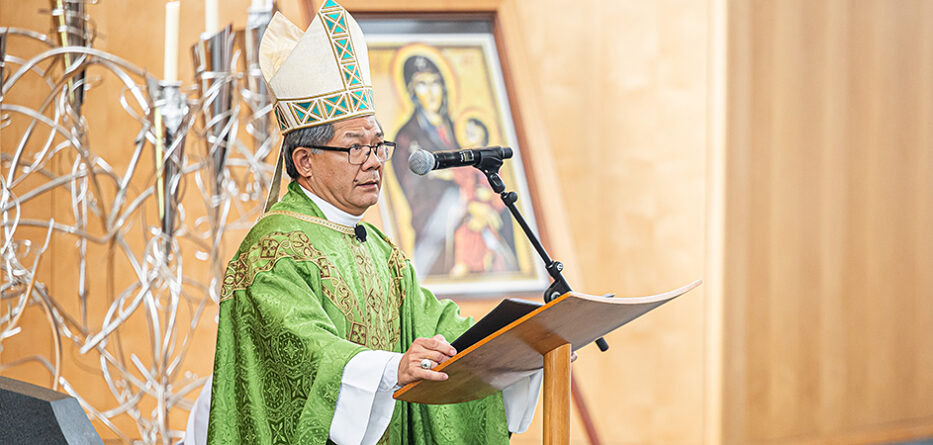
Most Reverend Vincent Long Van Nguyen OFM Conv DD STL, Bishop of Parramatta
Homily for the 14th Sunday in Ordinary Time, Year A
Readings: Zechariah 9:9-10; Romans 8:9-13; Matthew 11:25-30
Learn from Jesus who is one with the poor and the lowly
My dear friends in Christ,
Like many of you, I have been following the World Cup with interest. My allegiance is with the Socceroos, but I also support the underdogs who can inspire us with their courage, resilience and fighting spirit. The Iranian team, for example, had to compete under difficult circumstances, not the least of which was the way they were forced to leave the US immediately after every game. In Los Angeles, prior to departing, they left a handwritten note in the locker room thanking the host city and the fans. ‘From the ancient Persia of thousands of years ago to the civilized Iran of today, the spirit of Iran remains alive and steadfast,’ the note began. But it also contained the hashtags #168 #minab – a reference to one reported death toll of 168 mostly children in the attack on a school in late February in the city of Minab.
We need to be reminded of the human dignity of every person, especially those whom we often underestimate for their nationality, culture, socio-political situation and religion. If the aim of sports is not simply to win but to form character and to show solidarity, the Iranian team has earned the respect of many. In our quest for success, dominance, security, prosperity, convenience and comfort, we can be blind to the pain and suffering of our fellow human beings; we can be indifferent to the bigger picture of God’s plan for the world.
The Word of God today helps us to see reality through the prism of faith and to live with integrity, humility and openness to divine revelation through vulnerability. In the first reading, the prophet Zachariah addresses the exiles who have returned to their homeland in a state of confusion and uncertainty. They experienced war, displacement and even genocide. The symbols such as the Temple, the priesthood, the monarchy etc… had all been destroyed. Their faith in God was shaken to the core. Upon their return from exile, they are unsure as to how God’s promise of a deliverer, a saviour and a Messiah would be fulfilled.
It was against this messianic expectation that Zachariah makes some of the most startling predictions. “Behold, your king comes to you; he is victorious, humble and riding on a donkey. He will banish the weapons of war and proclaim peace for the nations”. This description does not fit into the popular expectations and aspirations of the masses. The Babylonian exile made an end to the pomp and pride associated with the powerful Davidic kingship. It was a purification of the worldly and imperial notion of a chosen people and a new understanding of the Messiah. He is not a warrior but a peace maker; not a conqueror through domination and violence but a humble servant through non-violence and justice. The association with the she-donkey is very telling in that donkey is not an instrument of war like a horse, but of peace. Furthermore, it is considered an unclean animal. By riding on a donkey, then, the Messiah is seen as a reconciler between Jews and gentiles, clean and unclean.
The Gospel today is no less subversive and radical than the prophecy of Zachariah. Jesus declares that the mysteries of the kingdom are revealed not to the learned and the clever, but to mere children or the little ones. In its context, Jesus has encountered much opposition and rejection, particularly from the supposedly enlightened ones like the scribes and Pharisees. He might have felt bitterly disappointed at the lack of success of his mission when he said earlier: “We played the pipe and you did not dance; we sang a dirge and you did not mourn.”
In contrast, it was the poor, the gentiles, the unclean, the tax collectors and sinners who are more open and receptive to his message. It was the lowly and insignificant who could best understand God’s revelation. Thus, everything about Jesus smacks of a reversal of human expectation and an affront to human wisdom. And yet, that is precisely the way God has worked in history and continues to work in our lives today. He uses the unlikely, the weak, the lowly, the despised, the rejected to achieve his way.
My dear friends,
The Word of God today speaks to us about the God who does not let us get away with our propensity towards the comfortable status quo. We are challenged not to be indifferent to the pain and suffering of others. We must not allow ourselves to be numbed by the opium of prosperity, security, normalcy and comfort. Jesus’ critique of the privileged and solidarity with the oppressed are the recurrent theme throughout the Gospel. The lowly are dignified and yet the mighty are cast down. In the Magnificat and the Beatitudes, we find the reign of God manifested in this way. The Church is a living embodiment of this reversal.
Let us pray that we as disciples and community of faith have the courage to walk the downward journey that the humble Messiah exemplified for us, in his words, deeds and relationships. On this NAIDOC week, let us renew our commitment to follow Jesus’ example in doing the work of healing, justice, restoration and reconciliation. Like him, let us not be detered by the lack of success or by rejection but persevere on the journey to the fulness of God’s kingdom. Inspired and strengthened by him, let us commit ourselves to the task of enabling the weak and lowly among us to be stakeholders in new social possibilities.