

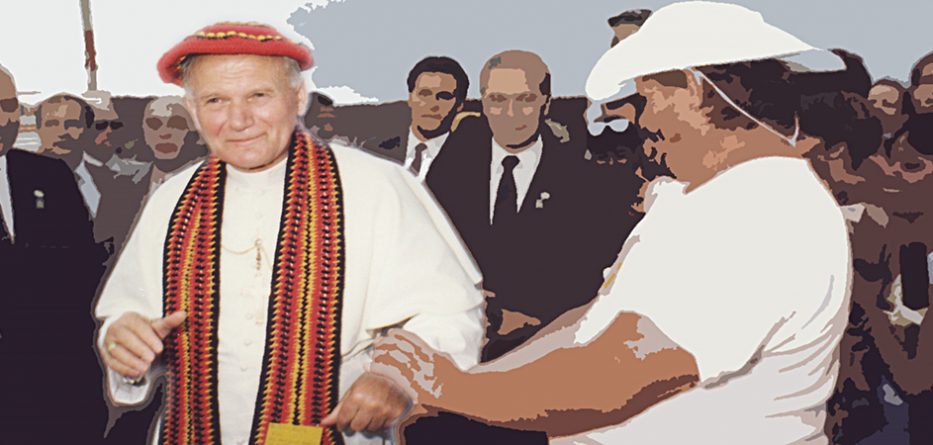
Sunday July 5 is NATSICC Sunday. NATSICC, the National Torres Strait and Indigenous Catholic Council, represents Australian Indigenous Catholics. This year the Day also celebrates the fortieth anniversary of Pope John Paul II’s powerful address to the Indigenous community at Alice Springs. It speaks just as powerfully to our own day.
His speech contrasts strongly with the message of many politicians and commentators today. They deny the distinctive claim that Indigenous Australians make on all Australians today. They wish to abolish welcome ceremonies, treaties and other signs of difference. For them the gap between the lives and opportunities of Indigenous Australians and others are evidence of inferiority.
In contrast to this contemptuous view of Indigenous lives from outside, the Pope attempted to represent Indigenous cultures from within and expressed wonder at what he saw. Their communities and culture are a continuing gift to be nurtured and not an annoying relic of an inferior race.
The Pope also appealed to a view of the world that is shared by Christian and Indigenous visions but not by Australian culture today. Both Christians and Indigenous Australians inherit belief in a reality beyond the boundaries of our universe. This reality is present and shapes our lives. Respect for the land in Indigenous culture mirrors the Christian respect for God’s presence in creation. It has much to say to a world threatened by the consequences of its unbounded trust in technology. The Pope touches on this.
You did not spoil the land, use it up, exhaust it. and then walk away from it. You realised that your land was related to the source of life.
When surveying the effects of European invasion on Indigenous peoples, Pope John Paul sees them through the The Colonists’ and Indigenous eyes. He avoids seeing them as enemies. He is unsparing, however, in listing the effects of colonisation on Indigenous cultures – dispossession of traditional lands and loss of customs, the forced separation of children from parents, migration to towns with no space for kinship practices, inability to find work, restricted access to education, and daily experience of discrimination. He recalls
If the Pope were to write today, he would certainly also note the tireless work of the leaders of Indigenous communities to preserve culture and secure justice, and the beneficial effects of the access to higher education of future leaders. He would also have deplored the racism evident in Australian society and promoted by politicians.
At Alice Springs Pope John Paul addressed the Indigenous Catholic community. His message was radical in affirming the rights of people to pray in the words and images of their communities.
All over the world people worship God and read his word in their own language, and colour the great signs and symbols of religion with touches of their own traditions. Why should you be different from them in this regard, why should you not be allowed the happiness of being with God and each other in Aboriginal fashion?
This question is heartfelt. It continues to hang in the air today. Any effective conversation about these areas in a hierarchical Church must be initiated by the Pope and Bishops and carried through by clergy. In the case of the Indigenous Churches this has been difficult because there were almost no Indigenous priests. In addition the bishops and priests appointed to the churches where Indigenous Catholics met had generally little or no familiarity with Indigenous language and culture. There is unfinished business.
The Pope’s speech continues to challenge all Australians today. In response to a political culture that encourages hostility and blanket dismissal of people and positions with which we disagree, it urges us to attend to the people who differ from us and to ask where their hostility comes from. Politics is about winning people, not winning arguments. To do that we need to seek to understand our opponents from within.
Fr Andrew Hamilton SJ writes for Jesuit Communications and Jesuit Social Services.