

Aboriginal and Torres Strait Islander Sunday
Walking Together in Christ: 40 Years On!
Reconciliation Church, La Perouse
Homily for the 14th Sunday in Ordinary Time
Readings: Zechariah 9:9–10; Psalm 145; Romans 8:9, 11–13; Matthew 11:25–30
Listen at soundcloud.com
Today we celebrate Aboriginal and Torres Strait Islander Sunday. We also commence the 50th NAIDOC Week established by the National Aborigines and Islanders Day Observance Committee. Introducing NAIDOC Week, Minister for Indigenous Australians, the Hon. Senator Malarndirri McCarthy, said: ‘This year’s NAIDOC Week theme, 50 Years of Deadly, celebrates a powerful milestone in the history of NAIDOC. It reflects the pride, strength and resilience of First Nations people and it points to a bright future ahead.’[1]
And we do so as people of faith. We hear Jesus’ words in today’s gospel: ‘Come to me, all you who labour and are burdened, and I will give you rest. Take my yoke upon you and learn from me, for I am meek and humble of heart; and you will find rest for yourselves. For my yoke is easy, and my burden light.’
In the Australian Catholic Church we recall the first decree of our recent Plenary Council which was entitled ‘Reconciliation: Healing Wounds, Receiving Gifts’. In that decree, the plenary council indicated that it was taking the lead from the National Aboriginal and Torres Strait Islander Catholic Council (NATSICC). The plenary council received a number of recommendations from NATSICC which were submitted in ‘the hope that the Catholic Church in Australia will more resemble the Church that Jesus Christ wants her to be in relation to Australia’s First Peoples (John Paul II, Address to the Aborigines and Torres Strait Islanders, 29 November 1986)’.
So in our celebration today, we take the lead from NATSICC who have written to us saying:
This year invites us into reflection. We mark 40 years since St Pope John Paul II spoke to Aboriginal and Torres Strait Islander Peoples in Alice Springs, and we celebrate 50 years of NAIDOC Week. These milestones are more than anniversaries — they are reminders of enduring faith, resilience, and our shared call to walk together.
At times, it is important to look back. Not to dwell in the past, but to recognise the path that has been travelled — to see the strength, the challenges, and the grace that have carried us forward. In this, we trust in God’s providence, present in every step of our journey.
Our theme, Walking Together in Christ: 40 Years On!, speaks to this moment. It calls us to continue the journey with humility and hope – listening deeply, and walking side by side as one Body in Christ, guided by the Holy Spirit.[2]
I was fortunate to be at Alice Springs for that gathering with John Paul II 40 years ago. So I am going to look back, ‘not to dwell in the past, but to recognise the path that has been travelled — to see the strength, the challenges, and the grace that have carried us forward. In this, we trust in God’s providence, present in every step of our journey.’
The meeting at Blatherskite Park was remarkable. I was invited to accompany a busload of people from Kununurra and Turkey Creek in the Western Australian Kimberley because they did not have their own priest with them. The community leaders gave me a screen-printed red T-shirt which depicted their Dreaming. We all wore yellow head bands, and waited patiently for the Pope’s arrival. He had been delayed by the breakdown of his Mercedes ‘Popemobile’ which was unsuited to the hot conditions. Workers resorted to throwing iced water over the engine but failed in their attempts to get the vehicle running. Eventually the Pope arrived on the park’s caterpillar dreaming track in the back seat of a plain white Australian Ford sedan which was more becoming than the foreign vehicle. There had been months of planning and negotiation about this meeting on the Yipirinya dreaming track. People came from all over Australia.
There had been some consternation early in the planning because the offices for the papal visit had been donated by a major mining company. But Aboriginal leaders were assured that the Pope’s message would not be qualified because of the generosity of the corporate sector. A week prior to the visit, there was unresolved conflict between the church’s national advisory committee of Aborigines and Islanders preparing the visit and the local Aboriginal community. The committee wanted only Aboriginal and Islander children to have access to the ceremony area where the Pope would be welcomed. But they heeded the call of the local Elders with the result that Alice Springs children of all races who shared in the local Dreaming were permitted to participate. The Alice Springs Mayor said, ‘It’s wonderful. The Aboriginal people are doing the right thing. It’s not the locals that have caused any problems. It’s people from the south who wanted to segregate the races.’[3] The tension between the local church community and national Aboriginal church leaders evaporated by the time the Pope arrived at Alice Springs airport. He was welcomed by eight traditional owners who greeted him in the Arrernte language. Among the group were the late Wenten Rubuntja and Charles Perkins.
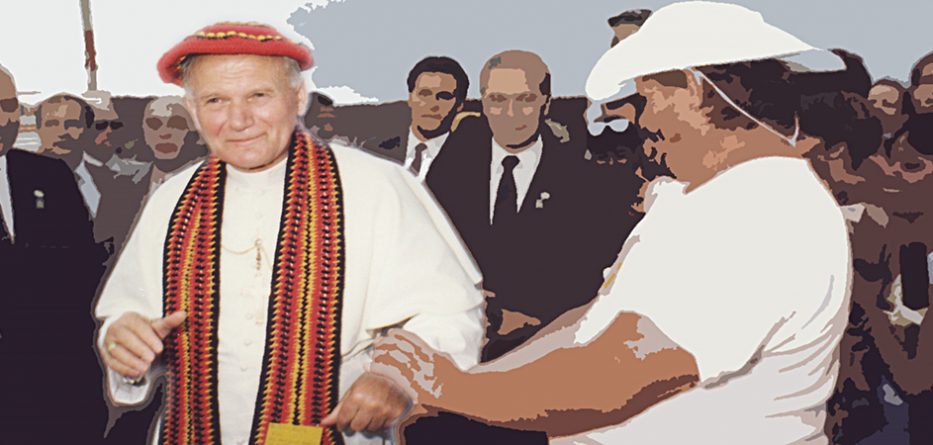
Protocol dictated that the Pope could not be attired in the Aboriginal colours. But Vatican rubrics gave way to local custom when the Pope was presented on the dreaming track with a crocheted stole and beanie in black, red and yellow. Being the consummate performer on the international stage, John Paul graciously received the gift and wore the accoutrements for some distance along the path of the dreaming track. Then Louise Pandella from the Nauiyu Community at Daly River made her way to the barrier and handed her baby Liam to the Pope. The Pope held Liam up to the cameras which captured one of the iconic shots of John Paul II. When I rose at 4.00 a.m. in Minneapolis nineteen years later to watch the papal funeral, the major US television networks used the photo several times during the course of the broadcast.
Along the dreaming track, the Pope met the nation’s most respected Aboriginal leaders who presented him with a shield inscribed with an aspirational message. The Director of the Alice Springs based Central Land Council, Patrick Dodson, who had left the priesthood, respectfully stood in the background to spare His Holiness any embarrassment. The Pope received numerous other gifts including a copy of the ‘Our Father’ in the local language of the Stradbroke Island people who had been the first indigenous Australians to receive Catholic missionaries.
At the end of the dreaming track, the Pope then made his way up to the stadium while threatening storm clouds were gathering on the horizon. Behind the Pope was a mural by Wenten Rubuntja depicting the caterpillar dreaming and the mountain gaps around Alice Springs. As the Pope completed the lengthy speech, he took a large gum branch, reached into a clay coolamon which later would be used in the Alice Springs church for baptisms, and blessed the people with water. It was at that moment that the lightning sounded and the heavens opened. All of us in the crowd were convinced that grace and nature were one and indivisible at that moment in the red centre of the great south land of the Holy Spirit. The local newspaper the Centralian Advocate reported that ‘as an electrical storm was threatening the gathering of about 4,000 people, most of the thunder was coming from the podium.’[4] The local newspaper didn’t like what the pope said about land rights when he said:
Let it not be said that the fair and equitable recognition of Aboriginal rights to land is discrimination. To call for the acknowledgment of the land rights of people who have never surrendered those rights is not discrimination. Certainly, what has been done cannot be undone. But what can now be done to remedy the deeds of yesterday must not be put off till tomorrow.[5]
The Pope later confided to Bishop Ted Collins, ‘I think the people prefer meeting me rather than listening to me. But I had to say it all because otherwise it could not be published.’ The pope had spoken strongly about land rights, self-determination and reconciliation. But he put even more demanding challenges to the Australian church when he enunciated the place of indigenous Australians in the life of the church and when he outlined the relationship between Christian faith and Aboriginal culture and religious tradition:
The Church herself in Australia will not be fully the Church that Jesus wants her to be until you have made your contribution to her life and until that contribution has been joyfully received by others.
Aboriginal leaders praised the speech. Wenten Rubuntja said the Pope had ‘filled a vacuum at a national political level’. Pat Dodson said, ‘The main point about it is that the Pope, an international figure, and spiritual leader, has focused clearly on the fundamental injustices.’[6] Like Jesus, many of us in the crowd gave thanks to the Father ‘for although you have hidden these things from the wise and the learned you have revealed them to little ones. Yes, Father, such has been your gracious will.’
Next day at mass we all prayed the prayer which the national Aboriginal committee preparing the papal visit had composed. And 40 years on, we continue to pray this prayer seeing ‘the strength, the challenges, and the grace that have carried us forward. In this, we trust in God’s providence, present in every step of our journey’:
Father of all, you gave us the Dreaming.
You have spoken to us through our beliefs.
You then made your love clear to us in the person of Jesus.
We thank you for your care.
You own us, you are our hope.
Make us strong as we face the problems of change.
We ask you to help all the people of Australia to listen to us and respect our culture.
Make the knowledge of you grow strong in all people, so that you can be at home in us, and we can make a home for everyone in our land. Amen.
Fr Frank Brennan SJ AO, Adjunct Professor of Thomas More Law School at ACU and Adjunct Research Professor at the Australian Centre for Christianity and Culture, is a former Rector of Newman College, University of Melbourne, and CEO of Catholic Social Services Australia (CSSA). His latest books include Pope Francis: the Disruptive Pilgrims Guide (ATF Theology, 2025), and Gerard Brennan’s Articles and Speeches: Maintaining the Law’s Skeleton of Principle (2 volumes) (Connor Court, 2025).
[1] See https://www.naidoc.org.au/news/naidoc-launches-2026-theme-50-years-deadly-marks-major-milestone
[2] See https://static1.squarespace.com/static/685e4c40445a5b7213387265/t/69f2cae14f755b1bfe233697/1777519329431/NATSICC+2026+Booklet_Digital.pdf, p.5.
[3] Sunday Territorian, 23 November 1986.
[4] Centralian Advocate, 3 December 1986.
[5] See https://www.vatican.va/content/john-paul-ii/en/speeches/1986/november/documents/hf_jp-ii_spe_19861129_aborigeni-alice-springs-australia.html
[6] Centralian Advocate, 3 December 1986.