


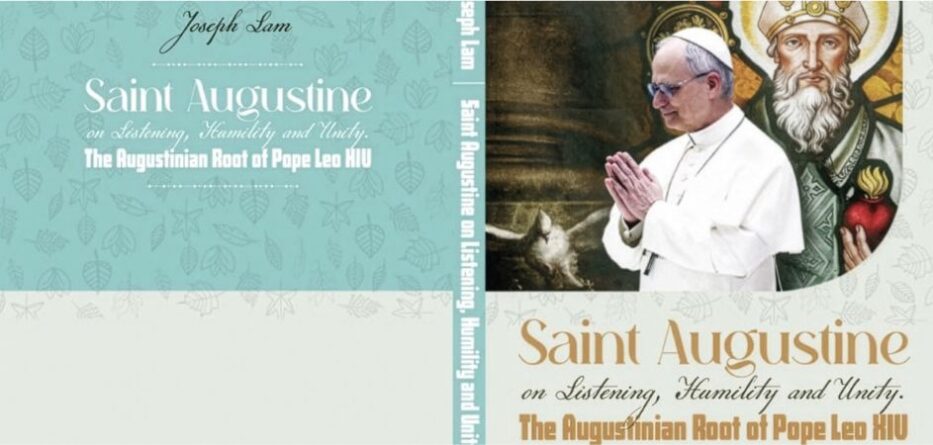
Joseph Lam’s book Saint Augustine on Listening, Humility and Unity: The Augustinian Root of Pope Leo XIV unfolds in four great movements.
- Searching for happiness and true religion
- God is ever ancient and ever new
- Augustine on finding a community of love
- War and Peace
In the Introduction we read that the Pope confided to Father Alejandro Moral, Prior General of the Augustinians, ‘I had to give up many things, but I will not give up being an Augustinian’. One can appreciate the Pope’s unrelenting love for St Augustine, by delving into this one book.
Augustine pursued a lifelong search for truth through the many encounters in his life, which challenged and honed his understanding of God. Lam elaborates on these influences, which include Monica’s strong faith, Manichean adherence, Platonic philosophy, Skepticism, Descartes’ question of self-knowledge and Augustinian’s re-interpretation through profound relationality, and many more.
The contributions of the Bishop of Hippo to theology and philosophy are extensive and his reasoning is profound. Yet his faith was even greater. Joseph Lam pivots his study of Augustine’s teachings around the Book’s title on listening, humility and unity.
Listening: Augustine teaches that listening is the first act of love. The Spirit speaks in the penetralia cordis (depths of the heart). Listening is foundational for discernment, friendship, and unity.
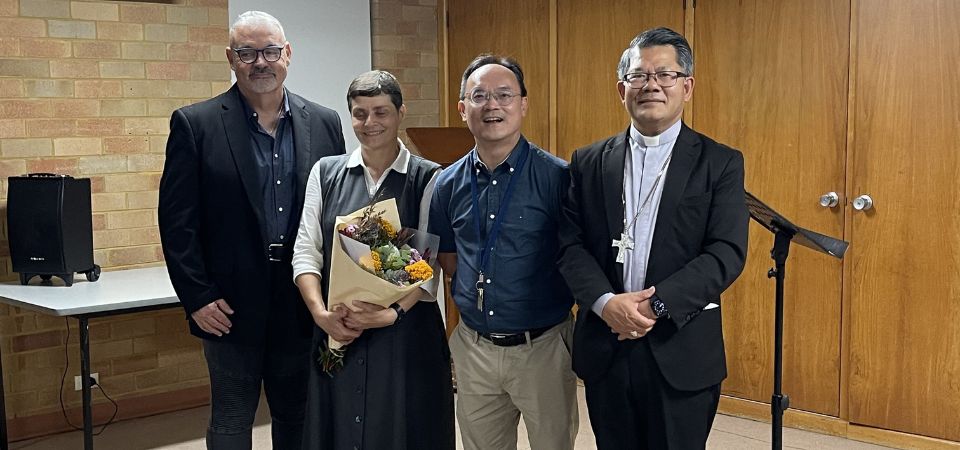
Fr Joseph Lam, second from right, at the launch of the book, with Bishop Vincent, right, Sister Dr Margaret Ghosn, and MC Steve Harrison. Image: Supplied
In his analysis of happiness, Augustine leaned on Cicero but developed the understanding of happiness further. Lam writes, that for Augustine, the ignorance of absolute Truth equals a life of misery (pp44-45). In Augustine’s words, ‘Everything that is there will be good, and the most high God will be the most high good, and will be available for the enjoyment of his lovers, and thus total happiness will be forever assured.’
Humility: Joseph Lam explains that the incarnation does not play a major role in Paul’s writings, but for Augustine, not only the passion and death of Jesus Christ, but also the incarnation itself, was conceived as an act of divine humility (dispensatio humilitatis) (p77). Divine humility in the incarnation was considered the highest form of God’s grace, summa dei gratia (p79). Lam writes of Augustine’s understanding, that loving humility, freed from proud self-assertion, creates a space for humanity and for communion with God (p106).
Unity: As Joseph Lam explains, unity is first a Eucharistic reality. If the Church is the Body of Christ, unity is who we are. In his anti-Donatists sermon, Augustine states: ‘Receive what you are, so that you may become what you receive’ (p116). He linked the physical bread, which is made up of many grains of wheat, to the one body of Christ, which unites many individual believers into a single community.
Perhaps the most important aspect of Lam’s book, is his study of Augustine’s response to war. Augustine wrote to the Roman military commander Boniface, ‘Think, then, of this first of all, when you are arming for the battle, that even your bodily strength is a gift of God; for, considering this, you will not employ the gift of God against God’ (p126). Augustine claimed the objective of the war, the achievement of peace, determines the conduct of the war and the means of warfare. Augustine excludes any form of aggressive military deployment aimed at destruction (p391). Lam emphasises Augustine’s opposition to warfare which in current day circumstances is valuable advice.
Lam delves into many of Augustine’s writings, which in itself is an applaudable effort. He makes accessible in one book the many teachings of the Bishop of Hippo. Lam explores themes from Dialogues, Soliloquia, The Confessions, On the Trinity, The City of God, Against Faustus and other writings.
Augustine is quoted throughout Lam’s book and the author ensures that Augustine’s famous quotes are afforded reflection. As such the book lends itself to the modern reader who seeks words seeped with creative wisdom, including the ever popular, ‘Restless is our heart, until it finds rest in You’ (Confessions 1,1).
Pope Leo XIV refers to listening, humility, and unity that were central to Augustine’s faith and life (p130). Listening forms the basis for understanding, humility enables the recognition of one’s own limitations and the appreciation of others, and unity is the result when these values lead to connection and mutual respect. These principles foster open, constructive discussion and stronger communities by emphasising reciprocity and complementarity beyond mere equality.
Joseph Lam has highlighted Augustine’s take on listening, humility, and unity throughout his book. He draws together the profound insights of Augustine that ignites a fervour to listen to the Word in humility and strive for unity. Lam has captured the extraordinary insights of Augustine in a book that is accessible to both the scholar and the everyday believer.
Sister Dr Margaret Ghosn, is a theologian and Principal of Maronite College of the Holy Family in Harris Park.
If you would like a copy of the book, please contact Baulkham Hills Parish via admin@parishofbaulkhamhills.org.au with Subject Line: Book Order. Fr Joseph Lam is the Parish Priest of Baulkham Hills Parish.
This reflection is an example of the Diocesan Pastoral Plan priority of Formation to achieve the objective of becoming a Humble and Healing Church. Visit Synodality to learn more.