

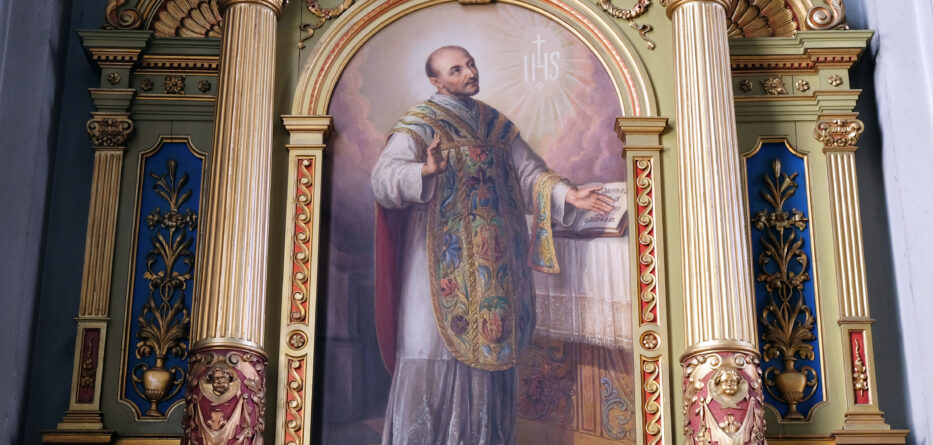
Like St Paul before him, St Ignatius is a saint for all seasons. By the time that he was chosen to be the first Superior of the group that would become the Jesuits he had been there and done that. But he was still searching for his calling, still gathering insight into his complex and changing world. His feast day invites us to take a snapshot of his life in 1526 and ask what experience he had gathered on the way.
This was extraordinarily rich. It included first-hand -or perhaps more accurately first-leg, experience of war and of the new dangers that gunpowder provided. He had also been a courtier with the knightly ideals of winning battles and women, had experienced an extraordinary religious conversion, lived as a beggar and itinerant spiritual guide, had travelled as a pilgrim to the Holy Land and been politely expelled, and had gone back to primary school to study Latin and theology. And he was still seeking to know what God asked of him.
In 1526, he arrived in Alcala for further study that would better equip him for his work with people. There he found himself caught in the coils of the Reformation and anxieties of Church leaders and kings about its implications. It was a confusing time of redefining boundaries and changing alignments. In Alcala, a charismatic and unconventional mother with her beautiful daughter sought him out. This contact brought him to the notice of the Inquisition for possible heresy, with its death penalty that would follow conviction. By this time he had attracted a number of devout companions, and much of the next two years were spent under examination. Throughout this time he prayed, observed, dealt with crises as they came, and found a way. In the following year he travelled to study in Paris. There he met the gifted and passionate companions who would form the nucleus of the Society of Jesus.
We normally think of Ignatius as the finished deal, always destined to lead the Jesuits in a world marked by the division between Protestant and Catholic and by the victory of Christians over Muslims in southern Europe. In reality, Ignatius was confronted with a world still being moulded, still hoping to return to Palestine, and intent on finding a way to serve God best. His world was very like our own, with its wars and rumours of war, with a Church in ferment, with new wheat and new thorns seeding, and the challenges to living faithfully within it.
Ignatius’ way was to focus on prayer, on engaging with people from every level of society about how to live faithfully, on weighing God’s call to him in his own life, in those of the people whom he met, and in the temper of the times. He entered his world from the bottom and not from the top. That was his way. Perhaps he also speaks to our world, which is similarly divided, is similarly a period of great change that will touch institutions in ways that we cannot predict, and similarly calling for attention to God’s presence and call.
Fr Andrew Hamilton SJ writes for Jesuit Communications and Jesuit Social Services.