

Dear Brothers and Sisters in Christ,
Out of the four evangelists, only Luke and Mathew included the actual event of Christ’s Ascension in their Gospels. Yet they do not agree on the location where the event took place. Matthew places it on a mountain in Galilee, while Luke tells us that Jesus led the disciples to Bethany, where He then ascended out of their sight. Readers following the scriptural narrative may find this discrepancy confusing and might ask, “Where did He actually ascend from? And where do we encounter Him now?”
Still, this apparent lack of precision in recording the exact location points not to an inaccuracy, but to the different priorities of the evangelists. Their intention was not to write history with accuracy, but to inspire Christians to meditate on the Ascension. As Catholics, we are less concerned with commemorating the historical details of the Ascension and more focused on what Christ’s Ascension means for us today, by answering the question: “How do we encounter Him today?”
Following the account of Jesus’ Ascension in the first reading from the Acts of the Apostles, the disciples are described as gazing intently into the sky. Perhaps they were wrestling with a profound question: “Where shall we find our beloved Lord again?” In their uncertainty, they may have thought that looking toward the place where He disappeared was their best hope. So absorbed were they in this moment that the angels had to rouse them from their stillness and redirect their attention.
The message of the angels points to a deeper truth: Christ is not found by remaining fixed upon the heavens in passive longing. Rather, the disciples are called to lower their gaze and look around. They should recognise Him in the sacraments He established for them to nourish them until He returns. They should also encounter Christ in the people of God treating others with the same love and reverence which they would offer to Christ Himself.
Jesus established the sacraments as definite moments for us to acknowledge God’s presence and worship Him. Perhaps understanding how the word “sacrament” came about can help us appreciate the presence of Christ in the sacraments. In ancient Rome, men (including the Roman emperor himself) would make a solemn and sacred oath in which they bind themselves, their lives, and their property to the oath, as a way of demonstrating their commitment to it. The name for such a public oath was sacramentum. When the early Christian Church discerned a word that could express the gravity of God’s promise, it was inspired by the meaning behind the word sacramentum—an binding oath. Therefore, from the beginning, the Church understood that the presence of God in the sacraments was not a mere probability, but a solemn promise which He binds Himself to. Out of all the sacraments, in the Most Holy Eucharist, God becomes present under the semblance of bread and wine. If you want to be certain that you are in the presence of God and that your prayers are being heard, approach the Holy Eucharist with reverence and faith. This same reality of God’s definite presence is repeated in every sacrament. The sacraments, therefore, are the definite places where God has promised to be present. His presence is real because He has promised it to be so.
Sacraments are the ultimate place to find God, but do not stop there. Because there are people around us in whom God must be found. When we treat them with the dignity only God deserves we truly find and acknowledge God in them too. What are those likely moments and people where we need to look for Christ until he returns?
Let me try to answer that with the help of a story.
In a long hospital corridor, a young man was waiting. A nurse came running and escorted young man to the bedside of an elderly man. “Your son is here,” she whispered to the patient.
The patient was too weak to open his eye. But, He reached out his hand… and the young man tightly wrapped his fingers around it, squeezing a message of encouragement. The dying man said nothing, But he held tightly to his son.
After a while the young man took his rosary out and started praying silently.
Three hours passed. And the patient died peacefully. The young man placed on the bed the lifeless hand he had been holding, and then he went to notify the nurse.
While the nurse did what was necessary, the young man waited. When she had finished, the nurse began to say words of sympathy.
But he interrupted her. “Who was that man?” He asked.
The startled nurse replied, “I thought he was your father.”
“No, he was not my father,” he answered.
“Then why didn’t you say something when I took you to him?” asked the nurse.
He replied, “I go visiting hospitals offering to talk to those who are lonely. I knew that this man needed his son, and his son just was not there. I was not planning to stay for long. But when I realised that he was too sick to tell whether or not I was his son, I realised how much I can help. All he needed was a hand to hold, and I was happy to remain holding.”
Being the face of Christ does not require mastery of doctrine or eloquence in speech. What it asks of us is far simpler, yet far greater: a heart willing to believe, and hands ready to love another as though loving Christ Himself.
So let us keep watch for the quiet presence of God among us. And more than that, let us become His presence for others—a kindness in their sorrow,
a glimpse of comfort in a weary world.
Let us find God both in His abiding presence in His sacraments, and in the anxious faces of His children in need.
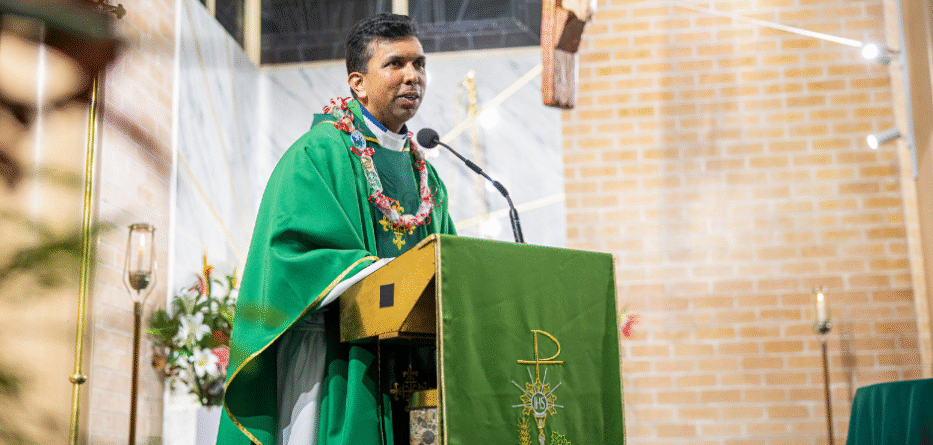
Fr Shinto Francis, Parish Priest of Sacred Heart Parish, Luddenham-Warragamba.