

I once slept for a week on the floor of a supply closet at an AIDS hospice run by the Mother Teresa sisters. I would fall asleep next to big jugs of off brand floor cleaner on one side and a faded holy card of Divine Mercy on the other that the sisters had taped at the right height to meet eye level when falling asleep or waking up.
I was there during what we call “The Pilgrimage,” an experience in my first year of Jesuit formation where we are given $35 and a one way bus ticket and are told not to be back to the community for a month. We are asked to rely on strangers, and through them, God’s Providence.
My one way ticket brought me to San Francisco and eventually to Pacifica, CA where I stayed with the sisters for a week before shipping off to the next stage of the journey. The sisters opened the hospice in the 80’s to care for AIDS patients and continue to do so.
There was another volunteer there at the time–a clearly off-balance, but well intentioned fellow who had recently found religion. (Maybe he would have said the same about me?) He wore khakis, a button up, and a black wrist brace over his oxford sleeves everyday. I don’t remember his name, but I do remember thinking he was a bit crazy.
I judged him. His thoughts on religion seemed too harsh. He was frequently talking to the patients about eternal damnation. He once placed an atrocious wooden sculpture of the dying face of Christ–a truly horrifying piece–just inches away from the face of a sick man who could only speak Polish. He felt this would comfort the man, even though the poor man would frequently push it away and refused to look at it.
This was distressing to me, as I saw it was distressing for this dying man. But the volunteer felt it was going to be good for him, perhaps it would coax him into asking for Baptism. Again–this all seemed a bit bizarre to me.
But this volunteer said something once that I now recall often. We sat with the dying Polish man and prayed the Rosary with him. When we got to the mystery of the Ascension, he said he believes that all the treasures of the faith are concealed in the Ascension.
At the time, I honestly thought this was about as meaningful as that awful sculpture. I remember thinking, “These are just some pious words he is saying to sound holy.”
I also, admittedly, had not spent much time thinking or praying about the Ascension myself. It didn’t seem all that meaningful to me. But it wasn’t too long after that, that I began to remember his words. I think he was on to something that my judgments blocked me from understanding then.
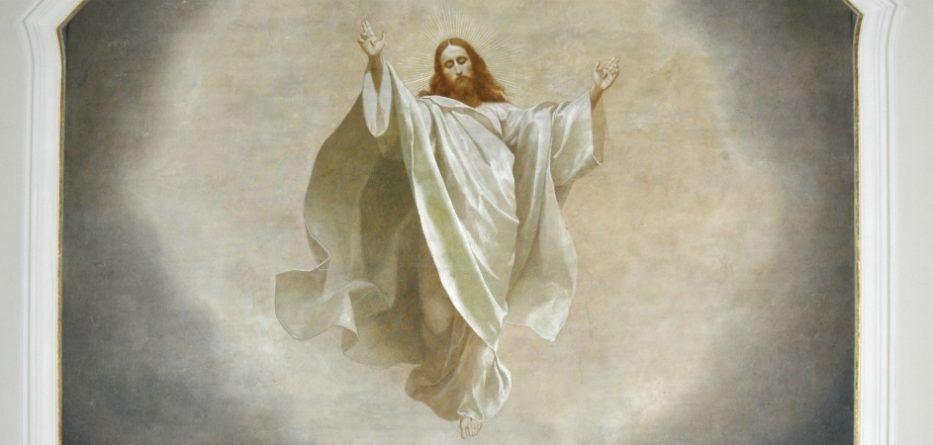
At the Ascension, we commemorate Jesus ascending into heaven. In one sense, it is a feast of Jesus leaving, of Jesus going away from us, of Jesus not being or feeling present. And this, I have since come to know, is a very real and common experience.
Jesus prepares his friends for his departure many times. He speaks candidly about his leaving. “I will be with you only a little while longer,” he says, “Where I am going, you cannot come.” (John 13:33)
Elsewhere he says, “I tell you the truth, it is better for you that I go. (John 16:7) At the conclusion chapter 16, he states it as plainly as can be: “Now I am leaving the world and going back to the Father.” (John 16:28)
Yet, for as clearly as he tells his friends that he is leaving, he makes just as clear that he will be present to them: “I will not leave you orphans,” he says. He promises to send the Advocate, the Spirit, to be present with us while he is gone.
Jesus promises us both absence and presence. “A little while and you will no longer see me, and again a little while later and you will see me.” (John 16:16)
Absence is perhaps the most common experience of faith. It is a necessary experience of faith, and one which must be accepted and grappled with. And the mystery is that presence is concealed in absence, that we come to hold both of them in the life of faith, neither threatening or cancelling out the other.
This is what I have come to think that volunteer might have meant when he said it is all contained in the Ascension: that even upon Jesus’ departure, we are left with the aching in our hearts that speaks both to his presence and to his absence. And this experience of longing, of ache, and desire, and ultimately, of love, is the Christian mystery which we hold in these earthen vessels.
It is the same mystery that Jesus lived on the Cross. He cried to God, “Why have you abandoned me?” There is the ache, the lament, the acknowledgement of absence alongside the conviction of presence in the direct address to a listening, but silent God.
The Anglican priest, Fleming Rutledge speaks about this paradox. She writes,
“The fact that God hides himself in the midst of revealing himself is paradoxically a testimony to his reality. Presence-in-absence is the theme of his disclosure. God isn’t hidden because we are too stupid to find him, or too lazy, or not ‘spiritual’ enough. He hides himself for his own reasons, and he reveals himself for his own reasons. If that were not so, God would not be God; God would be nothing more than projection of our own religious ideas and wishes.”
If we do not accept God’s absence, we fall into the trap, Rutledge points out, of making God simply a projection of our own wishes. This is an easy trap to fall into. Though, perhaps “trap” is unhelpful language. This is all part of a growth process; it is not about “getting it right” once and for all.
There is a beautiful depiction of this dynamic of presence and absence in the show Call the Midwife. The dear Sister Monica Joan has a vision of Christ appearing to her as a white stag. Enraptured, she says, “I knew it was him from the love in his glance. He came, he looked, and he departed.” You can/should watch the scene here.
This is a lifelong journey of grappling with presence and absence, having the courage and faith to hold and acknowledge both. To accept presence and departure. It is not easy. And, of course we know this is not only in regards to Jesus, but is a fundamental human experience–the reality of longing, of holding onto and letting go, of learning to not cling but hold with open hands.
There is an emptiness which all of us must accept; a personal emptiness and an emptiness in the world which speaks to the absence. This emptiness need not lead to despair, but rather to suppleness, an open readiness to receive God who wishes to fill the emptiness wherever, whenever, and however.
The Ascension, I believe, can invite us to trust in this emptiness, to not spurn it and to not cover it up. With grace and time, we may come to hold it freely, marveling at it and noticing just how full it really is—and utterly beyond our control. I hope so.
Reproduced with permission by From Every side and Billy Critchley-Menor SJ, where this article originally appeared.