

‘A wedding is for a day, but a marriage is for a lifetime.’ It’s the kind of thing people say so often it risks losing its impact, until you’re sitting in a room full of engaged couples, a few months from the altar, and the words take on a new weight.
By that point, I had spent months picking the right dress, collecting vendor quotes and finalising the guest list. The hours accumulate, and you let them, because a wedding demands it. Somewhere beneath the busyness of planning, a persistent thought was growing – that we had given so much preparation to a single day, and maybe nowhere near as much time preparing for the marriage itself. The Marriage Preparation weekend ahead felt like a chance to change that.
Marriage Preparation is a requirement for couples seeking to marry in the Catholic Church – an invitation to understand what the vows actually mean before they are spoken. For us, that meant a pre-marriage course with the Diocese of Parramatta: a Friday evening and a full day on Sunday. My fiancé and I had talked about these things before: money, conflict, children, faith. Conversations we’d already had in the first few weeks of dating. But participating in the Weekend Course shifted something. We were no longer asking whether we wanted this life together but instead about how to build it. It asks for a different kind of attention than we had given it before.

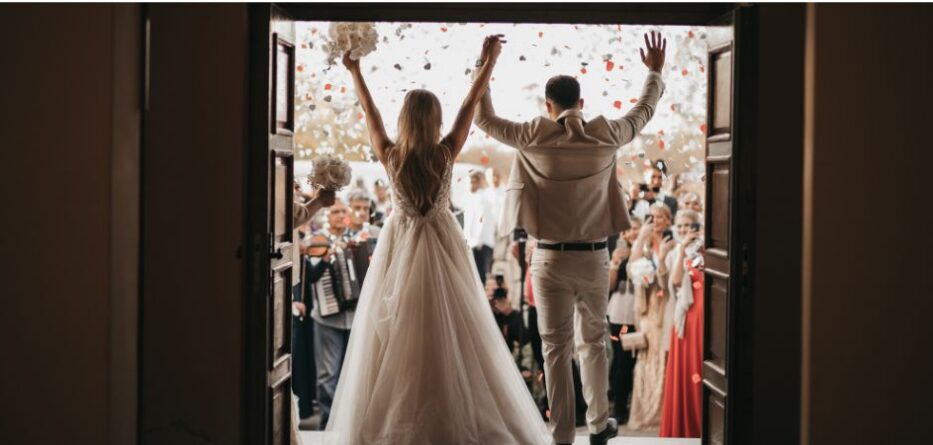
More than just picking out a dress, preparing for marriage requires understanding what the vows mean before they are spoken. Image: Shutterstock
When we arrived on Friday evening, we noticed that the tables were arranged in groups of two – and we both let out a sigh of relief, grateful we didn’t need to open ourselves up to complete strangers. Two facilitators welcomed us – a married couple whose ease with each other said more than any introduction could.
The homes that formed us
My parents divorced when I was young. So did my fiancé’s. It’s not uncommon, and I suspect we weren’t the only ones in that room whose understanding of family might have been shaped by its fracture. But it does change what the weekend asks of you. I came carrying a hope for something different, and aware that hope alone won’t hold it together.
The first session invited us to look at our families of origin, to understand the invisible inheritance we carry into adulthood. How was conflict addressed in the home – was it spoken or buried? Was money a source of shame, of stress, or just never discussed? And what values did my parents pass down to me?
I had expected the weekend to begin with theology, but instead it began with us, with questions I had thought about before but never with another person so firmly in the picture. It was grounded in real life in a way I hadn’t anticipated. The course drew on Dr John Gottman’s concept of the ‘Sound Relationship House’ – the idea that a strong relationship, like a strong home, is something you construct together, one level at a time. That weekend, we began the work of imagining what ours could be.
From ‘I’ to ‘We’
At one point, we were asked to answer questions individually – about roles, responsibilities, finances, parenting – before sharing our responses with each other. I’m naturally introspective, so writing down my own answers came easily. The more careful part came after, sitting with our answers side by side, realising we weren’t there to find a middle ground between two separate ideas of what life could look like. We were there to build something entirely our own. A movement from “I” to “we.”

Couples at a marriage preparation course are there to build something entirely their own. Image: Shutterstock
Where love becomes life
For us, that “we” has always included the hope of children, and the weekend gave us the space to explore that together. A Natural Family Planning educator walked us through fertility and what it means to plan a family naturally, covering everything from basal body temperature to cervical mucus to charting the fertile window. More than the method itself, what stayed with me most was this underlying principle – conceiving a child is never an “accident.” It’s something two people enter into, with full awareness and shared responsibility. The educator was explicit: the weight of family planning doesn’t fall on one partner alone. It belongs to both, equally. When you consider how narrow the window of fertility truly is, every conception begins to look less like chance and more like a gift. There is a sacred mystery in the fact that new life begins where two people become one.
Marriage as a witness
For all its practicality, the weekend never lost sight of the bigger picture of marriage within the Catholic Church. We were reminded that marriage is a sacrament – an outward sign of God’s grace, a covenant held together by something greater than the will of two people. That our marriage goes beyond us. It is a witness to our friends, our families, and one day our children – a sign of Trinitarian love, the self-giving communion of Father, Son and Holy Spirit from which all love finds its source. And God co-creates with us in this. In the home we build, in the children we hope to raise, in the small daily choices that shape who we’re becoming together.
Worth the work
Marriage asks a great deal. I think I’ve always known this. Wanting something to endure is one thing; knowing how to make it so is another. The Marriage Preparation weekend gave me a more in-depth consideration about what my fiancé and I are choosing, and a clearer sense of the work we have ahead of us.
It began with our families, moved into our finances, our roles, our hopes for children – the full spectrum of a life shared. It was less a lesson in Catholic doctrine and more an honest look at real life. It’s important, human work.
A wedding is a single day, and the marriage is every day that follows. Love, St John Paul II said, is a decision renewed every day. The weekend course was one step in that direction. And if it taught us anything, it is that preparing for a marriage – unlike preparing for a wedding – never really ends.
Gelina Montierro is a Senior Communications Officer for the Diocese of Parramatta. She is a parishioner at St John’s Riverstone and is preparing to marry her fiancé Jonathan later this year.
The Diocese of Parramatta offers two pre-marriage programs for engaged couples. Contact your parish priest or deacon as soon as you are engaged and book a course at least six months before your wedding day. For more information, visit parracatholic.org/celebrate/marriage/marriage-preparation/
Marriage preparation courses support the Diocesan Pastoral Plan priorities of Mission and Formation, and the objective of A Church Renewed in Spirit and Prayer. Visit Synodality to learn more.