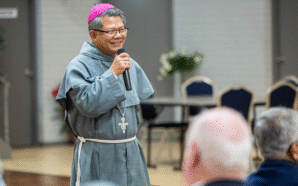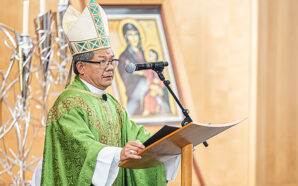


Most Reverend Vincent Long Van Nguyen OFM Conv DD STL, Bishop of Parramatta
Homily for the 21st Sunday in Ordinary Time, Year A
Readings: Isaiah 22:19-23; Romans 11:33-36; Matthew 16:13-20
Believing and embracing the self-giving model of the Messiah
Brothers and sisters in Christ,
You might have seen an episode of the Compass Program on ABC television called “Holy Trouble”. If you have not, I highly recommend it. “Holy Trouble” is the provocative name the Sisters of Charity in America call themselves. The nuns have a long history of standing up for people who are shunned by society. In the 60s they marched for the civil rights movement; during the HIV/AIDS crisis of the 90s, they housed those affected; now they keep vigil at detention centres in solidarity with undocumented migrants.
Though they are facing diminishment in numbers and the future of the congregation is uncertain, they live their lives with a sense of deep trust, passion and joy. They are not sitting around, moping and hoping for the good old days to return. They are busy getting on with the mission God has given them to do. They are nurturing and companioning others, including their lay associates. In the twilight of their collective existence, they demonstrate the discipleship of trust in vulnerability and courage in humility that the rest of the Church are called to embrace. They put in bold relief what it means to travel light, to stake everything on God’s promise and to live generously and selflessly till the end.
Scriptures for this 21st Sunday bear witness to the God who calls his people to a life of service in love, compassion and self-sacrifice. In Jesus, the Messiah, we find a model of living for others as opposed to the imperial model of dominion, power and self-preservation. To believe in him, therefore, means not only an acknowledgement of his divinity but also a lifelong commitment to emulate his self-giving and self-sacrificial love.
The first reading was written in the context of the gradual disintegration of Israel before the exile. This period was marked by apathy and political inertia. It was kind of a “grab what you can” mindset that had infected the leading citizens. Shebna, the king’s treasurer was one of those. He failed to care for the people in time of need and instead used his position for personal gain. Isaiah in his prophecy denounces Shebna “I will thrust you from your office and pull you down from your station.” In his place, Eliakim was chosen to be “the father to the inhabitants of Jerusalem and the House of Judah”. This prophecy is messianic in that Eliakim was a figure of the ideal ruler who would bring God’s true justice, love and compassion to the people.
The Gospel follows the theme of the first reading. It is set in Caesarea Philippi, the name that suggests the omnipresence and power of the Roman Emperor whose claim to divinity was carved into the imperial currency, the denarius. In no uncertain terms, Caesar’s claim turned out to be false, because there was only one true Son of God and it was Jesus. This is the Gospel’s subtle but unequivocal assertion. Peter’s response “you are the Christ, the Son of the living God” in effect meant a rejection of Caesar.
“Who do you say that I am?” is no ordinary question. In fact, it takes the audience back to the great “I AM” revelation at the burning bush. There and in many “I AM” statements throughout John’s Gospel, Jesus is identified with the God of Israel, God who gives life, who sustains and guides his people throughout the ebbs and flows of history.
Peter is praised for recognising the real identity of Jesus. He is called the rock. However, the rock can be either the corner stone or the stumbling block. So long as Peter lives out the call to emulate the Suffering Servant and to live a servant leadership, he is the rock of strength. But if he refuses to be part of Christ’s suffering and reverts to the imperial model of behavior, he becomes the rock of offense. Indeed, Peter is soon called a stumbling block precisely because he wants to remove the cross from the mission of the Christ and Christian discipleship.
Dear friends,
God’s Word makes it clear to us today that believing in him means also a rejection of the imperial mindset and practice that is contrary to the Christian ethics of justice, love and compassion. What the Sisters of Charity or the Holy Trouble highlight for us is the need for Christians to be the conscience of society. We are called to be like the prophets of old who have the burning passion to speak God’s alternate vision for humanity. Now we need to embody that vision in living as contrast communities, avoiding cultural accommodation and demonstrating a different way to be a society.
We must have the courage to be a community of hospitality, compassion and neighbourliness that serves as an alternative to the kingdom of Caesar.
Let us pray even as we enact liturgically the kingdom vision of Jesus in this Eucharist that we may be able to live up to that calling. Let us, like St Paul reminds us, trust in the One who accompanies those who love him and brings all things to a good end. Grounded by the rich knowledge and wisdom of God, may we not only profess the true Messiah as Peter did but also live out the self-emptying nature of the true Son of God by our love and service to one another.