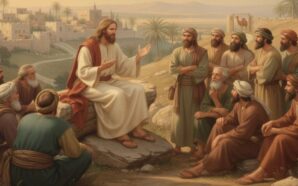


In Matthew’s Gospel (13:24-43), Jesus describes the kingdom of God being like wheat and weeds.
He proposed another parable to them. “The kingdom of heaven may be likened to a man who sowed good seed in his field. While everyone was asleep his enemy came and sowed weeds all through the wheat, and then went off. When the crop grew and bore fruit, the weeds appeared as well. The slaves of the householder came to him and said, ‘Master, did you not sow good seed in your field? Where have the weeds come from?’ He answered, ‘An enemy has done this.’ His slaves said to him, ‘Do you want us to go and pull them up?’ He replied, ‘No, if you pull up the weeds you might uproot the wheat along with them. Let them grow together until harvest;* then at harvest time I will say to the harvesters, “First collect the weeds and tie them in bundles for burning; but gather the wheat into my barn.”
Pondering this Gospel through the lens of Love, the story shifts from being judgemental about who among us is good wheat and who are not good weeds. It becomes a beautiful, encouraging story. All harshness and judgement disappear. A more interesting story emerges.
So how shall we think about the wheat and the weeds? Taking a social and emotional intelligence perspective, we recognise that we are all both wheat and weeds. If the wheat is our essential goodness. What are the weeds?
What if the weeds are the fear centre in us? Reactions built up over our lives in response to our need for safety or our memory of unsafety, whatever shape that took in our formative years or later. It is interesting in the Gospel that the wheat was sown first and the weeds came later. Since we are born in the image and likeness of God (Gen 1:26-27), perhaps at the moment of our birth, we are only the wheat, innocent of fear?
To flourish w,e need safety, love, respect and nourishment in all its forms. At the moment of our birth, we cry, having left the warm, secret place in which we grew in safety; undergone a profound, physically challenging experience to be born; are met with gravity, lights, sound, disconnection. Our innocence carries a shadow activated by our life-threatening vulnerability at birth: the collective human fear of not being safe, respected, nourished, loved and taken seriously. In this moment, the fear that our needs will not be met is activated. We carry this deep insecurity throughout our whole lives.
Until we find our safety and respect in God’s delight and love for us. Each of us and all of us. As we discover the personal, intimate love in which we are held, we are liberated, allowing us to see what God sees in us: wonder, beauty, goodness, frailty, vulnerability, dependency…which is what we see in a tiny baby.
Rather than judgement, Jesus is teaching about God’s deep compassion. The weeds are allowed to grow with the wheat. Just as violence, in thoughts, words or deeds, harms the perpetrator as well as the victim, pulling up the weeds will damage the wheat. God is prepared to wait, trusting in the goodness of the harvest. The reign of God cannot be diminished by the weeds of the world. Practicing non-violence and holding compassion for the weeds, in us and in our world, is our salvation and our liberation. Spiritual writer Anthony de Mello SJ advises us to “Be grateful for (y)our sins, they are carriers of grace”.
Wholeness is how we begin. Then we spend our lives trying to get back to being whole. Dan Siegel Director of the Mindsight Institute, captures this beautifully:
“You’re in the womb, effortless being; you don’t have to breathe, you don’t have to eat, you don’t have to make sure someone is aware of your existence and there is no separation of what we might call you from anything that is not you. We are just going to call that wholeness. Wholeness is embedded in implicit memory. You are out in the world. What’s the difference now? You’re separate. It’s dangerous. Our nervous system has certain important aspects of the way they function that get activated in response to this do or die situation. Wholeness is something that for our lifetime we are always trying to get back to.”
St Augustine says this spiritually: “You have made us for yourself, O Lord, and our hearts are restless until they rest in You”.
So, what are the weeds? Looking through the lens of love enables us to see that the weeds are a part of us, but like the wheat in the story, we can grow in spite (or because) of them.
We desire perfection, criticising ourselves when we don’t achieve the unachievable. Our attempt to be perfect is one way that the weeds take over. We are not consciously aware that our reactions are being run by the tapes of fear, the need for safety, the desire to be loved and taken seriously.
When we are compassionate rather than judgemental towards our triggers, we actively reduce their impact on us and on others.
Reading through the lens of Love, we discover that so much of Scripture speaks of God’s understanding of our human frailty and its impact on each of us individually and collectively. Jesus coming to live among us, dying and rising, expresses an unfathomable kindness and compassion for us and a remarkable belief in our goodness. More than that, in Jesus’ death and resurrection, he actively takes our weakness into himself, transforming it and thereby liberating us. We are not held in the thrall of fear or violence anymore. We are also no longer alone in our suffering. We are invited to trust in our goodness and, like Jesus, to embrace a radically non-violent response towards ourselves, others and our planet.
In the end, the weeds are bundled up and burned so all that is left is the healthy harvest of wheat.
What if that’s how God views us – as healthy wheat and weeds. What if, at our death, the weeds in us are gathered up and taken away, leaving only the wheat? Perhaps it is our innate beauty that enters into the presence of Divine Mercy, the One who has held us tenderly all our lives?
Catherine Whewell was Director of People in Ministry and Chancellor in the Catholic Archdiocese of Adelaide. Cathy now writes and is based in Denmark with family. Used with her permission.