

When Cardinal Robert Prevost – now Pope Leo XIV – emerged as the new Pope, many in the mainstream media, and even within Church circles, reacted with surprise. To them, his election appeared an unlikely outcome.
But for me, it wasn’t entirely unexpected. So why did I see him as such a strong possibility?
Despite being an American – which in ordinary circumstances might have worked against him for geopolitical reasons – Pope Leo XIV brought with him a life shaped by international ministry.
Though born in Chicago, he spent the majority of his priestly and episcopal life in Peru. That deep, enduring connection to Latin America earned him not just credibility, but real affection from the region’s cardinals, many of whom hold significant influence in a modern conclave.
Yes, there were other plausible candidates – Cardinal Tagle or Cardinal David from the Philippines, a French cardinal, a Spanish Salesian, even a Moroccan contender. But in the end, as the bells rang and the crowd erupted in St Peter’s Square, I felt a deep joy, not only because of the man chosen, but because I truly believed Leo XIV was always more than just a possibility.
A continuation of a legacy
From the moment Leo XIV stepped onto St Peter’s balcony, there was a palpable sense that this pontificate would not be marked by rupture, but by a steady continuation of Pope Francis’s vision – one defined by synodality, solidarity with the poor, and a global Church that listens before it lectures.
His first words as Pope spoke volumes. He invoked peace, not as a platitude, but as a core principle for our fractured world. He emphasised the importance of dialogue and discernment, the very heart of synodality that Francis so passionately advanced. He reaffirmed the Church’s preferential option for the poor, its enduring responsibility to migrants and refugees, and its moral imperative to walk alongside those on the margins.
These were not just gestures – they were signals of a type of future that Francis would have liked.
Even the name he chose, Leo XIV, was deeply symbolic. It ties directly to Pope Leo XIII, the towering figure of the late 19th Century who penned Rerum Novarum, the foundational social encyclical that thrust the Catholic Church into the modern world of workers’ rights, trade unions, and the fight against poverty.

Pope Leo XIV. Image credit: Vatican Media YouTube
Leo XIII made it clear that the Church could no longer remain silent in the face of injustice – and by choosing this name, the new Pope has made clear that those commitments will not be abandoned.
Global responses around the world have been remarkably positive. In Italy, where he speaks flawless Italian and has family roots in both France and Spain, the reception has been warm. In Rome, he’s already earned respect as someone who understands the Curia, speaks with grace, and leads without grandstanding.
In short, Leo XIV is not Pope Francis in style – but he is in spirit.
Not just an American pope
There was a very deliberate reason why Pope Leo XIV chose not to speak in English during his first public appearance. That decision, quiet though it may have seemed, sent a clear message: he is not simply an American pope.
It was, in effect, his way of saying, “I am not here as a representative of the United States.” He is not a flagbearer or a national figurehead. He is an internationalist – a man shaped far more by his mission in Peru than by any American identity. In fact, he also holds Peruvian citizenship. That, in itself, speaks volumes.
His 12 years as Superior General of the Augustinian order saw him travel to more than 40 countries. He speaks Spanish, English, Italian – all fluently – and several other languages. This is not just linguistic ability; it’s evidence of an expansive worldview, deeply attuned to the Church’s universal mission.
In my view, this internationalism is precisely why he was elected. The cardinals were confident that Leo XIV would not bring a narrow national perspective to the papacy, but a global Catholic view grounded in lived experience across continents and cultures.
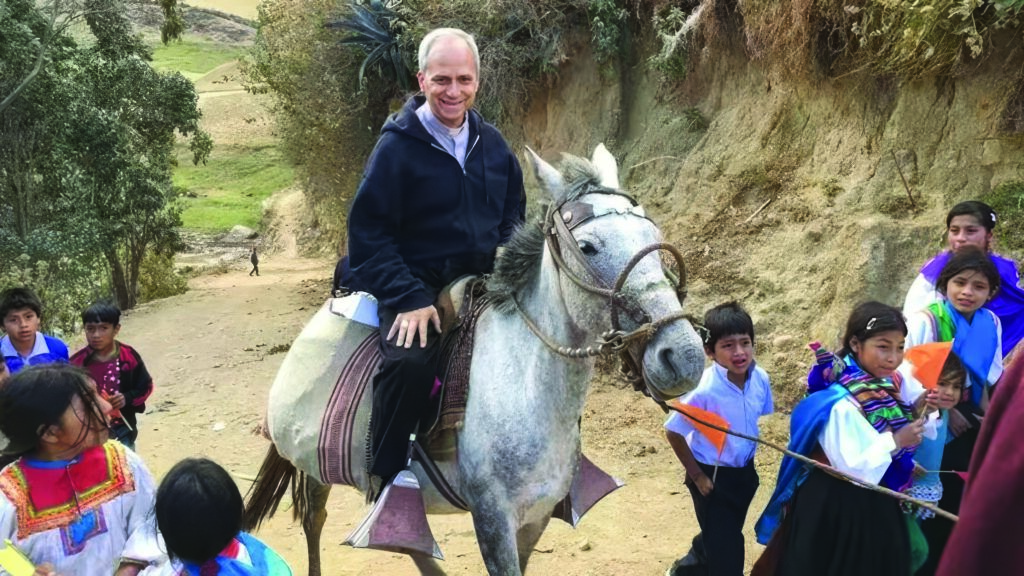
Before his election as Pope Leo XIV, Cardinal Robert Prevost spent the majority of his priestly and episcopal life in Peru. Image: Supplied
The Augustinian connection
Recently, I came across a quote from an Irish priest who had studied with Pope Leo. As a fellow Augustinian, he spoke warmly of the Pope, referring to him simply as “Bob.”
He wrote: “Bob is a gentleman. He is quiet. He is strong. He is reserved. He is very much one of us.”
That sense of humility and fraternity is not just abstract. It’s lived daily. Pope Leo XIV regularly eats at St Monica’s, the Augustinian general house just off St Peter’s Square. He joins in Mass with the community and shares meals with ordinary Brothers and visitors alike. He even helps serve the guests. That kind of simplicity – that kind of presence – speaks louder than any grand proclamation.
Among his fellow Augustinians, there is a palpable sense of pride. They know the weight of the responsibility he now carries, and they hope he will be supported fully. Because he brings something valuable – quiet resolve, deep humility, and a lifelong habit of listening.
He is, as I have often said, a quiet achiever.
Relationship with the late pope
I think there was a deep level of trust between Pope Francis and Leo. It’s clear that Francis saw in him not just a capable churchman, but someone who shares his vision, especially important given Prevost’s long experience in Latin America.
Pope Francis, being Argentinian, would naturally have seen Leo as someone close to his own ecclesial worldview. Leo had spent many years in Peru, and I imagine that for Francis, that made him “one of us, Latin Americans” so to speak. Their paths definitely crossed while Francis was still Archbishop of Buenos Aires and Prevost was the Superior General of the Augustinians. As Superior General, Prevost travelled extensively, including to Buenos Aires, so I am sure they met during those years.
Later, when Francis became Pope and Prevost was still in Rome as the Augustinians’ Superior General, their connection deepened. The choices Francis made speak volumes. He named Prevost a Bishop and sent him back to Peru, then three years ago, called him back to Rome, made him a Cardinal, and appointed him Prefect of the Dicastery for Bishops – a position of enormous influence. As the saying goes, “personnel is policy,” and I think Francis’ choice reveals just how much he trusted him.
Just recently, when I spoke with him, he mentioned that Francis had been out of hospital for a few weeks by then, and that he had visited him at Santa Marta at least twice. That really struck me. Very few people had access at that time, so it’s clear their relationship was more than professional.
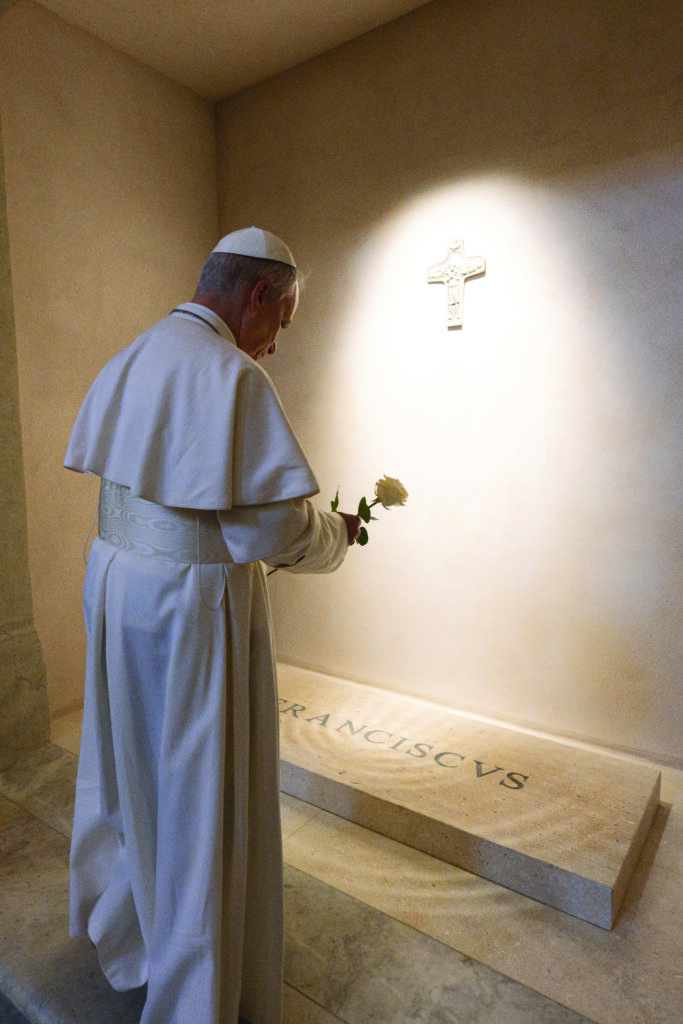
Pope Leo XIV at Pope Francis’s tomb at Santa Maria Maggiore, in Rome. Image: Vatican Media
My encounter with Pope Leo XIV
The first time I met Pope Leo XIV was in Rome three years ago in October. A group of us who were there at the time invited him to dinner, and he accepted. It was a gracious gesture, and it gave us the chance to speak, to share food, and to connect in a more relaxed and personal setting.
The following year, in February 2024, I had the opportunity to spend a full hour with him. We discussed the state of the Church, the world, and all the complicated things that sit in between. He struck me then, as he continues to, as a gentle and gracious man – someone who doesn’t spend a lot of time talking about himself but listens carefully and deeply. And when someone listens like that, you know it’s not just politeness. It’s attentiveness. It’s care.
Most recently, on 15 April, I met with him again for another hour. I brought him a gift from Australia, which led to some humour. When I handed it to him, he smiled and said, “I hope it’s not Vegemite.” He remembered his time in Australia – and clearly hadn’t developed a taste for it. I laughed and reassured him, “No, don’t worry. It’s Tim Tams.” He smiled again.
As a Catholic and a Marist, I am hopeful about his papacy. I believe Pope Leo XIV will be different in style from Pope Francis – but deeply aligned in vision. He is someone who listens carefully and acts with thoughtful deliberation.
Like Francis, he understands that the Church must speak not only to the pews, but to the poor, the marginalised, the refugee, the forgotten.
In this time of division, of violence, of noise and toxicity – especially across social media and political discourse – Pope Leo XIV’s voice will be one of calm and reconciliation. The very first thing he spoke about when he appeared on the balcony was peace, and the need to be a bridge-builder. That was not a throwaway line. It was a mission statement.
He gives me hope because he is steady, grounded, and faithful to the Gospel. In the end, that’s what matters. Whether you are a bishop, parish priest, religious, a layperson, or someone simply trying to live with compassion, the real question remains the same – how do we live the message of Jesus here and now, in our own communities, our own schools, our own families?
Pope Leo XIV, our leader, will accompany us as a Pilgrim of Hope as we journey towards the Kingdom.
Br Mark O’Connor FMS is Vicar for Communications and Editor of Catholic Outlook.
This article was originally published in the 2025 Ordinary Time | Winter edition of the Catholic Outlook Magazine. You can read the digital version here or pick up a copy in your local parish.