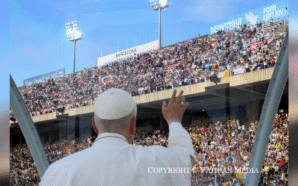


Those who predicted that Pope Leo XIV would slow or even reverse his Jesuit predecessor’s reform agenda seem to have got it spectacularly wrong.
Pope Leo XIV this week showed new signs that, contrary to those who hoped he’d slow down or even reverse the forward-looking vision Pope Francis set out for Church reform and pastoral/social action over the past dozen years, he’s actually intent on bolstering his Jesuit predecessor’s agenda.
The 70-year-old Leo published the first major document of his fledgling pontificate on Oct. 9, a lengthy text on the duty of Christians to care for the poor and to help eradicate systems of poverty and inequality.
Issued as an apostolic exhortation, the approximately 20,000-word document was mostly written by Francis before his death in April. But Leo, an American missionary who served as priest and bishop for many years in Peru, added his own strong words and advanced the original vision of his predecessor, who had been Bishop of Rome since March 2013.
Leo’s missionary experience in South America and his 12 years as worldwide head of his Augustinian religious order offer an obvious contribution to Francis’s original text.
The exhortation, “Dilexi te” (I Have Loved You) is divided into five chapters and includes 121 numbered paragraphs. It is addressed to “All Christians.” Leo signed it symbolically on Oct. 4, the Church’s liturgical Feast of St. Francis of Assisi.
Throughout the text, he quotes and expands on the teachings of previous popes who advocated for the poor, beginning with John XXIII (1958-1963). He also pays tribute to the contribution that religious orders and numerous saints have made to developing the Catholic Church’s “preferential option for the poor,” a development rooted in Latin America that grew out of the Second Vatican Council, but one that is often contested by doctrinal hardliners and neo-traditionalists focused more exclusively on the cultic-liturgical expressions of the faith.
In fact, Pope Leo makes explicit and frequent reference to the council and its documents, something Francis did not often do in his own writings and speeches, although his pontificate and teaching were clearly undergirded by the texts and spirit of Vatican II.
Those who expected Leo to soften or retreat from Francis’s insistence on advocating for a number of social issues as being part and parcel of the Church’s mission to preach the gospel will be disappointed in this new document. The American pope does not shrink from taking up his Argentine predecessor’s challenge. He actually advances it.
Resurrecting Francis’ plans for financial reform
Pope Leo also recently advanced a financial plan that Pope Francis had – it seems – intended to implement early on in his pontificate but decided to abandon because of internal pressure at the Vatican.
Most observers, however, seem to have misunderstood a motu proprio Leo issued earlier this October. It repealed a rescript signed by Francis in 2022 (under pressure from Vatican aides) that banned Holy See agencies from investing or depositing their financial resources in financial institutions outside Vatican territory. Leo has now reopened that possibility.
It bears repeating what has been written here before: Pope Francis’s favored approach to Church financial reform was always to step away from the banking or money management business altogether.
On numerous occasions during his first several months as Bishop of Rome he said, only half in jest, that St. Peter never had a bank account. It was clear from the beginning that he would have opted to close the IOR (Vatican Bank) and the Vatican’s other quasi-banking and real estate management departments, such as the Administration of the Patrimony of the Apostolic See (APSA) and the section within the Congregation for the Evangelization of Peoples (“Propaganda Fide”) that handles the congregation’s vast property holdings.
He seemed to have every intention of doing at the Vatican what he had done in the Archdiocese of Buenos Aires shortly after becoming archbishop: divesting the Church of any direct financial management and entrusting its funds to reputable banks.
And, as if to further distance himself from the Holy See’s sometimes scandalous money dealings, Francis ordered in 2017 that his image would no longer be on the euro coins the Vatican continues to mint.
No pope in modern times has been as clear, and perhaps as ignored, as Francis when it comes to denouncing the idolatry of money. But he was determined not to allow internal battles over the management of the Vatican’s material resources to derail his more ambitious reforms: that is, bringing about a colossal change in the attitude and ethos of what it means to be a Christian and engendering a poor Church for the poor that is like a field hospital, open and inclusive of all people.
Pope Leo has now resurrected the plan that was killed by opposition in the Roman Curia. This, again, shows that the American Pope – even if very quietly – is intent on moving his predecessor’s agenda forward.
These are just a couple of examples of how the new pope, whose style is very low-key, may surprise all of us in the Church and discreetly – yet forcefully – advance the work and ministry begun by his predecessor.
Indeed, up till now, he has shown no signs of abandoning it.
With thanks to the Union of Catholic Asian (UCA) News and Robert Mickens, where this article originally appeared.