

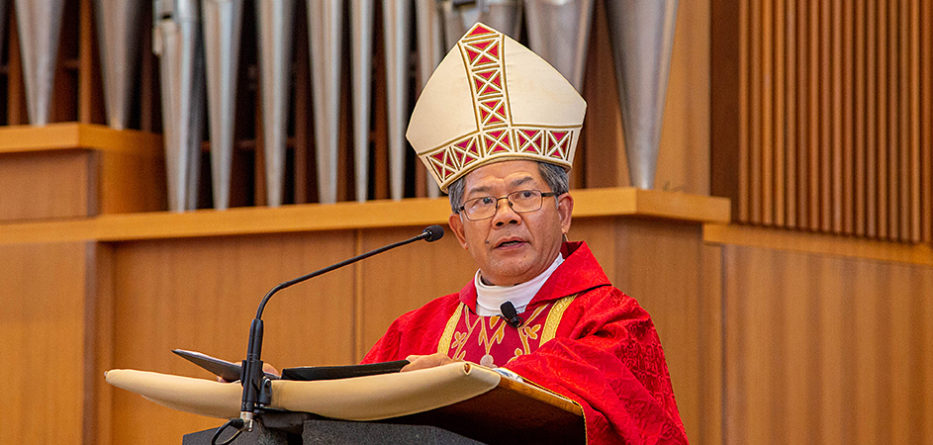
Most Reverend Vincent Long Van Nguyen OFM Conv DD STL, Bishop of Parramatta
Homily for Pentecost Sunday 2026
Readings: Acts 2:1-11; Gal 5:16-25; John 20:19-23
The Holy Spirit transforms the Church into the force of solidarity
Dear brothers and sisters,
We live in a particularly polarised atmosphere. Polarisation means we don’t simply disagree on contested issues. It means that we divide ourselves into opposing groups that antagonise and treat each other with contempt. The rise of social media often exacerbates this polarisation by creating echo chambers where individuals only engage with like-minded people, thus reinforcing one-sided or even extreme views.
In some countries, polarisation is so deeply entrenched that it threatens to undermine social cohesion and unravel the fabric of a civilised society. Australia is not immune from these global trends. Ideological positions are widening on every issue whether it is immigration, climate action, gender, indigenous reconciliation. In the world where truth is eroded and differences often lead to animosities, we -the people of faith- have a hard time imagining an alternative future and working towards a vision of God’s reign. Indeed, many are resigned to accept the impossibility of change while others retreat to a self-preservation mode.
Today’s celebration, however, is a proclamation that the power of God is overcomes evil and it breaks through human intransigence. The status quo does not have to be unchanged forever, because where the Spirit touches, radical upheaval and transformation always occur; barriers fall, doors are opened wide; all the towers and walls of ideological divisions collapse; fear and inertia disappear; initiatives are developed, and courageous decisions made. Whoever is dissatisfied and aspires to renew humanity can count on the Spirit: nothing can resist its power. Everything is possible where the Spirit of God erupts.
We are told that after the harrowing events in Jerusalem, the disciples are gathered in a state of fear and disarray. They were confronted not only with the hostile world outside but also with a deep sense of failure and recrimination from within. It was this very moment of vulnerability that the Holy Spirit came and transformed them into a force of leaven for the kingdom. They underwent a complete metamorphosis.
The Acts of the Apostles describes this transformation for us in dramatic terms. A powerful wind filled the house where they gathered, and tongues of fire came to rest on the head of each of them. One is reminded of the way the Torah was given in the midst of thunder, lightning and flames of fire. In other words, just as God had done in the past, life-giving spirit enabled the disciples to move beyond old boundaries to new horizons of possibility. Pentecost turned out to be the antithesis of Babel where the bond of humanity gave way to stalemate, chaos and conflict.
The Church is the embodiment of Pentecostal breakthrough -not by our own device but through the power of God. We are given the task of bridging the gaps and bringing down the barriers that separate people. We are called to embody the Spirit who transcends all boundaries and divisions. In fact, when we survey the way the Church has resolved seemingly intractable disputes through councils and synods, it is the Holy Spirit who is the protagonist. When we are guided by the Spirit, we can achieve unity despite our divergent views and even conflicting hopes. This was proven by our own Diocesan Synod in recent times.
St Paul in the second reading affirms this fundamental truth. He says “the Spirit and our spirit bear united witness that we are children of God. We are heirs of God and coheirs with Christ.” In other words, Pentecost is more about belonging to the community than making our own way in the world. Our belonging encourages us to grow together and take care of one another. We are at worst diminished and at best incomplete without each other. As co-heirs with Christ, we are called to foster his legacy. We must explore new ways of being together and living with one another and with the planet so that we can be a source of hope for the world.
“As the Father sent me so am I sending you” says Jesus to his disciples.
Dear brothers and sisters, this is our Pentecostal mandate. We are sent into the world to be the force of leaven, peace and reconciliation. We are sent to strengthen the sacred bonds that bind humanity and all creation with the Creator God. We are sent to build a new future, to venture to new frontiers of fraternity, to end mistrust and violence, to create social bonds, to foster common purpose, to catalyse humanity to a new era of global solidarity. Pentecost points us to divine renovation which is the new heaven and new earth. No easy task in a world where the strong make the rules and the privileged hold on to the existing structures of power. No smooth sailing enterprise when the myth of individualism and self-made prosperity underpin the very foundations of our society. Nevertheless, we go forward with the same confidence and sense of purpose that the early disciples of Jesus were equipped.
Pentecost propelled them to put concern for justice, inclusion, dignity and fraternity at the top of their missionary agenda. It was out of these concerns that the poor were cared for, the outsiders were welcomed and the rights of the minority were upheld. May we also be emboldened to go forward and witness to the reign of God, becoming the sign of hope and reconciliation for the people of our time.